
I left Moscow on Saturday the 27th of October 1984.
In the morning, the Attaché and a driver came to the hotel to take us to the airport for our flight to East Berlin.
On the way, we came across a body of the road and group of blokes trying to pick it up. They were all obviously very drunk.
Getting through immigration was a circus. The Official took my passport and simply stared at me. He then stared at the passport and at me again. He repeated this ‘over and over’ for at least half an hour.
Once through immigration we boarded our East German Airlines Ilyushin jet heading to East Berlin.
Flight from Moscow Interflug
I recall the flight was ‘different’. The plane climbed very steeply and was very noisy. The flight attendants were very large women. One of them walked long the aisle with a very large jug of very hot tea. The passengers held out their cups. The attendant filled the cups as the passengers held them. It was amazing the no one was burnt.
Schönefeld Airport
We landed at Schönefeld Airport and were met by the First Secretary from the Australian Embassy. Again there were issues at the immigration check point. We had switched our passports from the Diplomatic Passports, we had used to enter the USSR, to Official Passports. This really confused the East German Immigration Officials.
Interhotel
We were booked in the Metropol Hotel located on Friedrichstraße. The land behind the hotel was cleared – ‘no man’s’ land and beyond that was the Berlin Wall that divided East and West Berlin.
The Metropol was an Interhotel’. The Wikipedia entry is interesting.
“The Interhotel hotels were under the control of the East German state security service, the Stasi, under the Tourist Department. The Stasi tried to monitor the activities of international tourists, by sending prostitutes to audio- and video-controlled hotel rooms”.
First Crossing from East to West Berlin
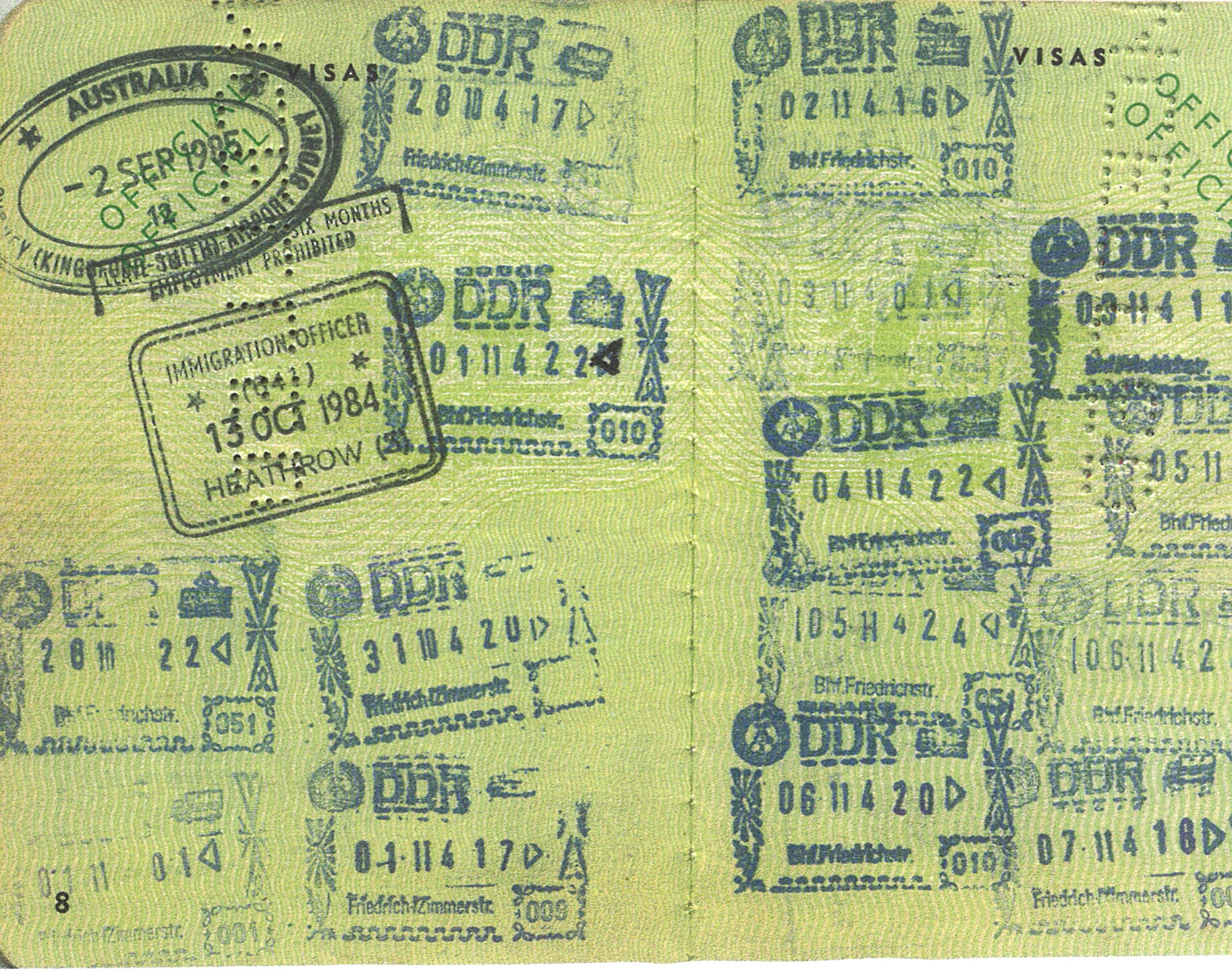
On Sunday we crossed the border into West Berlin at Friedrichstraße railway station.
Security was very high. Our passports were closely scrutinised. The officials were confused by the fact we appeared to have arrived at Schönefeld Airport, but hadn’t come from anywhere. Finally they let us through.
The next step was really interesting. Despite being located in East Berlin, Friedrichstraße station was on two intersecting rail lines that passed through West Berlin. The station served as a transfer point for these lines, and trains stopped there.
The other stations on these lines were in East Berlin. These stations were sealed-off ‘ghost stations’ (Geisterbahnhof). The trains passed through these stations under guard without stopping. As the train passed through the stations, you could see the East German guards with their metal helmets and sub machine guns.
Once through these stations the train was in West Berlin and the stations were, of course, open.
We had arranged to meet the Consul from the Australian Consulate in West Berlin. He was waiting at the first station on the West Berlin side. The Consul took us on quick tour of West Berlin finishing with a lunch.
In the afternoon my colleague I and took a walk through the main shopping precinct. I was really getting sick of John by this stage of the trip and was glad when said he said he want to return to the hotel.
I continued on walking around the city and found the Europa Center. It is large shopping and entertainment centre that was designed to showcase the best of the ‘West’ in this divided city.
Good Looking Women in the Bar
When I got back to the Metropol Hotel, I found John in the bar. There were 10 to 12, extremely attractive women in the bar and only a couple of other people – two pommie blokes who told us they were in East Berlin on business. The scene was consistent with the description in the Wikipedia entry.
Starting Work at the Embassy
Next day we started work at the Embassy. The experience was somewhat surreal. The Embassy was to closed and had already been downsized. There were only three Australian based staff – the First Secretary, an Attaché and a Communications Operator (to handle the cables). The only locally engaged staff member apart from an East German driver was a Swedish woman who was married to a Swedish Diplomat.
The First Secretary was a ‘character’. He had only been at the post for three months, but had managed to spend almost all of this annual ‘representation allowance’ on “parties most often attended by the ‘Friendlies’ (i.e. staff from the USA, UK and Canadian) and other Embassies”.
I was to come across this bloke on later trips with DFA and playing cricket in the ‘Bangkok Sixes’ in 1987. I will posted about that sometime.
Room Full of Bank Notes
The East German government (DDR) fixed the country’s currency, the ‘Ostmark’, at one to one with the West German ‘Deutsche Mark’. This was similar to the Russian Rouble being set at one to one with the USA Dollar.
Both the Rouble and the Ostmark were ‘soft currencies’ and could not be traded or exchanged on the open market. They were, however, traded on the ‘black market’. The black market rates revealed the real value of the currencies. In the case of the Ostmark v the Deutsche Mark’ the black market rate was more like 40 to one.
The GDR forced the western embassies to convert a certain amount of hard currencies (Deutsche Marks, USDs, GBPs and AUDs etc.) into Ostmarks each month and to pay all their expenses (local salaries, utilities etc.) in hard currencies.
The embassies, including the Australian Embassy did however, receive income in the form of visa fees and the disposal of unneeded equipment etc., in Ostmarks. The problem was that there was virtually nothing the embassies could buy with this money, apart from some foodstuffs.
The result was that the Australian Embassy accumulated a huge amount of Ostmarks in cash that it could not spend.
There was a room in the Embassy that was almost full of paper Ostmarks of various denominations. They were stacked from the floor to the ceiling. The notes were rotting and really stank.
It you applied the official exchange rate, these notes were nominally worth thousands of Deutsche Marks and AUDs. In reality, they were worth nothing. They couldn’t even be sold on the black market as that would have been illegal.
Back into the West
We ate dinner in the hotel on Monday night. The food was very ordinary.
On Tuesday I decided that I wasn’t going eat in the hotel again and told John that I was going to eat in the West. Part of the reason for doing that was that I knew that he would be stay in the East and would not be venturing out of the hotel.
I crossed that border at Friedrichstraße station and headed to the Kurfürstendamm, the main shopping and entertainment street in the West.
I found a good restaurant and ate well.
I took the train back to , Friedrichstraße station and crossed back into East Berlin. I now had three DDR stamps in my passport.
Dinners with A Based Staff
Later in the week we had dinners at the staff from the Embassy in their apartments. I can recall, as we were driven to and from the apartments, how dark the streets were in East compared to the West. There were hardly any cars and no people walking.
Back in the West
On Friday night, I headed back into the West and the Kurfürstendamm district. After eating. I went to an Irish Pub. The place was really jumping.
I started chatting to a group of people who speaking English. One of them turned out to be a Swedish girl who worked as a nanny for a Swedish diplomatic family living in East Berlin. She of course knew the Swedish woman who was working as a locally engaged staff person at the Australian Embassy.
When it was time to head back into the East, the Swedish girl said that she was taking taxis to ‘Checkpoint Charlie’ and where her “family would be here to meet her”. She asked if I wanted to share the taxis. I did.
The crossing at Checkpoint Charlie was interesting in that it was ‘open’ as opposed to the crossing at the railway station.
The “family” turned out to be the father. He offered me a lift to the Metropol.
Quick Trip to Hamburg
Next morning John and I crossed back into West Berlin and caught the train to Hamburg. It was interesting travelling on the train, as it crossed form West Berlin into the part of East Germany west of the city and then into West Germany. There was a lot of carry on with East German border guards.
We stayed overnight in Hamburg, returning to East Berlin on Sunday afternoon.
Meals in the West
On Monday and Tuesday I cross over to the West to eat. I had decided to cross back into the East via Checkpoint Charlie. This involved taking a taxis to the Border, passing through the Checkpoint and walking back the hotel along Friedrichstraße which ran parallel to ‘The Wall’.
As I walked along the street, a Trabant car followed about three metres behand me. When I stopped, it stopped. When I started walking again, it started up again.
It was surreal. It is almost certain that the two blokes in the car were from the Stasi.
Date with Swedish Girl
I had arranged to have dinner with the Swedish Girl that I had met in the West the previous Friday.
We had agreed to meet in the same Irish Pub in the Europa Center. Over the meal she told me her experiences living a working the East including, the constant surveillance.
One of the stories she told me was about efforts by the Swedish Embassy to find ‘bugging’ devices in their cars.
They had concluded that was impossible to stop the bugging in the Chancellery or the residences. Like the Australian Embassy the bugging in the Chancellery has counteracted by the use of a ‘sound proof box’ constructed within the building. If sensitive issues needed to be discussed, staff went into the box.
The Swedes did, however, think that they could find any ‘bugging devices in their cars. They drove on the cars across to West and searched them thoroughly for any bugs. They didn’t find anything.
They then orchestrated a series of events including conversations in the cars, designed to determine if the conversation were being bugged.
Whatever the East Germans did next proved that they must have be listening to conversations in the car.
The Swedes took the cars back into the West again and searched for the bugging devices. Again they found nothing.
No Talking
After dinner the Swedish girl and I crossed back in the East via Friedrichstraße station. As we approached the entrance to the hotel she told me that she “wasn’t going to speak to me anymore”. I wasn’t sure what to make of that.
As it turned out there was a lot of writing on pieces of paper and sign language.
Flight to Bonn
We finished up at the Embassy around lunch time the next day, Thursday the 9th.
Our next stop was Bonn.
The First Secretary drove us to Checkpoint Charlie. We walked across into the West where the Australian Consul in West Berlin met us and drove us to Tempelhof Airport.
The flight was interesting in the that when the plane was flying over East German land east of Berlin, it was only allowed to fly at 10,000 feet. When we cross into West Germany it climbed to the normal 35,000 feet.
It was evening by the time we checked into our hotel in Bonn.
Flickr Link
https://www.flickr.com/gp/twwilko_photos/SF4Yr0
About Interflug
https://en.wikipedia.org/wiki/Interflug
About Interhotel
https://en.wikipedia.org/wiki/Interhotel
Europa Center
https://en.wikipedia.org/wiki/Europa-Center
Kurfürstendamm
https://en.wikipedia.org/wiki/Kurf%C3%BCrstendamm
Checkpoint Charlie
https://en.wikipedia.org/wiki/Checkpoint_Charlie
 billrider2013
2 thoughts on “East Berlin 1984”