I decided to ride to Huskisson via Gerringong and Nowra. The alternatvie would have taken me through Berry.
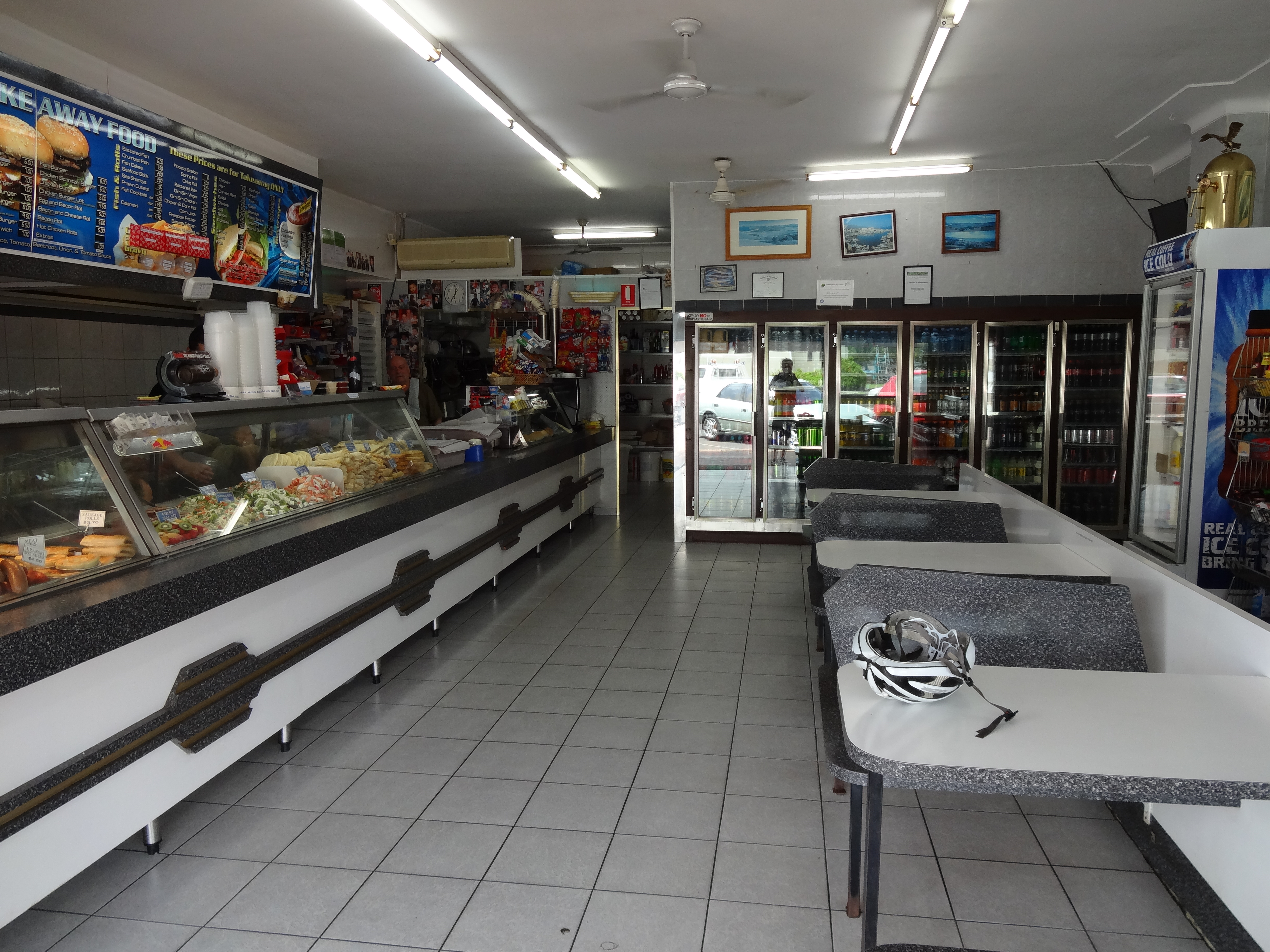
Both Berry and Gerringong are popular towns on the South Coast. For some reason certain towns fall into favour and others don’t. I stopped in Gerringong at an old time Milk Bar. These shops where every where when I was growing up. All shopping centres in suburban shopping centres at least one Milk Bar. Milk Bars Every country town also had They served a range of good and bad food and goods: Milk Shakes (naturally), Hamburgers ts (most with the ‘lot’) Ice Cream and fried chips and Dim Sims (what was them, I am not sure). They also sold cigarettes and the daily newspaper when the nearby Newsagent closed at 5.00 pm.
Most Milk Bars were owned and operated by Greek Families with a seemingly unlimited supply staff, all related and willing to work all hours. The Gerringong Milk Bar, turned out to be owned and operated by a Greek family. On the day of my visit Dad and two sons were holding the fort. I made the comment that you don’t see these shops in Sydney now. They agreed and the old man said: “that is because the young people don’t want to work”. I suspect the demise of the Milk Bar is not as simple as that. Young people do work in all sorts of retail food shops at all hours e.g. McDonalds and coffee shops.
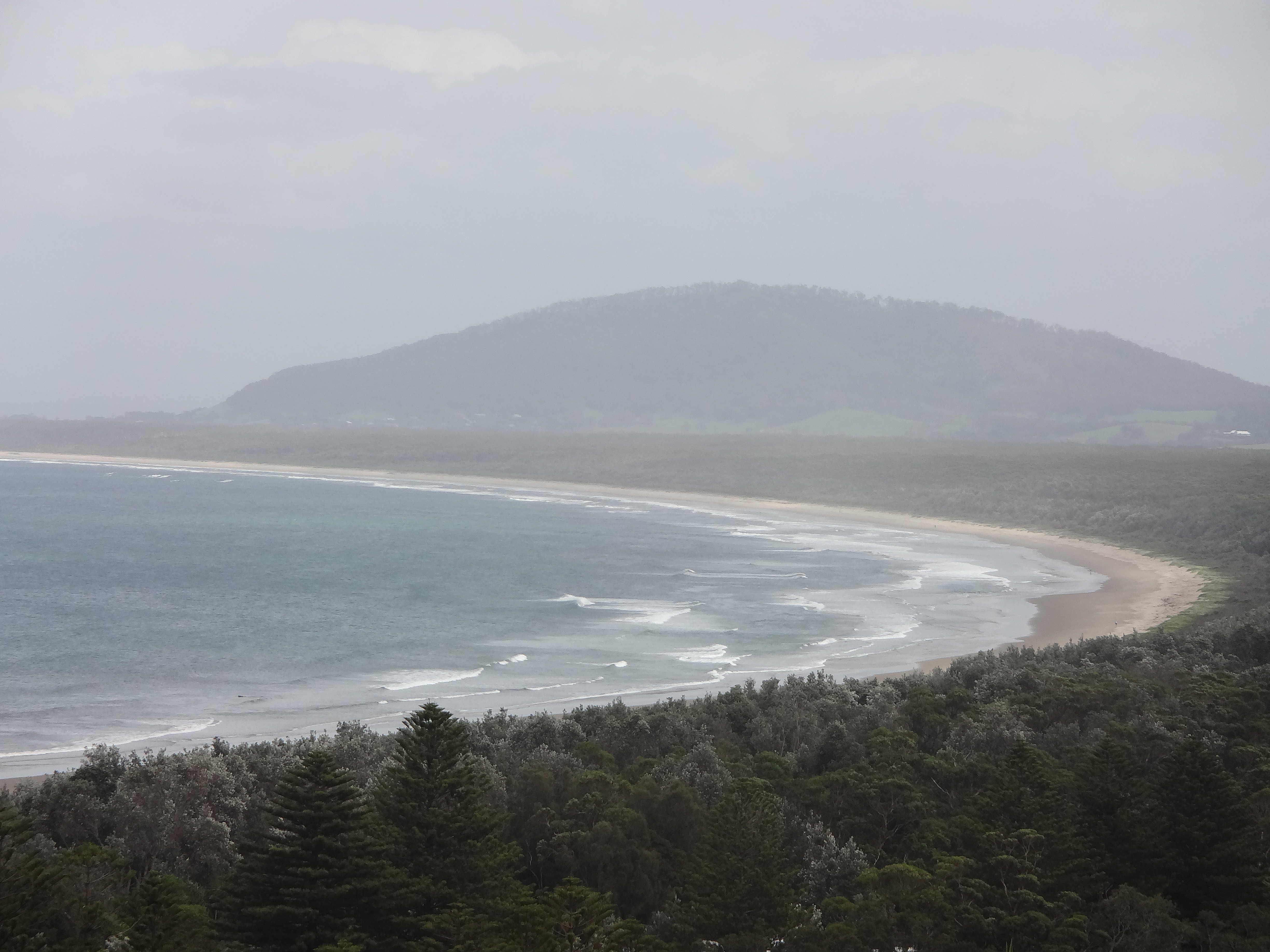
My route took me past 7 Mile Beach. It seems that a lot of beaches in Australia are named after their length. There are also a lot of creeks with mileage names e.g. 5 Mile Creek, which I assume is the distance that the creek is from somewhere e.g. Nowra. I can’t recall any other country where this distance based naming convention has taken hold. It is probably preferable that Bondi Beach is Bondi Beach rather the One Half Mile Beach. I don’t even that Americans will their tendency to name streets and avenues numerically, would wish to change Malibu Beach to 5 Mile Beach.
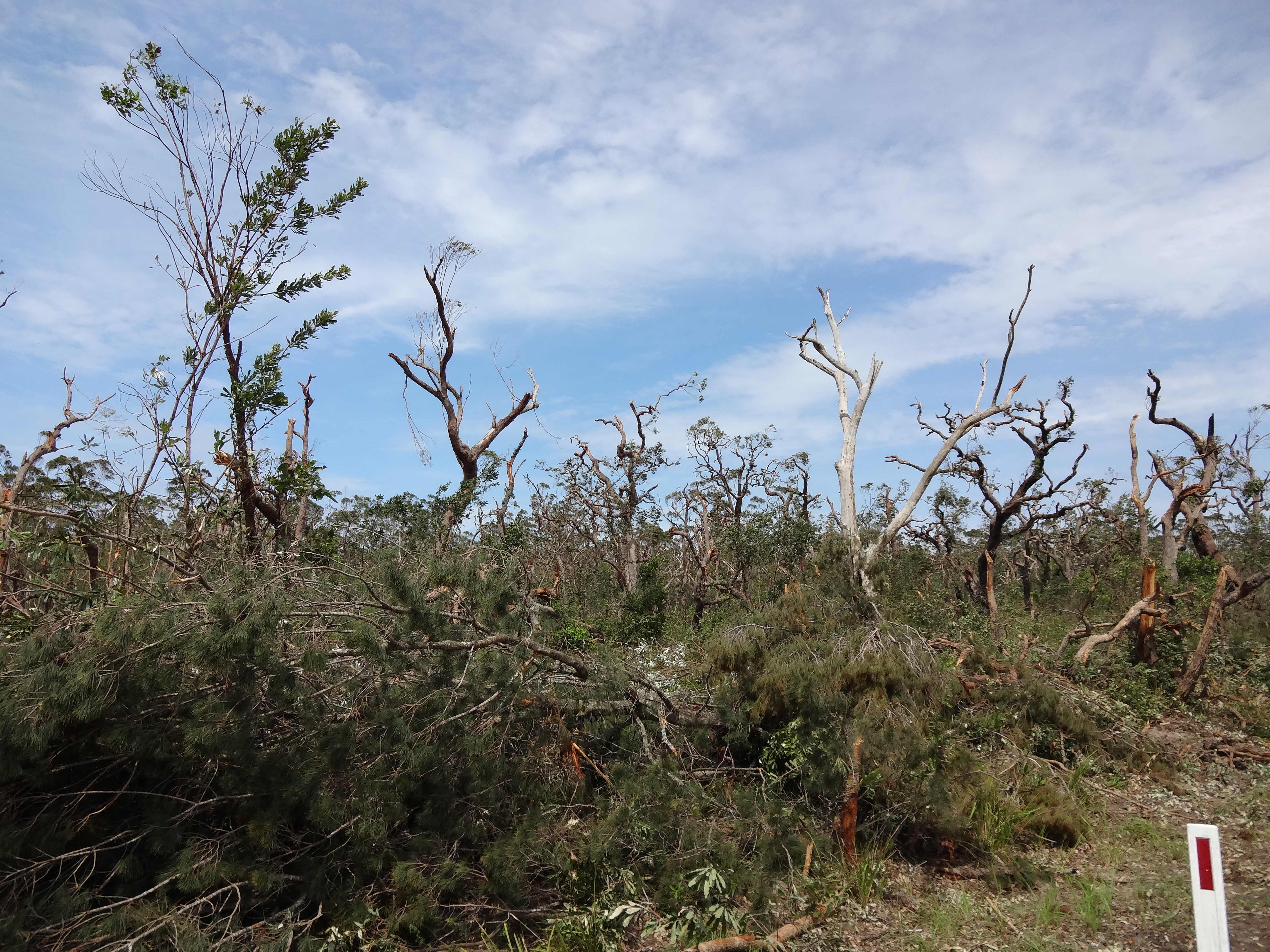
The road behind 7 Mile beach was one the areas hit by the mini tornado on the 22nd of February, the day before I headed off. Amazing damage to trees. Check out the photo
I arrived in Huskisson late in the afternoon. I have not been there for over 35 years. Amazing sand and clear water. In 10 minutes I decided to stay at least a day.
7 Mile Beach. Not very imaginative name.Damage caused by mini tornadoOne of the last Milk Bars on the planet
I had a long chat with my neighbours in the Bulli Caravan Park. One were a middle aged couple from Taunton in Somerset. The others were a young Welsh couple. Both couples were travelling around Australia by van.
The English couple had travelled from Darwin down to Alice Springs, across to Cairns and down the Queensland and NSW coast.. They really impressed by what they had seen so far, but less impressed by the AUD/GBP exchange rate. The husband turned out to be a ‘cricket tragic’ and we chatted for sometime about the Somerset and other teams. During the late seventies and early eighties Somerset had the privilege of having the Vivian Richards and Joel Garner as ‘foreign’ players and Ian Botham, one of the all great English all rounders on their playing list. Richards and Garner were members of West Indies team that dominated world cricket in the late seventies and eighties. My West Country acquaintance was at pains to point out that man for man that West Indies team was far better than the Australian team at that time. He went on to claim they were better than Australian teams before a since. He had all the statistics at his disposal. In deference to his wife, whose ‘eye rolling’ suggested that she had heard all of this before and had had enough, I was forced to agree.
The young Welsh couple ‘ listened’ to the cricket discussion while playing very close attention to their iPads. I suspect they were not checking the claims being made on the West Indian statistics. When the conversation opened up, the Welsh couple said they desperate to stay in Australia. They had been getting unskilled jobs, but wanted to find an employer that would sponsor them for permanent residency. They said that “despite having university degrees, they didn’t have the skills on the Department of Immigration’s point list”. They seemed to be precisely to sort of migrant that Australia needs.
The route from Bulli took me down the bike track that hugs the coast to Wollongong. The beach shacks along the path are rapidly being demolished and being replaced with mansions, some with architectural merit, others less so.
I stopped briefly at the City Beach which, as it name suggests, is adjacent to the Wollongong CBD. This is similar to Newcastle, the other ‘steel city’, which is the north of Sydney. It is not surprising that both cities seeing a resurgence based on their proximity to the beach.
The bike path was clogged with riders, runners and walkers mainly over 50 years old. Wollongong and similar Australian towns and cities such as Newcastle, Byron Bay, Noosa, Geelong and the Gold Coast must have the fittest 50 plus population on the planet. This does not bode well for the nation’s health care costs in the future as will not die young.
A couple stopped to chat with me on the path near the City Beach. Seeing the bike, the bloke said: “See that Jan it’s a Cannondale, single fork – nice”. I did point out that it had two front forks because it was old. Even Cannondale’s technology had not extended to the ability to carry two front panniers on one front fork.
Leaving the beach, the path passed the WIN Stadium, one the home grounds of the merged St George and Illawara Rugby League team. The team was training on an outside ground next to the stadium. The forwards were down one end and the backs at the other end. With only a cursory look, it would not be easy to workout who were the forwards and who were the backs. They all look the same – very big. This is huge contrast to the 70’s and before when the forwards, e.g. Arthur Beetson were big, and the backs e.g. Changa Langlands were skinny. It seems something has made all the players the same. The couple that chatted to me at the beach rode past when it was watching the practice session. The bloke said; “if you want any steroids, just call out” to the trainers”.
Just south of the Wollongong CBD, the path leads into Port Kembla the site of the former BHP, now Bluescope, Steel Works. BHP Billiton was exited the steel business and is now that world’s largest mining and energy company. Their CEO has announced this retirement at the age of 51 this week. Comments on that at a latter time.
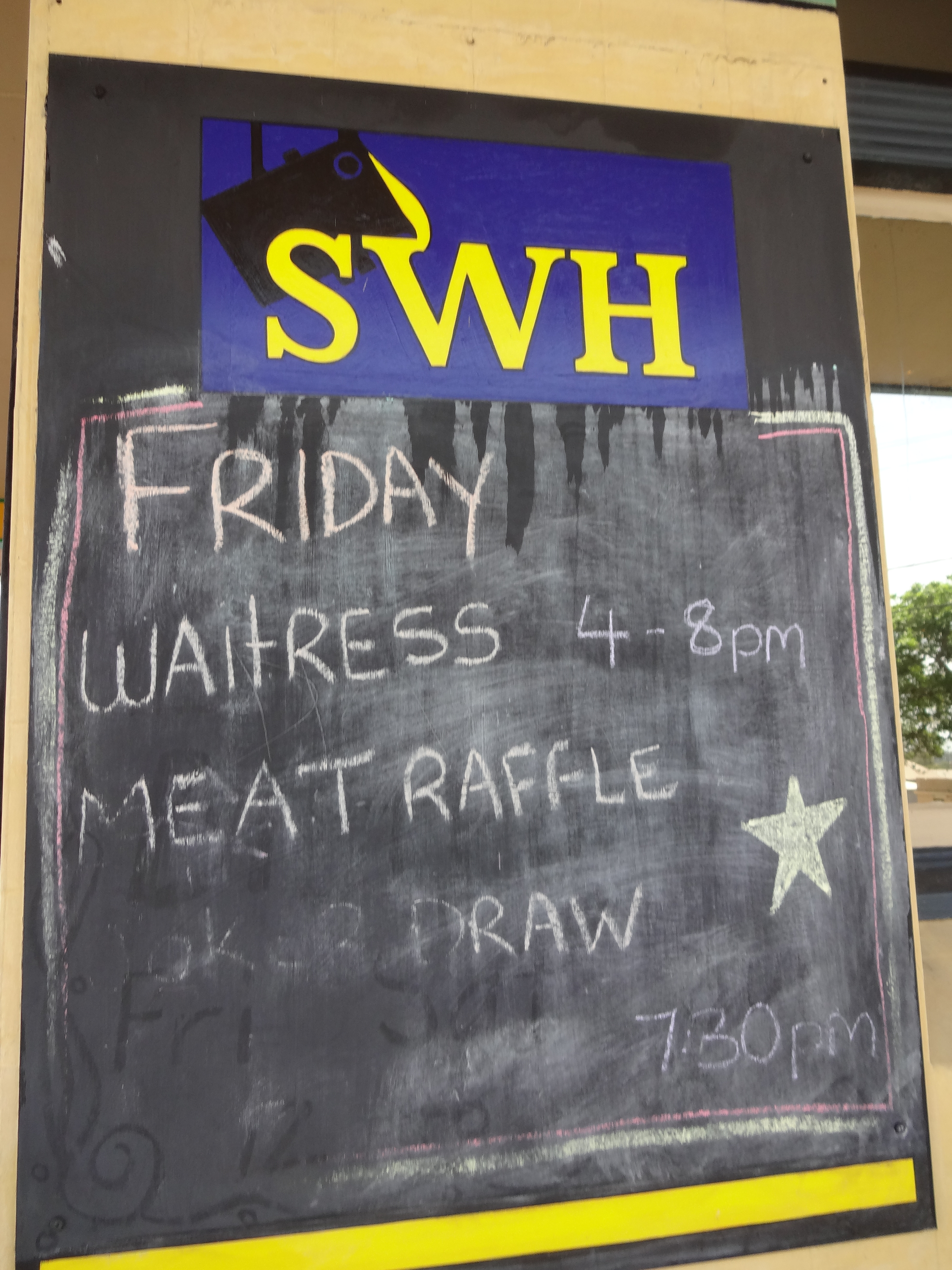
Leaving the Bluescope Plant area, I came across the ‘Steel Works Hotel’. A sign out the front promised great things for Friday; ” Waitress from 4pm to 8 pm and a Meat Tray Raffle and 7.30 pm. Looking around at the customers at lunch time on Monday wasn’t sure which of the forgoing would have been the greater attraction.
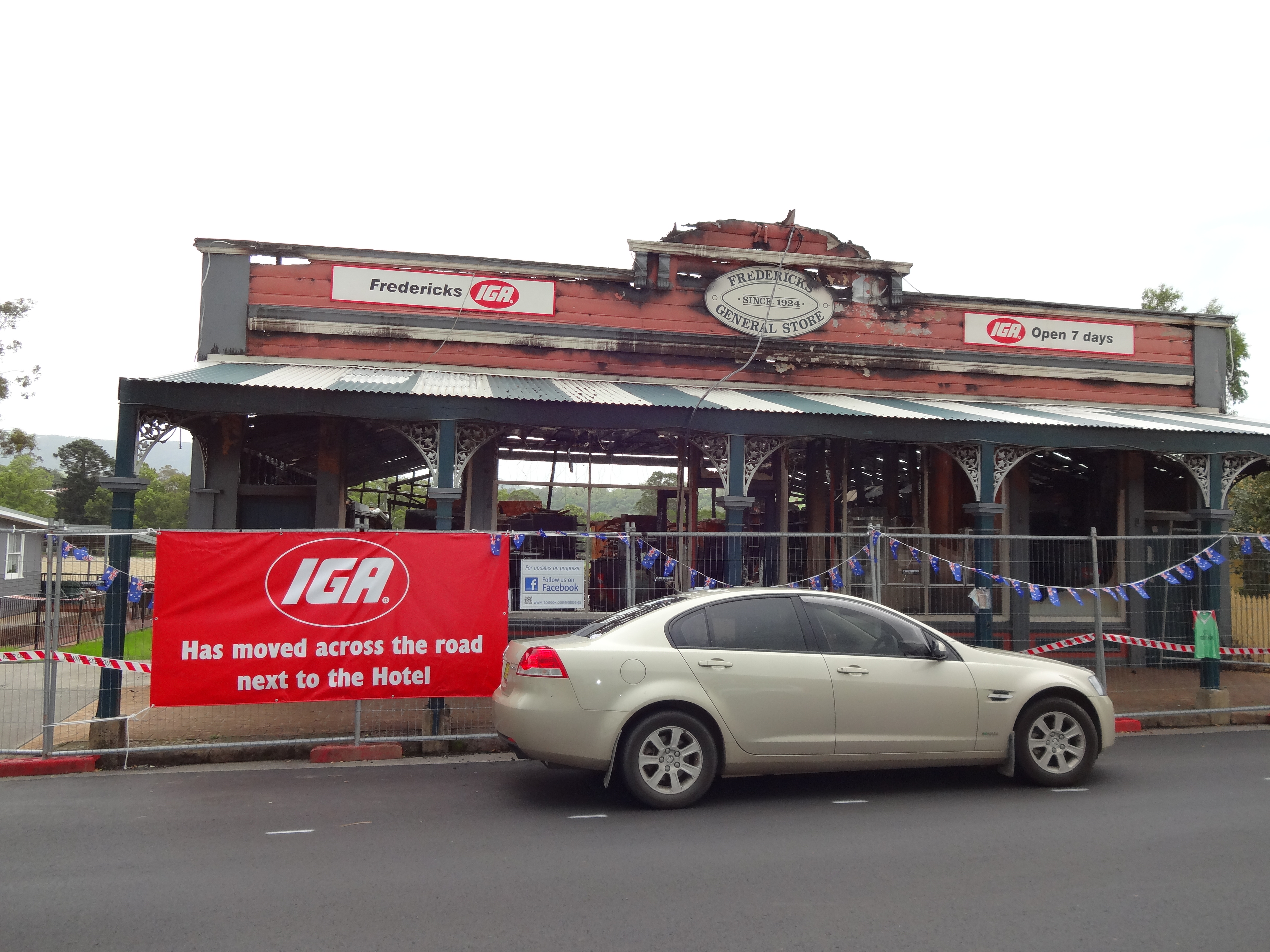
I ended up in Kiama. I will talk about the fire at the IGA store later.
I may not go back for the Friday attractionsThis place is less than 100 metres from the Fire Station
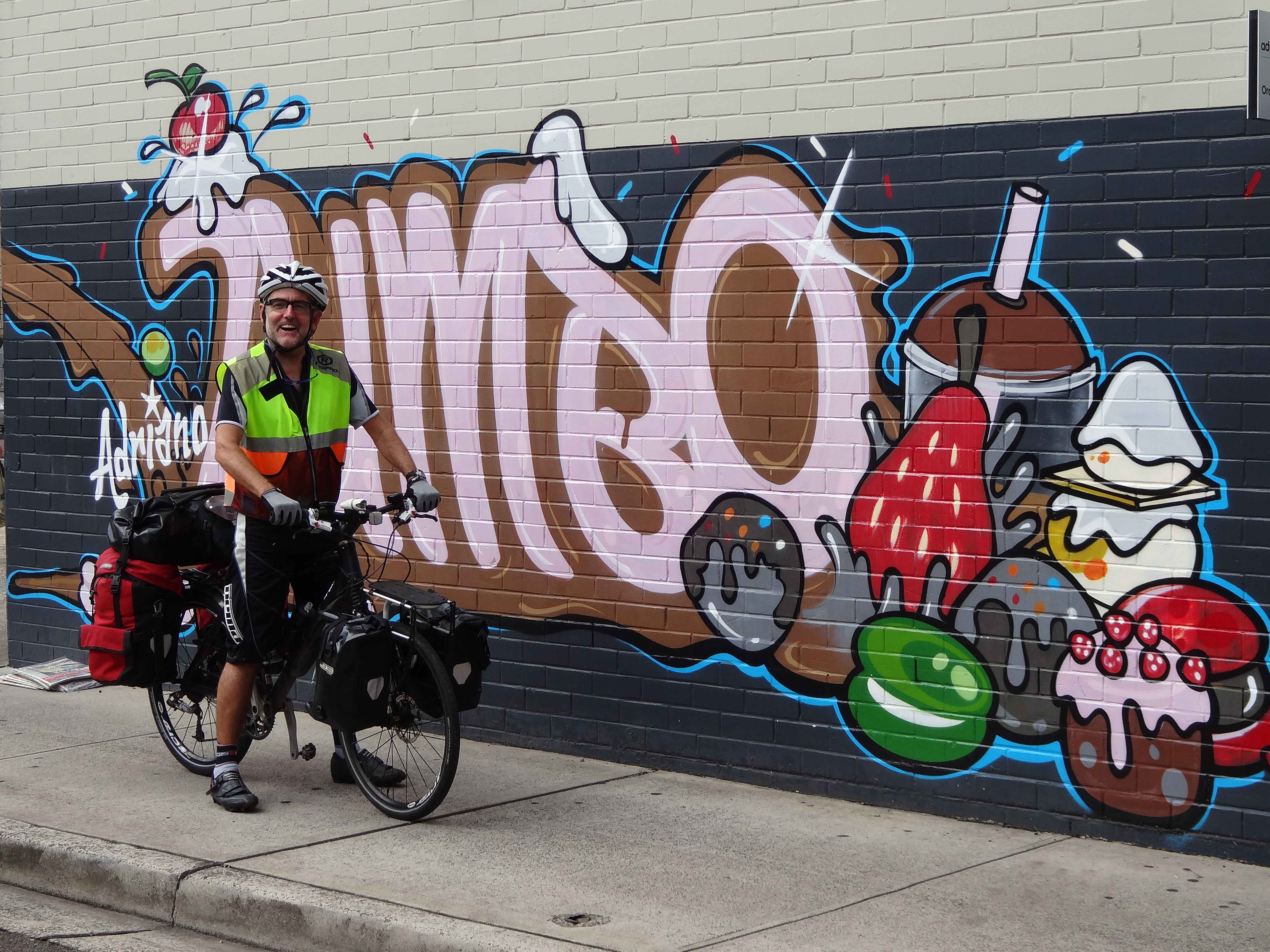
After some room cleaning I finally left the garage in Balmain. I accompanied my host to on his normal walk to Adriano Zumbo, a patisserie for a coffee and croissant. Zumbo’s is a fantastic business. It started in a ‘hole in the wall shop in Darling street, Balmain. It specialises in ‘Zunbarons’ and very high quality breads. The business has expanded to Rozell, Prymont and Manly. I am sure it will not stop there. The Rosell shop is where a lot of the patisseries are made. When I first went there you were able to watch the work being done through a glass wall. Apparently the employees objected, and the the wall was blanketed out. It is pity as it was interesting to see the how the products were made.
My route out of Sydney took me through the inner west suburbs to the Cooks River. The Cooks Rivers was one the most polluted rivers in Sydney. After great efforts the river is now relatively clean and the vegetation, including the critical mangroves, are thriving. The areas adjoining the river has been developed for recreation; with sports grounds, walking and cycling paths, all being used extensively on beautiful Sunday afternoon.
Riding slowly through city streets gives you the opportunity to look closely at the houses. A really disappointing feature of the inner west of Sydney has been the destruction of the some many of the original Victorian era houses and their replacement with brick veneer, ‘sixities shockers’. That term refers to the period the 1960’s. when most of the development occurred. A combination of the ignorance of behalf the owners (many were poorly educated migrants), unimaginative builders and incompetent local councils led to the destruction of large numbers of the perfectly good houses and the construction of these sixties shocker. They have left a blight on the urban landscape.
The Cooks River leads to Botany Bay new Sydney’s airport on Botany Bay. The debate as to whether there should be a second airport for Sydney has gained much publicity again. It appears that this occurs whenever an election, State or Federal, looms. It is claimed that a second airport is required because of congestion at the existing airport,and that this congestion will only increase. I can recall a lecture given my a visiting Canadian academic when I was doing my Master degree with a major in logistics. He put up a series of slides of copies of the Sydney Morning Herald with headlines along the lines of: ‘Urgent Need for New Airport’, Air Traffic Chaos Looms’ etc. He took the dates of the pages of the paper and asked that audience to guess the years when the headlines appeared. No one got close. The years started in 1946, through to 1966. He pointed out that the capacity of airports in terms of passenger numbers is more dependent on the size of the planes and traffic control ( how close the planes can fly to each other) than the number of planes and the whether there is an alternative airport nearby. I suspect the debate about whether there should be second Sydney Airport will rage for another fifty years. In the meantime, improvements on planes and air traffic control will mean that the existing airport is more than adequate.
My route took me around Botany Bay. For those without much knowledge of Australian history, this is where Captain Cook landed in 1770 and claimed the island continent for Britain. He continued to sail north failing to notice the entrance to Sydney Harbour. Seven years later the North American colonies, decided that they didn’t want to pay Britain taxes on tea. They proceeded to declare independence and refused to take prisoners from Britain. This resulted in the need for an alternative prison colony. It was decided that Australia would be that place. Lieutenant Arthur Philip was sent with 11 ships loaded with convicts and soldiers to establish the penal colony. They landed in Port Botany, but decided to look further north and entered Sydney Harbour. The city and the nation were born.
Leaving Botany Bay my route took me down the Princess Highway for until Waterfall when I turned into the Royal National Park. I understand it is one of the oldest, if not the oldest National Park in the world. Apparently Yosemite claims to be the oldest. Anyway, what a great idea it was. The park and the parks to the west of Sydney, in the Blue Mountains have constrained the spread of the city and provided a great recreational amenity for its residents.
Due to my somewhat delayed departure, I was only able to make it to Bulli before it got too dark to continue. I set up my tent in the Bulli Caravan Park. The nearest place to eat was the Bulli Workers’ Club. Chicken Schnitzel, $9.50 and a schooner (3/4 pint) $3.80. A far cry from Sydney prices. This a good example of market driven ‘horisontal fiscal equilisation’, to use our Treasurer’s cant.
A group of customers were discussing Sonny Bill William’s (SBW) return to Ruby League. From their point of view he had nothing going for him: he started his career with the Canterbury Bulldogs, he play Ruby Union in France, he had been signed by Easts, and of course worst of all – he is a New Zealander.
I returned to my tent just in time to seek cover from a torrential downpour. The Vaude Tent performed yet again.
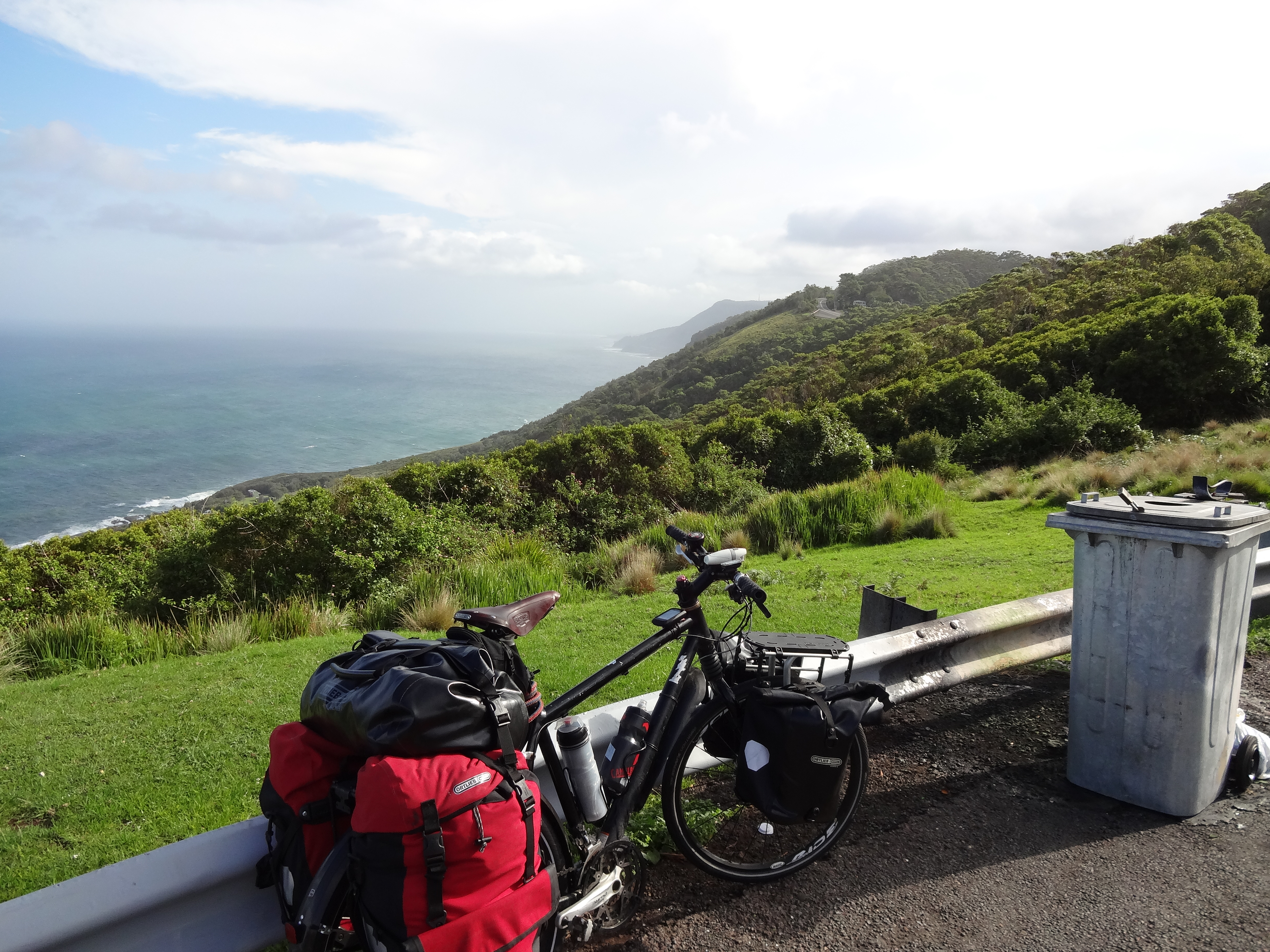
Spectacular coastline just south of the Royal National parkCoffee and Croissant on board and ready to ride.
I have been thinking about why I think Balmain is a good place.
Put simply it has many of things that people want in a place to live today. Most people want to live in city. Sydney is a great city. If you live in city it is better to live close the centre. Balmain is only 10 klms from the centre. As with most inner city suburbs in any big city, Balmain has great public transport; ferries and buses. It may soon get get light rail. The housing in the suburb is fairly diverse. There are the old and new mansions in areas such as Birchgrove. There are the modest workmans’ cottages, both ‘originals’ and those that have been renovated.The latest addition to the housing stock are flats and units ranging from luxury to modest.
The combination of housing and transport has meant that a range of residents across a broad demographic. World famous actors and musicians, highly paid business people and public servants, professionals, middle and lower income people all live in the suburb. There are are also young through to old. It is great mix. It does, however, appear to predominately Anglo Saxon.
A great thing about Balmain is the you see people on the street. This statement comes from someone brought up in Canberra. My Mother (a real city person) was unique in Canberra in that she walked. She often said she could go for days without seeing anyone else walking. In Balmain you always see people walking in the streets. Obviously that occurs more in the shopping strip (Darling Street), however, you see people on the streets all times of the day.
On the day I arrived 0n 31 August last year, I went on a jet lag suppressing walk with my host. In a short walk I ran int0: a former boss (GM of the Sydney Harbour Foreshore Authority), a friend of my ex-wife, and a delightful English girl (with connection with Sunderland) who worked for me briefly about three years ago. It made me feel very much at home.
Such encounters such as above do not happen very day, however, it highlights the benefits of relatively dense living. One day a couple of weeks ago, I noticed a very attractive woman, of an appropriate age, having coffee in Darling Street. As I approached it was clearly (I do has sight problems) Rachael Ward.
I first became aware of Rachael Ward when she was in the worst TV epic based on the even worse book, ‘The Thorn Birds’. However, notwithstanding the quality of the TV show, she was ‘as hot as !!!!’. It transpired that Byran Brown, was also of that opinion and he and Rachael became an item. About five years g after the TV show was aired, I was in London on a Department of Foreign Affairs trip. In the QANTAS Captain Lounge (what a wank that was) I noticed Bryan Brown facing towards me. There was the back of a ‘long haired’ head between me and him. The excitement was hard to contain. It had to be Rachael Ward.
After a beer to contain the excitement I casually walked in the direction of the couple. I was mortified to find that the owner of the ‘long haired head’ was Mel Gibson. I vaguely recall that he was in a film called ‘Brave Heart’ around that time which obviously necessitated growing the hair.
After all that, 25 years on, I finally got to see Rachael Ward. Thank you Balmain.
I have lived the past 6 months on and off in Balmain. This is far longer than my long suffering host had expected.
I have put in job applications and I am waiting for responses. In the meantime I will be riding to Canberra and beyond. If I can’t secure a job within a reasonable time, Plan B is a career change. More about that later.
For those that don’t know, Balmain is a suburb in the inner west of Sydney. It is situated on the harbour with all points less than 10 klms from the Sydney CBD. My first encounter with the suburb was in 1988 when I started working for Caltex Oil as an Auditor. Caltex owned and operated a lubricant blending plant on Ballast Point. The plant was built in 1930 and produced all of the Caltex lubricants and provided bunkering services to the Sydney Ferry fleet and other shipping, including overseas liners in the harbour.
The Caltex plant was just one of many industrial operations in Balmain. Others included the Colgate Soap Factory and the White Bay Power Works. The suburb was industrial and the residents primarily working class. The majority of the houses were small timber or brick workman’s cottages. Most the population worked in the local factories or on the wharfs. There were many pubs. Most of these were ‘blood houses’. This referred to the many fights related to excess consumption of beer between the time the workers finished work, and six o’clock, when the pubs closed. This was known as the ‘six o’clock swill’. The suburb was known to breed tough characters. One former resident, Neville Wran a long Labor Party Premier, famously said: “Balmain boys don’t cry”.
By the mid 1980’s Balmain, had started to become gentrified, with professionals moving in the take advantage of the proximity to the city and the improving transport links, including the building of the ANZAC Bridge. This gentrification included the tarting up of the pubs. One of the first to receive this treatment was the Dry Dock Hotel, which was not far from the Caltex site. Others to be gentrified were The London and the Royal Oak.
My first visit to the Caltex plant was huge shock. It was like walking into an industrial museum. It appeared that very little had changed since it was built back in the 1930’s. The feedstocks for the lubricates were held tanks on the highest point of the site. The various stages of the production process were performed at levels down slope, essentially a cliff, to the water’s edge. The blending, was done in huge copper tanks. The bottling was done on amazingly basic equipment, with a lot of manual input. Most the accounting and monitoring of the process was done on manual records, with only the final product being recorded on the Caltex mainframe computer system.
One seemingly bizarre aspect of the process was that the Chief Chemist, held the recipes for the lubricants on a very cheap Commodore 64 computer that he had to buy himself. Seeing the place in operation was surreal. This particularly the case when you looked at the marketing of the ‘hi tech’ lubricants, including the advertisements and sponsoring of the car races such as the Bathurst 1000. by the mid 1980’s, most of the staff were over 50 years old and had expected to have retired or been made redundant for many years.
A task I had to perform as an Auditor was to dip the storage tanks as part of a surprise stock-take. I performed one of these stock-takes after having lunch at the Dry Dock Hotel. It was one for the first pubs to serve Redback beer, the latest trendy boutique wheat beer. I chatted to the Storeman doing the tank dip about the lunch and the pub. I made the comment that the pub was pretty good. The response was: “The pubs are being ‘f**ked’. You can’t by a beer without some silly bugger putting a lemon in it”.
It transpired that the reason Caltex didn’t invest in the equipment in the plant was that they wanted to have the site rezoned as residential. The plan was to either sell it, or re-develop it in a joint venture. They did this with a site in Hong Kong (another story). They also transported the feedstock by truck through the Balmain streets, rather than by barge. This was designed to upset the locals and get them to support the rezoning.
The site was eventually sold the Walker Corporation, a property developer. This was contentious to say the least. If you are interested, do an internet search. In the end the NSW Government acquired the site for public land. It was decided to develop a public park on the site. The development was managed by, what was to become, the Sydney Harbour Foreshore Authority (SHFA).
I worked for the SHFA from 2003 to 2005. I had some minor involvement in the contracts for the development of the Ballast Point Park. Late in 2005, I was asked if I would attend a lunch for an ex-Caltex employee that had been employed by SHFA after the government had acquired the site. I was told that he had been employed because of his knowledge of the site and it was necessary to continue the bunkering service for a period after the acquisition of the site. He managed these services. The lunch was to celebrate his retirement from SHFA.
The lunch was held at the Royal Oak pub. I walked in the pub and has introduced to the Chief Chemist. His comment was “I feel I have seen a ghost”. It was a great lunch, lots of reminisces about the history of the Caltex plant. We both drank Redback Wheat Beer with a lemon in it.
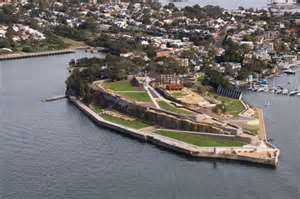
The Ballast Point Park was completed in July 2009. It is great example of well designed public space. The architects have cleverly retained some of the relics of the old Caltex plant including the frames of the storage tanks. It highlights what a great loss the use of the site for private residential buildings would have caused. Now everyone, rather than a privileged few, can enjoy the site with its views of the harbour and the city.
It has been great to live in Balmain for the past months. The place simply gets better and better. More comments on the place to follow.
Great view of the Ballat Point ParkBallast Point Park. Clever use of the relics of the Caltex PlantSite of a great lunch.
The last year has been a bit dramatic: issues at work, an ongoing property settlement, 3 months travelling in England and Europe, being made redundant and being of no fixed abode.
It looks as though I may not be able to work for sometime and will be on my bike a lot.
I have decided to start a blog to record my movements and thoughts along the way. I have been reading books written by fellow touring cyclists. The authors are professional travel writers and I do not expect to achieve their standards, however at least I will have a record of what I have done and seen. Some readers may find it interesting.

 billrider2013