The ferry from Chios to Cesme left at 8.40 a.m. I was told by the ticket agent to be at the departure at 8.00 a.m. “because of passport control and security”. Sure enough there was a Smiths airport style scanning machine at the border crossing. I am certain Al-Qaeda has shares in this company.
Cesme
The ferry is relatively small and takes only 45 mins to cross the short distance to Cesme. It is another example of the seeming lack of any real correlation between the cost of a ticket and the distance travelled.
I walked from the ferry terminal around the marina into the town. I was immediately struck by how prosperous the place looked. If Turkey is an ‘emerging’ country and Greece is part of the ‘first’ world Europe, then it is not apparent looking at Chios and Cesme.
I happened across the ‘Bonaparte Otel’. It looked like a nice place to stay. This was confirmed by one of the owners, the wife of a husband and wife team. She was French and spoke perfect ‘Peter Sellers’. She told me that she could do a “good price given it was so quiet”. After checking in I wandered around the town, checking out the Castle and the museum.
I had dinner in place called ‘The Place on the Corner’, aptly named as that was its location. A good meal washed down with Efes beer. That and Tuburg seemed to be the only choice.
Over breakfast the Frenchwoman, told me about her concerns about the Turkish Prime Minister wishing to change the constitution. This would entail a move away from the current pluralist arrangement established originally be the founder of modern Turkey, Mustafa Kemal Ataturk, to a more Muslim based constitution. She was particularly, concerned about the potential loss of freedom for women.
I checked out the resort area of Ilica Beach. This was somewhat surreal, with large resort hotels with huge pools etc and virtually no tourists. All the Europeans had gone home
Izmir
Over breakfast the owner, chatted more about her life in Cesme and her concerns about what was happening in Turkey. She said that if things progress as she expects, it may be necessary for her and her Turkish husband to move to France. She said the she was originally from Bordeaux, however, if they did return to France, they would live in the north, close to Paris – “you earn more in the cold” – she advised.
The bus to Izmir took about an hour. I had asked the driver to drop me at the ‘centre’. A Polish couple also want to be dropped there. They told me that they were staying in one of the resort hotels in Ilica and were surprised “how quiet it was”. They were heading into Izmir for the day.
The driver stopped at corner of a very busy intersection, in the middle what appeared to be major works. The Polish couple were as confused as me as to where we were. We asked people passing by, “the direction to the centre or centrum”. We were greeted by plank looks. We decided head down hill on the assumption that at least we would be heading towards the harbour. As we walked I could help noticing the Polish girl’s legs. They were amazingly long. She had an extraordinary ‘leg to trunk’ ratio.
Fortunately were soon came across a small ‘local’ bus depot. We asked some young people for some directions. They had a bit of English and pointed us to a bus that was going to the ferry port. I was later to find out that the bus from Cesme was going to the Otgar (Bus Terminal) that was about 8 lkms from the main part of the city.
I hopped off the local bus near the ferry terminal and looked for a place to stay. I found a place fairly quickly and checked in.
My plan was to take the train from Izmir to Selcuk. The train station was only about 1.5 lkms from the hotel. I walked there to enquire about the tickets. I was immediately struck how different Izmir was to Cesme. Apart from being busy (it is Turkey’s 3rd largest city), it appears to be very Muslim. There was no obvious sign of alcohol and the limited number of women of the street typically had their heads covered.
The girl in the ticket office at the railway station was very keen to help me. She wrote the times of all the trains to Selcuk in the note book I gave her show that was where I want to go. I headed back to the hotel in the back streets running parallel to the main road. There appeared to be section with shops specializing in various products e.g. mobile phones, tools, plumbing supplies etc. There were so many, how they all make money seems to be a misery.
I had a meal of various courses in different places – mussels, kebab, and ice cream. I end up buying a couple of cans of Efes and taking them back to hotel.
Selcuk
I ended up taking the mid-day train to Selcuk. The fare was 5.75 Turkish Lire. That is about AUD 3.00. Not bad for a 1 and 1/2/ hour journey. The train was modern and fairly fast, albeit it stopped many times.
I had booked into a place called Attila’s Gateway off the hostel site I occasionally use. I knew that it wasn’t in town. The direction of the site said that if you were driving “turn right just before the Diesel Factory sign”. I stop at a travel agent a short distance from the railway station to ask directions. The girl at the desk in broken English: “Arrh Aussie, he will come and pick you at bus depot – I call”.
As it turned, out Attila was a 47 year old Turkish Australian who had established the hostel with about 20 years ago, when he returned to Turkey with his parents, who had lived in Australia for 20 years before deciding to wasn’t the place for them.
One of the staff from the hostel drove into the town and met me at the bus depot. It was a 4 klms drive to the ‘Diesel (as in T Shirts) Factory sign and the hostel. It turned out to be a rather odd place with a bit swimming pool and an assortment of room types – private twin rooms and various dormitories. I was put into a dormitory by myself.
The same staff member drove me back into Selcuk promising to return at 7.00 p.m. to take me back to the hostel for dinner. I had a wander around the town. There were lots of tourist shops and blokes sitting cafes drink tea and smoking. There were however a couple of bars selling – yes – Efes beer.
When I returned to the hostel, the other guests, about 20 altogether were sitting at a large table waiting for the dinner to be served. It was great meal. There was also very interesting conversation among the group of mainly late 20’s to 30’s something’s from Germany, Holland, Italy, France and Australia. There were two American couples; however, they only briefly joined the conversation. One of the Dutch girls was seeming fluent in all the European languages.
After dinner we were introduced to Attila’s Dad. He challenged me to a game of pool. He seemed to have forgotten all his English since returning to Turkey. We ended up having 3 games, interspersed with conversations with the Europeans. Not for the first time I interested to hear the views of Germans and Dutch people on the future of the EU, compared to views of the French and Italians. The Australians that had been working in Ios were able to provide some comments on what the Greeks they knew thought. The Americans were totally disinterested.
Virgin Mary’s House and Ephesus
The reason you go the Selcuk is to see the ancient city of Ephesus. It was about 5 klms from the hostel along a path that runs along the ridge high above the main road into town.
The other attraction is the Virgin Mary’s (as in Jesus’s Mum) House. As you would expect, those of the Catholic branch of the Christian faith, are very keen on seeing this place. I decided to walk the extra 5 klms or so up the hill to see the house. I was passed by lots of buses and taxis as I walk up the road.
When I finally got to the top for the hill and the reserve where the house and chapel is located, the place was crowded with serious pilgrims. About 10 people made comments (in various languages e.g. “Bravo”) which I took to mean that they were impressed that I had walked up the hill.
I paid my respects to the Virgin and took taxis down the hill to Ephesus.
My view of Ephesus would probably not do it justice. I will say a few things though:
- The audio guide was great
- It’s good that you can walk through the ruins, and not just look at them from a distance
- The Austrian’s have to be applauded for financing and being involved in so much of the archaeological work at the site
- The terrace houses (see the Flickr pics) are incredible in that you getting to see how the people actually lived
- The Romans knew a thing or two about plumbing and sanitation
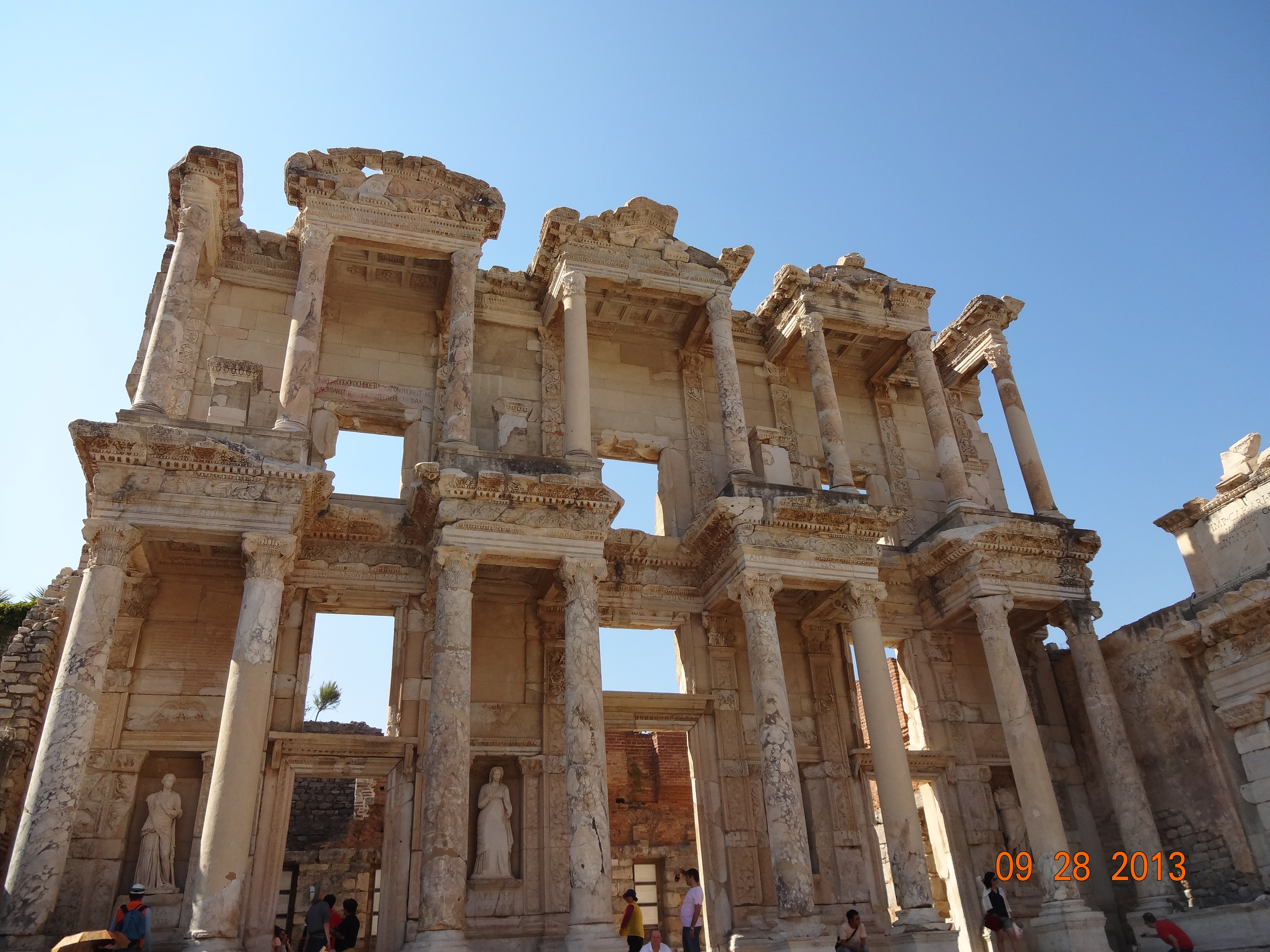
- The Library and Stadium are probably more impressive that you will expect.
Finally, the decline of the place was caused by changes in the topography and climate that meant that it was no longer near the sea and there was insufficient water to sustain the population. The latter point is likely to be relevant for a number of Australia cities, including Canberra, given climate change.
Flickr Link
 billrider2013