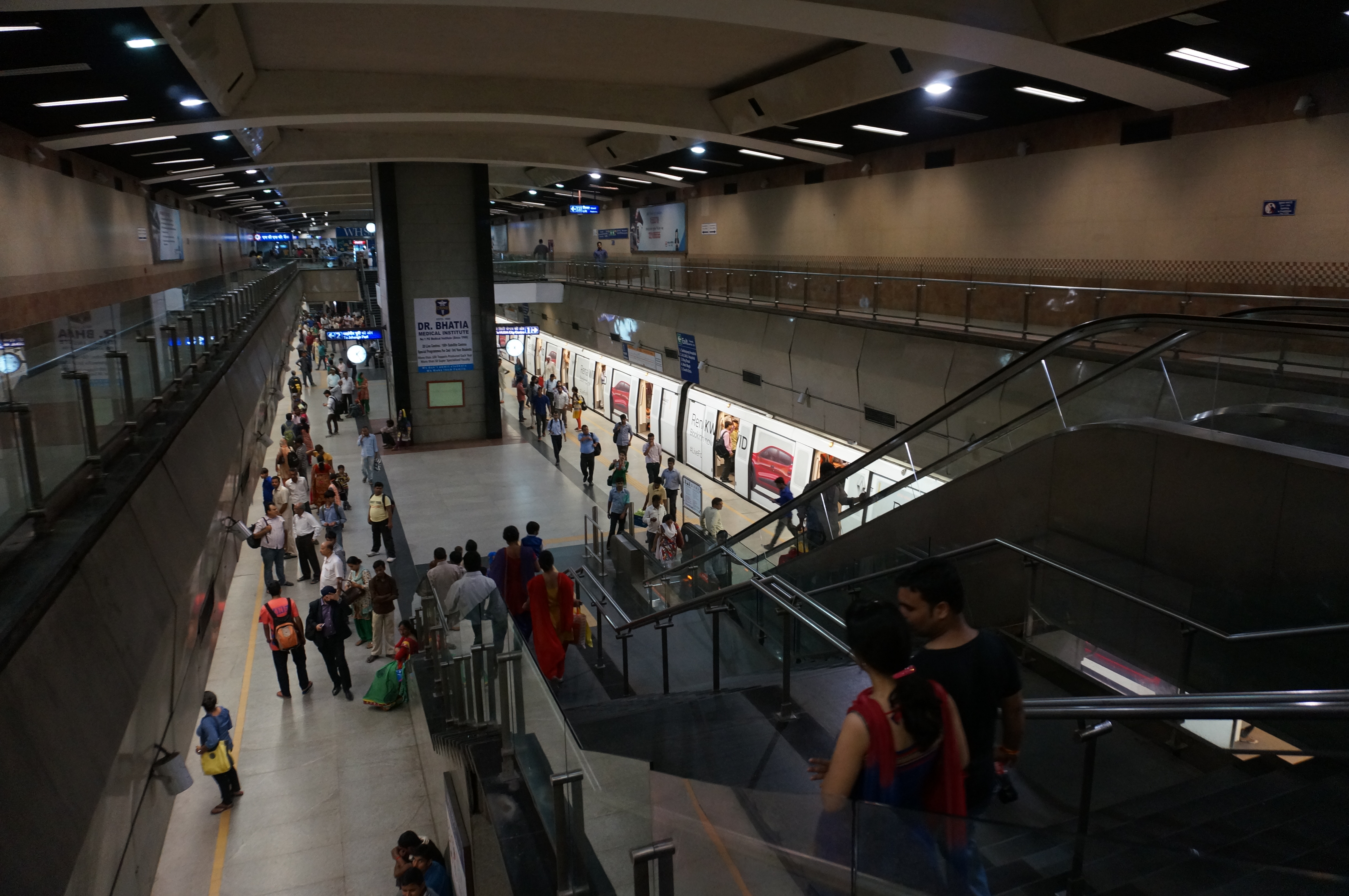
Probably the biggest change I have noticed in Delhi is the metro train system. It is not that it is physically obvious, particularly in the central area in that a lot of it is underground. Where it is above ground it is mostly on pylons – in the sky.
A Modern System Comparable to Anyway
It is a very good system with modern air conditioned trains running on very smooth tracks at high speeds (for a metro system). There is electronic ticketing and automated gates. It is on par with other ‘new” systems I have seen in Shanghai, Singapore and Seoul. In many respects it is better than ‘old ‘systems in London, Paris, New York, and Rome and in Sydney and Melbourne.
There is no doubt that a good metro train system has more of an impact on a city that simply being a way to get around. It has a social impact.
Two Stories to Illustrate a Point
I recall the Roderick Carnegie (the former head of what is now Rio Tinto the second largest mining company in the world) being interviewed. He said that he liked living in Melbourne rather than Sydney because he could get to work by tram. He said that he travelled to meetings in the CBD by tram. This amazed visitors from Sydney and the USA, less so those from the UK.
Another story I liked was David Attenborough (I don’t have say who he is) talking about travelling on the London Tube. He was standing on a District Line train heading to South Kensington. A girl sitting below him was reading his autobiography and did not notice, or pretended not to notice, that he was standing front of her.
The point of these stories is to highlight that impact of good public transport of society. It brings most levels of society together.
It also so encourages civil behaviour.
Women on the Delhi Metro
In the case of Delhi, it is notable that the behaviour on the trains is excellent. There is no splitting, no litter, and the people are generally courteous and wait in line to get off and on the trains.
There is a heavy security presence, but that is unfortunately necessary.
The attitudes to women and the attitudes of women are also interesting.
The front carriage is reserved for women. I didn’t bother looking whether they were are more or less used than other carriages.
In the carriages I caught, there was a mixture of ages, gender and (I assume) class. There are signs on some seats indicating women have preference. I saw numerous case where men stood and offered seats to older women irrespective as whether it was a ‘preferred’ woman’s seat or not.
On one occasion, a middle aged woman got on the train. A younger well dressed man was sitting in the ‘preferred seat’ (he looked like the equivalent of an ex-Shore Boy who was up himself) She stood over him and stared. He eventually got the message and stood up. I suspect she had noticed that I had been watching and smiled. The man walked to the end of the carriage.
I suspect an encounter like that would not have occurred between a Delhi man and woman on bus 30 years ago.
Back in to Different Word
The Metro runs about a kilometre from where I am staying in the Main Bazar, a very old and traditional area of Delhi. It is run down (in a nice way) and chaotic.
As you exit the air-conditioned and orderly Metro, you are met with the sounds and smells of ‘old’ Delhi.
There is a queue of bicycle Rickshaw operators. I took one back to my Hotel.
The contrast between the Metro and the Rickshaw ride is a quintessential Indian experience.
Flickr Link
To come Internet permitting
 billrider2013