Up the East Coast Days 7 to 12

36781362845_53762f8fdb_m

Cromer and onto Kings Lynn

From Lowestoft, the route took me north west through Great Yarmouth.  I cannot recall anything particularly ‘great’ about Great Yarmouth.

I had booked a pitch at Comer Hall Camping which turned out to be very close to the town.  It was somewhat confusing to find a place as the camping ground is on a large farm that also is the site of a zoo.  This confused even Google Maps.

Anyway, I finally found the place and there was a note on the office door, telling me to “pitch up anywhere I like”.

After setting up my tent, I walked into town.  There were lots of people wondering about the town.  I ended up having a meal a ‘gourmet’  hamburger place.  I rarely eat hamburgers, but these ones were OK.

The Pier

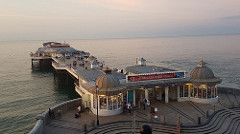
The hamburger restaurant overlooked the Comer Pier, which is a major tourist attraction in the town.  I walked down to the pier and took a photograph of the sunset.  There were lots of other people taking photographs of sunset.  It was very spectacular.

Good Café

In the morning, I wandered back into town looking for a place for breakfast.  I happened upon a small café which turned out to be very good.  The owners worked in the café and were very interesting to talk to. The wife is an avid trekker and frequently travels to Nepal where she undertakes long walks in the Himalayas.  All of the tips that are collected in the café are given to charities in Nepal.

Travellers Causing Trouble

As I wandered around the town after breakfast I noticed that they were a lot of policemen also wandering around the town.  This seemed rather odd for such a small town.  I asked one of  the policeman why there were so many of them around.  He said, “haven’t you seen the news about the troubles here”?  I said I hadn’t.

The policeman went on to tell me about the trouble there had been with ‘travellers’ that had descended on the town a couple of days ago.  Apparently, a very large group of mainly Irish ‘travellers’ arrived in the town in campervans.  The main trouble they caused was in restaurants and pubs where they ordered food and drinks, and then left the premises without paying.  They also abused people in the street.

Apparently, all this ‘carry on’  got quite a bit of a coverage in the national press.

Walking Around the Town

Cromer is nice town with a nice little beach and some interesting shops.  It was very pleasant just wander around and checked things out.

Library in Church

I also spent some time in the local library which is housed in an old church.  It is good to see old church been put to good use.

Waking up to Growling and Snorting

On the morning of the second day in Cromer I awoke to the sound of very loud growing and snorting.  Obviously, it was one of the animals in the Zoo next door.  I think we have all found ourselves sleeping in close proximity something that growls and snorts at some time in our lives.

Concert

In the evening , I booked a ticket to the show that was playing in the theatre which is located the end of the pier.  The show was old time ‘variety show’ that I suspect you would have been seen in the theatre between the two World Wars.  It had bit of everything – singing, dancing, comedy, and juggling.  All of the performers seemed to be able to do at least two of these things.

Lots of Dog

Comer is another town where everyone seemed have at least one dog.  There were dogs everywhere.

One family, I came across had white schnauzers.  I am very familiar with schnauzers, having owned two miniature schnauzers myself.  They were grey, also known as ‘salt and pepper’. The owner of the white schnauzers said, “these guys are just salt”.  She also said that they are always the centre of attention, and “when people ignore them they get upset”.

Short Ride to Sheringham

Leaving Comer, I had a very short ride to Sheringham where I stayed in YHA.  I had a private room which turned out to be very good.

Wells-next-to-Sea

After Sheringham, the route took me along the coast towards the quaintly named, Wells-next-to-Sea.

A couple of kilometres before the town, I saw the sign saying, ‘Miniature Railway’.  I followed the sign to check it out.

The railway turned out to be very miniature.  You can see a video of the train on Flickr.

The town of Wells next Sea was absolutely packed with tourists.  I only stopped briefly before heading towards King’s Lynn.  The route took me away from the coast through some pleasant villages.

Old Rectory

I had booked into a B&B called the Old Rectory in King’s Lynn.  This place turned out to be really good.  The owner had sent me a SMS with instructions were to find the keys and which Carey’s face in which locks.  Included in his message was a recommendation for a meal.  He recommended the restaurant in the hotel next door.  I took his recommendation and was pleased I did the meal was excellent.

Flickr Links

Cromer

https://flic.kr/s/aHsm3mKXRC

King’s Lynn

https://flic.kr/s/aHsm3cVUgM

Garmin Links

Lowestoft

https://connect.garmin.com/modern/activity/1946937360

Cromer

https://connect.garmin.com/modern/activity/1946937391

Sheringham to King’s Lynn

https://connect.garmin.com/modern/activity/1946937465


Riding up the East Coast Days 4,5 and 6

36618667221_c09f65d35b_m

From Felixstowe to Lowestoft

The Orwell Hotel in Felixstowe turned out to be very good.  It was great value at only AUD 60 per night.

Leaving Felixstowe

I got a bit lost leaving Felixstowe and heading north.  I was looking for the ferry that crossed the Deben River.  You would think it would be easy to find. The Garmin found it difficult.

I finally found the ferry crossing and continued heading north.  The route took me through the Suffolk Coast and Heaths Area of Natural Beauty (AONB).  While it was quite pleasant riding on mainly flat country roads, there wasn’t too much natural beauty to be seen.  There were, however, a large number of pig farms.  Each sow, appeared to have been given a small hut to live in.  I guess that that is better than nothing, and more humane than ‘battery farming’.

Staying in YHA in Blaxhall

As was riding along a noticed a sign to a YHA.  It turned out be in a village called Blaxhall.  The village really only consists of the YHA and a pub.

I checked into the YHA and headed to the pub for a meal.  As I was ordering my meal, the two lady cyclists that I had run into on the Felixstowe Harbour and Beach ferry, turned up in the pub.  We ended up having a meal together.  They were staying in, what I took to be, a very up market B&B not far from the village.

The YHA turned out to be very good. The YHA hostels in the UK have certainly changed a lot since I first stayed in them in the late 1970’s.  Those days, you are required to bring your own sheets,  and do chores such as sweeping the floors and cleaning the toilets.

There is none of that nowadays – staff in the hostel do all of that stuff. Also, most hostels like this one, serve alcohol and provide breakfast.

Into Adleburgh

Leaving Blaxhall, I headed towards the coast to the seaside town called Aldeburgh.  It is one of the more popular seaside towns that is in this part of the world.  It is known for its festival.  The festival had taken place the day before my arrival.  However, there were still lots of people in the town and there was no accommodation to be had for love or money.

I headed inland looking for a place to stay.

Camping in Lieston

I ended up staying in a campsite on farm just outside a village called Lieston. The contrast between this village and Aldleburgh was stark.  It is really amazing how villages that are so close together can be so different.

The only place to get an evening meal in Lieston was a very dodgy Indian restaurant.  I didn’t have a very good night’s sleep as a result of eating in that restaurant.

There was no place in the village that served breakfast.  A passing local told me that there was a reasonable café at Sizewell about five kilometres away. Sizewell is famous, or possibly infamous, for being site of one of the UK’s nuclear-powered electricity generating plants.

The café was on the beach and was very popular.  The power plant overlooks the beach.  I was really surprised at how many people were at the café.

Ride to Walberswick

After breakfast, I headed north on country lanes to a village called Walberswick.  It was a glorious English summer’s day.  When I arrived in Walberswick, there were people everywhere.  There were  almost as many dogs as people.  It seemed that there was a rule that said ‘you need a dog in your family to be allowed in the town’.

Row boat ferry to Southwold

Walberswick is on the southern side on the River Byth.  There are a number of ways to cross a river including Bailey Bridge over which the cycle path crosses.  However, there is also a small ferry.  This one turned out to be very interesting in that it was a rowing boat.  Check out the Flickr link to see a video of the ferry.

Lunch in Lord Nelson

After the ferry crossing I headed into Southwold for lunch in the Lord Nelson pub.  At some time in the future I will have to add up the number of Lord Nelson pubs that I have visited over the years.  I am sure it will prove to be a lot.  They can be found, not only in England, but around the world including Geneva.

On to Lowestoft and Trouble with Westpac

I headed onto Lowestoft, where I had booked a hotel on the beach front.

The ‘check in’ did not go well.  The receptionist told me that my AMEX card had been rejected.  I tried to use my Mastercard that is linked to the same account.  It was also rejected.  I called the Westpac so called ‘helpdesk’.

Westpac told me that both transactions where charged my account.  As we chatted I logged into the Westpac online app.  I could not see the transactions.  Indeed, the only transactions that I could see were from five days ago.

The hotel said that they needed proof that the transactions had been processed because, their  system had no record of them being processed.  That seemed a reasonable to me.  I asked the Westpac ‘helpdesk’ why I couldn’t see the latest transactions on my account. They told me that they were having problems with their systems.  This is something that Westpac customers have to put up with on a regular basis.

I had thought that things were getting better at Westpac , but it would appear that are not.  The problem is, as we all know, that it is difficult to change banks.  Also, there is no guarantee that the service will be any better if you do.

In the end, I had to pay for the room using my currency card. It was all very embarrassing.  I suggest to everyone, think twice about banking with Westpac.

Walk and Meal

Once I had finally settled into the hotel, I decided to walk along the seafront to find a place to eat.  I found a gastro pub which served a very good night baked seabass.  A bonus was that they accepted my credit card.

It was a bit cool as I walked back to the hotel.  Clearly, the end of summer was on its way.

Flickr Link

https://flic.kr/s/aHsm3khEHU

Garmin Links

Felixstowe

https://connect.garmin.com/modern/activity/1935320278

Blaxhall

https://connect.garmin.com/modern/activity/1935320300

Leiston

https://connect.garmin.com/modern/activity/1935320319

Up the East Coast Days 2 and 3

36648855486_d16e33f3f4_m(1)

To near Colchester and onto Harwick and Felistowe

It took me awhile to get out of Burnham on Crouch.  In fact,  it wasn’t until after lunch time that I finally left the town.

Past the Aerodrome

The route took me past an aerodrome.  There were a number of light planes flying around. One appeared to be a WWII Hurricane.

Getting at bit

In this part of the world, the signage on the Sustrans routes is a bit problematic.  I found myself getting lost a number of times.

Finding the Campsite

I had booked myself in to a campsite about five kilometres from Colchester.

It was late by the time I arrived at the site and decided to find a meal before pitching the tent.

Meal at the Alma Pub

A couple on the site suggested that I eat at the Alma pub.  While I was eating my meal, I noticed that there was cricket on the television.  It turned out to be the first Test between England and the West Indies.  What was really notable about this game was that it was the first Day/Night Test  to be played in England.

Unfortunately for cricket, virtually nobody in the pub seemed the slightest bit interested.

It was very late by the time I got back to the campsite. It was a bit of a pain, pitching the tent in the dark.

Chat with Norwich Couple

In the morning, I ended up having a rather a long chat, with a couple who were camped nearby.  They had only come from Norwich to told me that they often just head out into the country for short breaks in summer.

The bloke from told that owned a  Norton Commando 850 Mark 2 Interstate, that he was currently restoring.

Into Colchester

In the morning,  headed the short distance into Colchester where I had breakfast.  The major attraction of the town it is castle which dates back to Roman Times.

Onto Harwick

After leaving Colchester, I headed onto towards Harwich.

About 15 kilometers short of Harwick, I stopped briefly in a pub.

The notable feature of the pub was that they had a copy of the front page of the Sydney Morning Herald the day after England’s Rugby World Cup win in 2003.  The page was signed by Martin Johnson.

The landlord and great pleasure in showing me this memorabilia.

I was not impressed.

Ferry across to Felixstowe

I rode on to Felixstowe and  found the jetty for the ferry that would take me to the northern side of the harbour.  The ferry is known as the harbour and beach ferry.

On board I met two other cyclists.  They were  a couple of Englishwomen who were riding up the coast to Comer.

The ferry took about 15 minutes to cross the harbour, where we were to find how it got the second half of its name – we landed on a stony beach.

It was actually quite an effort to get the bikes over the beach onto firm ground.  It was then a short ride to my hotel, the Orwell in Felixstowe.

Flickr Link

https://flic.kr/s/aHsm1xAkPs

Garmin Links 

https://connect.garmin.com/modern/activity/1928778286

https://connect.garmin.com/modern/activity/1928778373


Up the East Coast Day 1

36605293916_eda60216b1_m

Southend on Sea

I rode from SW18 to Fenchurch Station in the City and caught the train to South end on Sea.

Faded Glory

I had book a night in the Bay Guesthouse that is on the Esplanade.  It is one of many such places in Southend.

Southend is one of many English seaside towns that have struggled since the 1970’s when the poms started travelling to Europe and beyond for their holidays.

There are lots of the ‘entertainment’ arcades and large ‘adventure’ park with mechanical rides.

Dinner on the Beach

I had a reasonable meal at a café on the beach.

The Pier

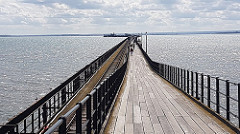
The main feature of the town is the pier.  It is the longest entertain pier in the world.  The reason for its length is the extraordinary tidal movements.

There is a train that runs along the pier.  A ‘ride and walk’ ticket is only GDP 2.50 for ‘Seniors’, including holders of NSW Senior’s Cards.  Very good value post Brexit Vote.

Ride to Burnham on Crouch

In the afternoon, I head towards Colchester.  This involved crossing the River Crouch on a very small ferry.

As I crossed the river, the heavens opened. I decided to stop in the town on the other side Burnham on Crouch. The ferryman suggested the White Harte Hotel. It turned out to be a good choice.


Flickr Link

https://flic.kr/s/aHsm2WTbH3

Garmin Link

To Fenchurch Train Station

https://connect.garmin.com/modern/activity/1925204848

North from Southend on Sea.

https://connect.garmin.com/modern/activity/1925204903


About Southend on Sea Pier

https://en.wikipedia.org/wiki/Southend_Pier

London August 2017

35821569923_9ec2306450_m

I travelled from Jersey via Portsmouth to London.

I arrived in time to join my hosts celebrate an ‘elderly’ neighbor’s birthday at a restaurant by the Thames. N.B. anyone born before 1955 is elderly in my eye’s.

My host’s left London for a few days to visit their granddaughters .  They were kind to offer me the use of the house. There was a condition however: “don’t set off the fire alarm”.

Pink Floyd Exhibition

I went to see the Pink Floyd exhibition at the Victoria and Albert Museum in South Kensington.

On the way there, I made my obligatory visit to the Zetland Arms.

The Pink Floyd Exhibition was great.  It has exhibits on each phase of their history, and related albums.  There is lots of memorabilia, including instruments and hand written lyrics.  There are also interviews with the band and other people.  The audio system works really well.

Motown Musical

I also went to the Motown Musical.  It about the history of the Motown recording label.  It uses hits from the era including songs by Diana Ross and the Supremes, The Jackson Five, Stevie Wonder and Smokey Robinson.

It is really good.

New Saddle

When I was in France, the tension bolt on my Brooks saddle fell off.  It is not possible to replaced the bolt without the assistance of a special machine that stretches the leather. This can only be done at the factory.  It was told by Brooks that this could take over a month.

Albeit that I could still ride on the saddle, I decided to lash out of new touring saddle. The old saddle will be installed on a ‘road’ bike in the future.

Off to South end on Sea

My next ride is up the East Coast of England.  I had decided to start from South end on Sea in Essex.

I road from SW18 to Fenchurch Station in the City and caught the train to South end on Sea.

Flickr Links

London

https://flic.kr/s/aHsm6FMczf

Pink Floyd Exhibition

https://flic.kr/s/aHsm2Fwocs

Pink Floyd Exhibition Link

http://pinkfloydexhibition.com/

Questions to Ask Climate Change Deniers and Skeptics and Related Views and Comments

Hurricane_Irma_wikipedia2

Is Carbon Dioxide (CO2) a Greenhouse Gas?

The correct answer is yes.

“Greenhouse gases most closely connected to global warming include carbon dioxide, methane, nitrous oxide and the fluorocarbons.

The greenhouse effect is caused by these gases in Earth’s atmosphere. Incoming solar energy passes through the atmosphere, which retains the resulting heat and warms Earth’s near-surface temperature. This effect is driven by the greenhouse gases, which capture and retain heat.

Consequently, the energy entering the atmosphere is greater than that leaving it, and this gradually raises the overall global temperature” (Sciencing, n.d.).

“The existence of the greenhouse effect was first identified 1824.  However, the term “greenhouse” was first used in this way by the Swedish Physicist Nils Gustaf Ekholm in 1901 (Wikipedia , n.d.).

What are Fossil Fuels?

Even the dumbest ‘denier/skeptic’ will get this correct.

“In common dialogue, the term fossil fuel also includes hydrocarbon-containing natural resources that are not derived from animal or plant sources.

Fossil fuel is a general term for buried combustible geologic deposits of organic materials, formed from decayed plants and animals that have been converted to crude oil, coal, natural gas, or heavy oils by exposure to heat and pressure in the earth’s crust over hundreds of millions of years”. (ScienceDaily, n.d.)

Does Burning Fossil Fuels Generate CO2?

The correct answer is yes.

“There are both natural and human sources of carbon dioxide emissions.

Natural sources include decomposition, ocean release and respiration.

Other…sources come from activities like cement production, deforestation as well as the burning of fossil fuels like coal, oil and natural gas”. (whatsyourimpact?, n.d.)

Does Human Activity Cause the Generation of CO2?

The Correct answer is yes.

Humans burn coal, gas and oil products.

The ‘denier/skeptic’ will almost certainly drive a petrol or diesel powered car.

Does Nature Absorb CO2?

The correct answer is yes.

“Plants absorb carbon dioxide from the air, combine it with water and light, and make carbohydrates — the process known as photosynthesis” (theconversation, n.d.).

The ‘denier/skeptic’ will often tell you this simple fact in a tone of voice that suggests that you have never heard of photosynthesis.

Other ways nature absorbs CO2 is includes absorption by the oceans.

For many years scientists have known that about 40%   of the carbon dioxide generated by human activity gets absorbed in the ocean waters”. (The Guardian, n.d.)

There is a possible issue with this however:

“When carbon dioxide (CO2) is absorbed by seawater, chemical reactions occur that reduce seawater pH, carbonate ion concentration, and saturation states of biologically important calcium carbonate minerals. These chemical reactions are termed “ocean acidification” or “OA” for short” (pmelcarbonprogram, n.d.).

Ocean acidification “expected to impact ocean species to varying degrees” (pmelcarbonprogram, n.d.).  It is thought to be a reason for the bleaching of coral reefs including the Great Barrier Reef.

Are levels of CO2 in the Atmosphere Increasing?

The correct answer is yes.

“Ancient air bubbles trapped in ice enable us to step back in time and see what Earth’s atmosphere, and climate, were like in the distant past. They tell us that levels of carbon dioxide (CO2) in the atmosphere are higher than they have been at any time in the past 400,000 years”. (NASA, n.d.)

More importantly, on May 9, 2013, the daily mean concentration of carbon dioxide in the atmosphere of Mauna Loa, Hawaii, surpassed 400 parts per million (ppm) for the first time since measurements began in 1958 (NOAA Research, n.d.).

Is the Increase in CO2 in the Atmosphere Related to the Burning of Fossil Fuels?

It would appear that it is:

“Before the Industrial Revolution in the 19th century, global average CO2 was about 280 ppm. During the last 800,000 years, CO2 fluctuated between about 180 ppm during ice ages and 280 ppm during interglacial warm periods.

Today’s rate of increase is more than 100 times faster than the increase that occurred when the last ice age ended” (NOAA Research, n.d.).

Has the Climate fluctuated in the Past?

This is a favourite line of the ‘denier/skeptic’.  They will tell you the climate has always been changing.  They often tell that in tone that suggests that they are aware of that fact and you obviously aren’t.

The answer is yes, the climate has always been changing – there have been periods of ‘ice ages’ and more temperate periods.

This fact is known to everyone of the planet, with even a modest level of education.

For example, this from a UK Infants School curriculum:

“Stone Age to Iron Age covers around 10,000 years, between the last Ice Age and the coming of the Romans. Such a long period is difficult for children to imagine, but putting the children into a living time-line across the classroom might help” (Historical Association , n.d.).

What is the Probability that Scientists are Unaware of Past Climate Fluctuations?

Let’s get real, the answer is nil.

The scientists are almost certainly to have IQs more than 15% higher than the average person.  They will likely to have post graduate degrees, including doctorates. They will all have been to Infants School or its equivalent.

Who thinks that Anthropocentric Climate Change is Real?

As we all know, it is widely reported that 97% or more ‘Climate Scientists’ believe that human activity is changing the world’s climate.

NASA reports the following:

“Multiple studies published in peer-reviewed scientific journals1 show that 97 percent or more of actively publishing climate scientists agree: Climate-warming trends over the past century are extremely likely due to human activities.

 In addition, most of the leading scientific organizations worldwide have issued public statements endorsing this position”. (NASA, n.d.).

The ‘Paris Agreement’ suggests that all of the world’s leaders with the exception of Donald Trump and President Assad of Syria believe that Anthropomorphic Climate Change is real (UN Framework on Climate Change , n.d.).

Who doesn’t think that Anthropocentric Change is Real?  

We all know a few: Donald Trump, Pauline Hanson, and so on.

You maybe one yourself.

You maybe married to one.