When I was thinking of traveling to Adelaide, I also thought about traveling out to Kangaroo Island. I had heard that it was well worth a visit.
The Fires
In the period between when I had thought about going to Kangaroo Is and actually getting close to the place, there were some fires.
Actually, these were not just ‘some’ fires, they were catastrophic. Check out the links below.
Taking a Tour
An issue with Kangaroo Island at the best of times is that it isn’t an easy place to get around. There is no public transport on the island and it is quite big – 150 kilometres long and 50 kilometres wide. The only real options are to take a tour or hire a car. Cycling is an option; however, you need plenty of time. It was also not an option for me on the Brompton.
I looked at some tours. One looked really good, taking in most of the ‘tourist’ spots and some ‘activities’, including sea kayaking and fat tyre bike riding.
Unfortunately, this tour was not on offer because of the fires. The accommodation it used was burnt down and the some of the activities were in areas that were impacted by the fires.
In the end I had to settle on a ‘standard’ tour.
Trip Down to the Ferry
The start of the tour involved a bus trip from Adelaide to Cape Jervis via the Maclaren Vale region.
I sat next to a young German woman on the bus. She told me that she a nurse living in Hamburg. She was originally from Rostock. In our chat, I detected a reticence to talk about the fact that she was brought up in the former ‘East Germany’. I have encountered this before. Even though the ‘Wall’ came down in 1989, its impact still lingers.
Across to the Island
It is a short ferry ride from Cape Jervis to Penneshaw in the island. The crossing was very rough. Check out the video.
Meeting the others on the Tour
Once of the island we were direct to our bus and introduced to our guide. The other people on the tour were all from overseas. There were people from Germany, Switzerland, the Netherlands and Iceland.
Sheep Station
Our first stop was a sheep station. There was a ‘sheep dog and shearing’ show. It was actually quite interesting. The dogs rounded up the sheep and drove them into a pen. They obviously enjoyed their work.
The farmer then sheared one of the sheep. At the ned of the show he had a bit of a ‘rant’ about “vegan animal liberationists”. This didn’t impress a Dutch girl on the tour. She was proud vegan.
Eucalyptus Distillery
Our next stop was an Eucalyptus Distillery. The most interesting thing about this stop was the ‘information sheets’ they had prepared for visitors.
The guide asked what language people spoke and a offered sheet in the relevant language e.g. German and Dutch. The Icelandic girls were stunned to find that there was a sheet in Icelandic. Apparently, the translation was performed by Icelandic volunteer who worked at the distillery for a period.
The owner of the the distillery is known on the island as an ‘animal orphan mother’. She looks after animals, mainly kangaroos and wallabies that are orphaned, usually as a result of ‘roadkill’.
At the time of our visit she was looking after a young female kangaroo joey. She was a hit with the overseas visitors.
Sea Lions
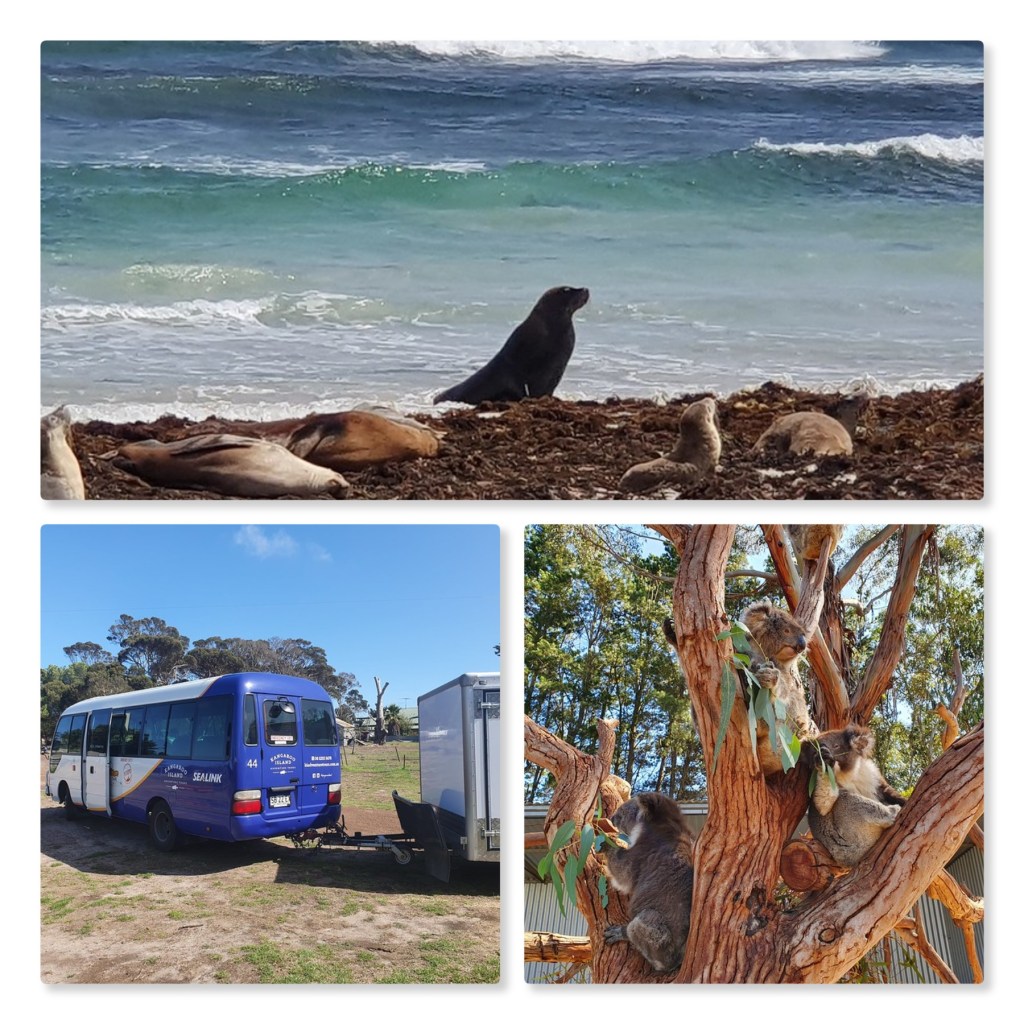
Our next stop was a Sea Lion colony. Kangaroo Island has a large population of Sea Lions. The colony is within the National Park and access to it is restricted. You are only allowed to the area where the Sea Lions are in the company of a Park Ranger.
It was very interesting to see the animals in the wild. They are fascinating to watch. The males are frequently ‘fighting’ and ‘posturing’ and staking their claims over the females. The pups are ‘playing’ and practicing their hunting skills. The females seem to be intent on getting some rest between their ‘mothering’ activities and trips out to sea to catch food.
The ranger told us that the Sea Lions typically go out to sea for two to three days to hunt food before returning to the Island for a similar period. Some don’t return. “They are are popular meal for Great White Sharks”.
Sand Dunes
Our las stop for the day was some sand dunes. We were offered toboggans and boards to ride.
I actually enjoyed the toboggan ride facedown, luge style. Unfortunately, I didn’t get a video of me in action. Maybe that was fortunate.
Dinner and Overnight
After the dunes, we headed back to Penneshaw for dinner and our overnight accommodation. Neither were particularly flash. Both were hastily organised as replacements for the place that was burnt down.
Some of us went to the pub after dinner. The owners of the pub were pleased to see us. Most of their other customers were locals and some Army Reserve people that were still on the island helping with clean up and recovery operations after the fires.
There was only one problem. The pub had run out of draft beer and was down to a limited selection of bottled beer. One of the locals was “extremely worried that he may have drink sherry” before the beer supplies resumed.
The Fire Affected Area
The next morning, we headed west and to middle of the Island.
Our route took us through some of fire affected areas. It was extraordinary to see. Over forty percent of the island has been burnt. Of course, the island has experienced fires for hundreds over years. However, it is unprecedented for the fires to cover such a large area, to burn for such a longer period, and with such intensity. The fires were started by ‘dry lightning’ strikes.
Wildlife Sanctuary
Our first stop was a Wildlife Sanctuary. Fortunately, the sanctuary was saved from the fires. That was not only good for the resident animals, but it has been critical in the days after the fires for other animals on the island.
The sanctuary is being used as a base for the rescue efforts for the wildlife impacted by the fires. Over 400 koloas, mainly babies, have been brought to the sanctuary where they are cared for by the staff and a group of volunteer vets. We got to talk to a couple of vets that are caring for the animals. There were very circumspect about the survival rates among the injured animals.
On a happy note, the Icelandic girls were able to hold a Koala. One of the girls was “was so happy, she couldn’t stop crying”. It was good to see.
The sanctuary has a fair number of the animals to see including snakes and other reptiles.
They also have some dingoes. The keeper who looks after the dingoes was very interesting. He told us that the dingoes are almost certain to become extinct in the wild within a short period. This is due to bating and cross breading with feral domestic dogs. This was sad to hear.
Emu Bay Beach
Our next stop was Emu Bay Beach. Check out the photos. It is very spectacular. This beach is where the sea kayaking would have taken place but for the fires.
Lavender Place
We had lunch at a Lavender Farm. The lunch was quite good.
Bird Park
Next stop was a bird park.
This turned out to be really interesting. Most of the birds were ‘birds of prey’ of various sizes.
Most have been injured or orphaned and are not suitable for release. They have been trained to some extent and put on a show displaying their hunting techniques and natural behaviours.
Check out the link below.
Honey Factory
We stopped briefly at a honey factory. This was interesting in that Kangaroo Island is famous for its honey. The health of bees is become at big issue worldwide. Kangaroo Island bees are thankfully disease free. Hopefully it can stay that way.
Main Town
Before head heading to the ferry, we stopped in the main town of Kingscote. Its pub had beer.
Back to Adelaide
The drive back to Penneshaw was long. As I noted before, Kangaroo Island is big. We had time to eat dinner before catching the ferry to the mainland.
It wasn’t until after 11 pm that we finally arrived back in Adelaide.
We trip to Kangaroo Island was shorter because of the fire. However, I am glad I did it.
Flickr Link
Links to Information of the Fires
https://tourism.sa.gov.au/news-and-media/news/2020/jan/07/update-kangaroo-island-fires
Birds of Prey
Raptor Domain Kangaroo Island
 billrider2013