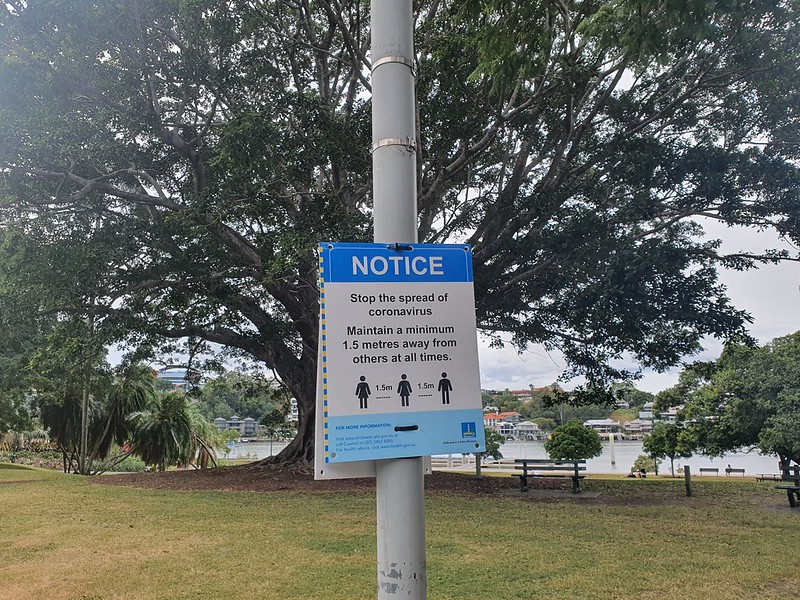
We are at the end of another week of the coronavirus crisis.
My ‘permanent’ Accommodation Sorted
On a personal note, I have sorted out my accommodation here in Brisbane. It is a one-bedroom unit in the suburb of New Farm on the Brisbane river. I move in next week.
The process was interesting. I had to provide references. This process was somewhat different to the norm given that I have effectively been of ‘no fixed abode’ since May of 2012. The letting agent had not experienced this before. Fortunately, I was able for provide suitable referees, one of whom’s wife rightfully claims credit for “my excellent vacuuming skills”. The comments on my skills caused great amusement in the letting agent’s office.
I am looking forward to a ‘long term’ stay in Brisbane. It will enable me to do a lot of the reading, some blogging, lots of listening to music. It will also give the opportunity to watch some movies and TV shows. In my peripatetic lifestyle I do not have many opportunities to watch either. Most of my movie watching happens on long-haul flights. I occasionally watch TV when I am in London and in hotel rooms. I have subscribed to net streaming service and will have NBN broadband in the unit.
Countries Looking Ahead
As I post this, events related to the virus are still moving fast. The USA is increasing its lead in both the number of cases and the death toll.
In the UK, things seem to be stabilising but are still pretty grim.
In parts of Asia, including China and Singapore there is evidence of an emerging ‘second’ wave of inflections. Things are not looking good in Japan.
In Europe, some countries are looking to ease restrictions in movements.
When Does It Stop?
The answer to this is simple. When people cease to catch the virus and pass it to someone. At that point, the virus effectively dies out.
The problem is that it is not a simple matter to get to that point. It may take years or decades. Look how long it took the eradicate smallpox. It took centuries, and it required the use of a vaccine.
There is no certainty that a vaccine will ever be developed for this virus. Further, there no certainty that it will be entirely effective, and that sufficient people will be inoculated to completely stop the transmission of the disease.
R0 is Important
The experts are telling us about a key concept that needs be understood with respect to the spread of the disease. This concept is ‘R0’.
“Scientists use R0 – the reproduction number – to describe the intensity of an infectious disease outbreak. R0 estimates have been an important part of characterising pandemics or large publicised outbreaks, including the 2003 SARS pandemic, the 2009 H1N1 influenza pandemic and the 2014 Ebola epidemic in West Africa.
It’s something epidemiologists are racing to nail down about coronavirus.
The formal definition of a disease’s R0 is the number of cases, on average, an infected person will cause during their infectious period.
If R0 is less than 1, the disease will die out in a population, because on average an infectious person will transmit to fewer than one other susceptible person. On the other hand, if R0 is greater than 1, the disease will spread”.
So the trick is to get the R0 for this virus below 1. Without any intervention it is thought to be certainly above 1 and possibly as high as 2.5.
Different Strategies Emerging
At the moment, it can’t be assumed that the vaccine will be developed anytime soon. Certainly, not for at least 12 to 18 months.
In the face of that reality, various strategies seem to be emerging.
The New Zealand Way
The NZ government is going for ‘eradication’. The intension of this strategy is to get rid of the virus as soon as possible. In the absence of a vaccine, this is achieved by rigid ‘lockdown’ protocols.
The first of these is cutting the country off from international travel except for exceptional circumstances e.g. NZ nationals returning home or aircraft crew flying planes carrying essential freight.
The next step is to limit internal movements within the country. People are required to stay in their home cities and towns.
Most crucially, there is strict ‘social distancing’. This involves people staying at home as much as possible. It also means any interaction is limited to family members where possible. Shops, restaurants, and cafes are closed unless they are essential e.g. pharmacies, supermarkets and places selling take way food. People are required to work from home wherever possible.
Another aspect of the ‘social distancing’ is the requirement that people stay apart from each other by at least 2 meters.
As I write this, the strategy appears to be working. There are 1,422 confirmed or probable cases of the virus and these only increased by 13 in last 24 hours. It would appear that the country is on track to achieving zero transmissions. If that is achieved and sustained, the virus will die out.
Swedish Approach
The Swedish approach is generally thought to be at the other extreme compared to the one New Zealand is taking, at least among rich countries.
The Swedish government have closed senior high schools and banned gatherings of more than 50 people. They have asked – rather than ordered – people to avoid non-essential travel, work from home. People over 70 have been asked to stay indoors. That request also applies to anyone will flu like symptoms.
This has been described as a ‘light-touch’ approach’.
“Polling suggests many Swedes continue to support the government’s strategy, which has entailed urging citizens to take personal responsibility for following physical distancing guidelines rather than strictly enforcing mandatory rules”.
Statistics show roughly half the Swedish workforce is now working from home, public transport usage has fallen by 50% in Stockholm and the capital’s streets are about 70% less busy than usual. However, peoples are still able to shop, go to restaurants, get haircuts and send children under 16 to school even if a family member is ill.
“However, Sweden has passed the grim milestone of 1,200 coronavirus deaths, far exceeding the tolls of its nearest neighbours”.
Nevertheless, “Anders Tegnell, the country’s chief epidemiologist, has described the Swedish approach as an attempt to ensure “a slow spread of infection and that the health services are not overwhelmed”, arguing that it is important for a part of the population to acquire immunity.
The chief epidemiologist has repeatedly stressed that the world is in uncharted territory with the coronavirus, arguing that while Sweden might have more infections in the short term, it will not face the risk of a huge infection increase that many other countries might face once their strict lockdowns are lifted.
Problems with both Strategies
It seems that the Swedish approach is based on an acceptance that, in the absence of a vaccine, the only way for people to become immune to the virus is to catch it and recover. If sufficient people become immune to the virus, this is thought to be 60-70% of the population, the R0 will drop below 1. Very quickly following that, the virus will die out.
A big issue will this approach is that many vulnerable people will die if they catch the virus.
Also, it is assumed people who have the recovered from the virus will have immunity to it. Apparently, that is normally what happens with coronaviruses. However, this is yet to be confirmed in the case of this virus.
The problem with the New Zealand approach is that people will not gain any immunity to the disease. It is all very well to eradicate the disease in the New Zealand. However, it is likely that it will still be infecting people around the world for months, if not years to come.
To stay disease free, New Zealand will have to cut itself off from the infected parts of the world until the virus is eradicated on a global scale. If infected people were to travel to New Zealand, and were not properly quarantined, they would likely introduce the disease into country. ‘Back to square one’.
Is there a Middle Road?
Question that appears to be being asked around the world is whether there is a ‘middle road’ between the approaches being taken in New Zealand and Sweden.
It appears the Australia is looking to one.
The strategy is ‘cautious relaxation’.
Firstly, this requires a sustained drop in transmission rates. When this occurs some the restriction may be relaxed. For example, schools reopen. Some people, possibly younger people are allowed to return to work.
It will also require strict monitoring to detect any spread of the virus. This will include widespread testing of people to see if they have the disease, with or without symptoms. There will also be testing for people with antibodies. These people will have had the disease and will have recovered.
There is also a need for ‘contact tracing’. That is a process where anyone who has come into contract will the disease in traced. They will be tested and if necessary, they will be placed into isolation.
There is discussion going about the possible use of mobile phone apps to assist in this ‘contact tracing’ process. This technology has been used in Singapore and South Korea. There definitely privacy and data security concerns with this approach. It does have ‘Big Brother’ overtones.
Whatever approach Australia decides to take, social distancing and washing of hands will stay. They are part of our new life, along with extremely limited overseas travel until a vaccine is developed and used globally.
A shemozzle in the USA
As you would expect, things are not going well in the USA.
The reason for this of course, their President.
He continues to get worse. It pains me to even think about. I will keep it brief.
On the 16th of April, the White House issued ‘Coronavirus Guidelines for America’. They are contained in a 16 page document. This far to big a document for Trump to read, let alone understand.
Essentially, it puts the onus of the State Governors to manage the way out of the current crisis. For example, they are to decide when ‘lockdown’ restrictions are to be lifted. The States will also be responsible for managing risk mitigation measures such as testing.
Around the time that the guidelines were issued, demonstrations began in certain States including Michigan, Minnesota and Virginia demanding the ‘social distancing’ restrictions be lifted. Trump sent out tweets in support of these protests. These States have Democrat Governors. The protestors were obviously ‘right wingers’.
The simple fact is that the Governors of those states were following the White House Guidelines.
Trump is encouraging people to disobey his own guidelines.
Explanation of R0
NZ Coronavirus Statistics
Swedish Approach
https://www.theguardian.com/world/2020/apr/15/sweden-coronavirus-death-toll-reaches-1000
ANU Professor’s View
Laura Tingle 18th April
Paul Kelly 18th April
White House Guidelines 16th April
https://www.whitehouse.gov/briefings-statements/coronavirus-guidelines-america/
Trump inciting Disobedience to Governors following His Guidelines
 billrider2013