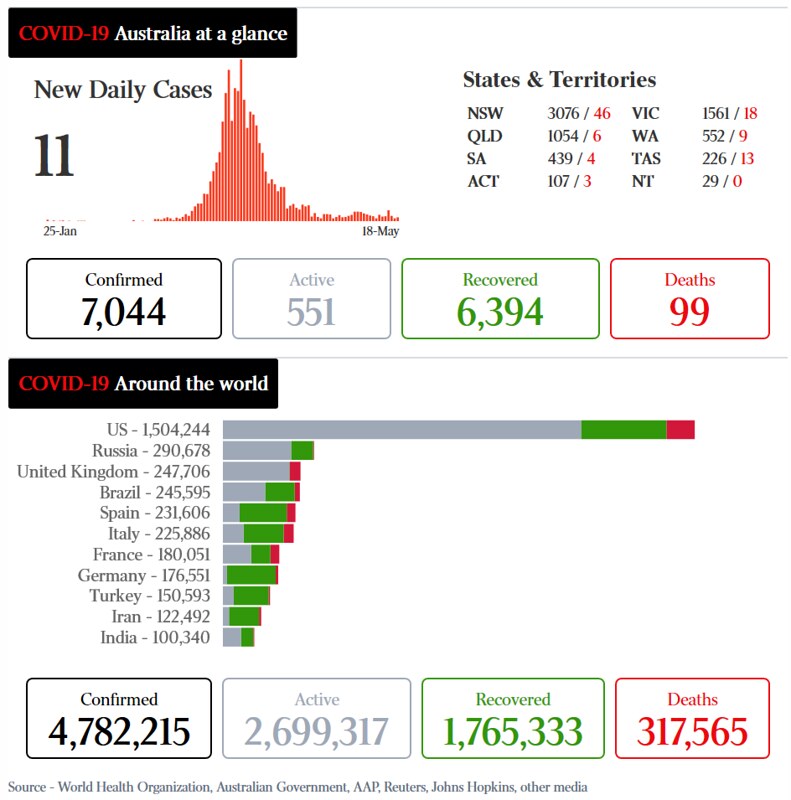
It is now well past the middle of May and the coronavirus crisis rolls on.
Today there are over 5 million confirmed cases globally with over 300k deaths.
In Australia, the ‘curve’ has seemingly been flattened with only 7,044 confirmed cases and only 11 new cases in the past 24 hours.
Easing of the Restrictions
This week marked the easing of restrictions in all the jurisdictions in Australia. The extent of the easing varied between the different states and territories. At one extreme, the Northern Territory moved to ‘stage 2’ of its easing of restrictions. This meant that many pubs, bars and restaurants will be back in business as normal.
In other states and the ACT, bars and restaurants were allowed to have ‘in house’ customers under certain conditions. These included restricted numbers, typically 10 at anyone time and the requirement that customers had to order a meal if they were drinking.
Reports in the media suggested that many businesses were taking a ‘suck it and see’ approach to opening up their businesses. For many it is simply not economic to operate with a limited number of customers.
In my wanderings in the local area around New Market here in Brisbane, I noted that many of the restaurants remained completely shut. Some of the cafes have opened their seating, particularly outdoors.
There has also been an easing of restrictions regarding gatherings both in homes and outdoors. I certainly noticed an increase in the size and number of groups in the local parks. There were many large family groups having picnics.
All of the states and territories have plans in place for schools to open. In some states including Queensland some of the children have already returned to school.
Borders still Closed
While things are easing up within states and territories, there are still controls on movements between the different jurisdictions. With the exception of Victoria and NSW, the borders between the states are still closed.
The Queensland premier has said they that its border may be closed until at least September. This has not gone down well with the NSW premier who apparently likes to holiday in Port Douglas in July.
Economic Impact
A whole slew of economic data has been released in the past week or so. It all points to one thing – a serious and ‘unprecedented’ economic downturn. This has led to an unprecedented use of the word ‘unprecedented’.
As would be expected, certain industries and businesses have simply stopped operating or have dramatically reduced activity. These include travel, entertainment, professional sport and well as restaurants and pubs etc.
The number people unemployed or under employed has increased. However, this increase has been suppressed by the ‘Job Keeper’ program under which the government pays employers $750 for each of their employees who cannot work because of the lockdown due to the virus. The employers passed the money on to the employees. These employees are not classified as being ‘unemployed’ by the Australian Bureau of Statistics (ABS).
As a result of this program and the issue of people simply no bothering to look for work, the true level of unemployment is difficult to determine. However, it is big. Dare I say it, it is ‘unprecedented’, certainly in my lifetime.
The official unemployment rate at the end of April was 6.2 percent. There are lots of the estimates of what the real number is. It is certainly over 10 percent and is certain to rise, at least in the near term.
Another looming issue is that the Job Keeper program is due to expire at the end of September.
In a later post I will talk about what is being said by people who seem to know what they are talking about regarding the economic prospects going forward. It would appear that it is very unlikely that a quick ‘V’ shaped recovery will happen.
The Logistical Problems of the Return to ‘Normal’
As part of the easing of restrictions, people are being encouraged to return to work. This is a noble objective; however, it is easier said than done.
The obvious problem is that the ongoing need maintain ‘social distancing’. This is a particular issue on public transport including buses and trains.
I will talk about this in a separate post focusing on Australia and the UK.
Vaccine on the Way?
The general consensus of opinion among the medical experts and politicians is the crisis will not be resolved until there is a vaccine to protect people against being infected by the virus.
There is no doubt the extraordinary efforts are being put into the development of a vaccine. However, there is still a great deal conjecture about when a vaccine will be available. Further, some experts are questioning whether a vaccine will be developed all at.
Problems with China
In my previous post I noted that the Morrison government was calling for an independent investigation into the cause of the outbreak of the virus. An investigation is necessary and doubtless one will be undertaken at some time”. The call for an investigation upset China.
Unfortunately, the problems with China have escalated. The World Health Assembly (WHA), comprising all members of the United Nations has also called for an independent inquiry into the outbreak of the virus. This is a positive.
However, China has said that this call for an inquiry by the WHA is not a vindication for Australia’s call for an inquiry. More worrying is that China has slapped a large tariff on Australia exports of barley and has placed bans on certain meat exports. It looks as though these trade issues are likely to escalate.
The Chinese actions have excited the right-wing loonies in the Australian commentariat and the wider Australian community. They are calling for retaliatory action against China. Fortunately, the Australian Foreign and Trade Ministers are competent and appear to be handing the matter well. It is also good to see that Morrison is keeping his mouth shut.
Looking Overseas
The USA continues to lead the league table both in terms of the number of cases and the number of deaths. They are followed by the UK, Russia, and Brazil
In a previous post I talked about the different approaches being taken by Sweden and New Zealand and that it would be interesting to see how they fared. New Zealand has gone for complete eradication of virus and Sweden seemed to be going for ‘herd immunity’ by deliberately allowing a substantial proportion of its citizens to get the virus.
New Zealand seem to have been successful in their goal. Albeit there are no mandatory lockdown rules in Sweden the population has been following social distancing and the spread of the virus has slowed. They are no where near achieving heard immunity.
What about the top Four?
It interesting to look at the top four noted above.
They all have something in common – populist leaders.
Trump has consistently underplayed the seriousness of the virus and sort to “get America open again as soon as possible”.
He has actively encouraged governors to ease lockdown restrictions in their states even before the conditions, detailed in the guidelines his own ‘administration’ have issued, have been met. He has supported demonstrations against governors who have complied with those guidelines,
Similarly, Boris Johnson underplayed the threat of the virus and infamously visited a hospital with virus sufferers and boasted about “shaking everyone’s hands”.
The journalist Alan Kohler summed up the performance of both men as follows:
“The US and UK are the nation states that have performed worst in the world in coping with the coronavirus pandemic. Americans and Britons make up more than a third of the 300,000 people worldwide who have died from Covid-19. They have paid the ultimate price for their governments’ slow and incompetent response to the spread of the disease.
Both countries have obvious points in common that explain their excess fatalities: Donald Trump and Boris Johnson are nativist demagogues skilled in winning elections, but not in coping with real crises as opposed to the ones they invent or exaggerate. Their critics had long predicted disaster if either man became national leader and this has finally happened”.
I think he is spot on.
As far as Russia is concerned, it should be taken as given that Putin and his administration would stuff up its response to the coronavirus.
Brazil in an interesting country one to watch. Its far-right President Jair Bolsonaro remains bitterly opposed to lockdowns, having described them as unnecessary over a “little flu”.
It is not a surprise that Brazil now features at the top of the league table. Yesterday its as daily COVID-19 deaths crossed 1,000 for the first time.
It would appear that Brazil is going to be a case study on what happens when a country ‘lets the virus rip’. Unfortunately, I suspect that its experience is likely to prove that the notion that there is a ‘trade off’ between a ‘health’ outcome and an ‘economic’ outcome is simple unrealistic.
If there is a serious ‘health’ meltdown in a country, it is inevitable that an ‘economic’ meltdown will follow.
Trump
I noted above that Trump has continued to peddle the line that all of the problems that the USA is experiencing in this crisis is the fault of the Chinese.
Another of his pet subjects I have mention before has been his promotion of the drug hydroxychloroquine as both and treatment and preventive measure for the virus. This week he announced that he is taking the drug.
Whether this is true or not is anyone’s guess.In the meantime, there are a number of clinical trials are being conducted into the use of the drug around the world, including in Australia.
 billrider2013