After over two years of not travelling overseas, I am finally back ‘on the road’.
The date of my departure from Australia was determined by important wedding. I was able to secure a flight from Sydney to London two days after that momentous occasion using QANTAS Frequent Flyer points. In fact, the fare using points and some cash was the cheapest long-distance flight I have ever taken.
Albeit it was a QANTAS fare, the flights were with Japan Airlines (JAL) via Tokyo Haneda.
Leading up to the trip, I received numerous emails from JAL informing me of changes to the timing of the Tokyo to London leg.
The flight from Sydney to Tokyo was uneventful except the requirement to be at the airport four hours before departure was a pain. As it turned out there were no delays checking in or passing through immigration at all.
Deserted Airport
The transit in Haneda was somewhat surreal. The terminal was very quiet as a result of the ongoing Covid-19 restrictions that are still in operation in Japan.
The majority of flights to Japan are still being cancelled. As a result, virtually all of the shops and cafes in the terminal are closed. In fact, there was only one food outlet was open when I was there.
The connecting flight to London Heathrow turned out to be leaving 3 hours early than originally scheduled. The reason for that was that it had been rerouted over the North Pole, rather than across Russia, as a result of the war in the Ukraine.
When we left Tokyo we headed North, steering clear of Russian airspace over Siberia.
Fortunately, the flight was only about 60 percent full and I was able to lie down across four seats and get some much needed sleep.
When I awoke, we still had about four hours to go be arriving in London.
Flying over the Artic
I was very glad to be awake. Out of the window I was presented with a great view of the Arctic not far from the North Pole. This was a first for me.
As we headed South, we passed over Greenland and Iceland before crossing over the Shetland and Orkney Isles before flying over mainland Scotland. We passed over Glasgow before flying down the middle of England into London Heathrow.
Smoothly through the Airport and into London
When we landed, we were advised that there could be problems getting into central London as a result of disruption to the rail system, including the Tube.
I was also expecting problems getting the luggage and getting through immigration. There had been a lot in the media about ‘chaos’ at Heathrow Airport.
As it turned out, the luggage arrived on the carrousel within minutes of me completing the very long walk from the plane.
The next step through immigration also went very smoothly. The automated passport control system works very well.
Surprisingly, the trip into Central London was also a breeze. The Piccadilly Line wasn’t going to operate until after 8.30 am, however the Airport Express and new Elizabeth Line trains were operating as normal.
I decided to take the Elizabeth Line which costs only GDP 11 as opposed to GDP 25 on the Airport Express. The only difference is that there are a few stops on the way to Paddington.
In Paddington, I took the Circle Line to Edgeware Road where I caught the District Line to Wimbledon. This turned out to be remarkably easy even with my fully laden Brompton. The Tube was very quiet. I can only assume people were staying away in the expectation that services were still being disrupted.
In Wimbledon, I stopped off at an EE Mobile Shop to get yet another UK mobile SIM.
Staying awake and No Jetlag
I then headed down to SW18 where I was greeted by my hosts. It was great to be back in very familiar surroundings.
My hosts had a very good plan for the day. They were going to keep me awake. This included a lunch in an excellent pub on the Thames with a friend and her extraordinarily likeable dog.
After lunch we went for a walk along a canal. The walk was mainly for the dog’s benefit, but it also assisted in keeping me awake.
I finally succumbed to the urge to sleep around 9 pm. I woke up in the morning fully synchronised to UK Summertime and free of jet lag.
It is now well over a year since the coronavirus crisis started. This time last year I had expected to be flying to Singapore on my usual journey out of Australia which ends in London at the end of May early June. Of course last year that didn’t happen.
Stranded for One Year
For the past year I have been stranded in Queensland, first in Brisbane and since the beginning of October, in Tewantin on the Sunshine Coast.
The Second phase of the Coronavirus
It would appear that the coronavirus crisis is now in a second phase. The beginning of this phase was marked by the roll-out of vaccines against the virus.
The development of the vaccines has been a remarkable achievement. This has been possible as a result of significant advances in medical technology. The key to the development of the vaccines was the identification of the coronavirus genome. Once identified, the genome was shared among scientists around the world, including those who were looking to develop vaccines.
As work on the development of the vaccines continued, governments made some key decisions designed to assist in the acceleration of process that would ultimately lead to their availability. This included committing to the purchase and funding of the manufacture of the vaccines before they were tested.
This meant that once the vaccines were tested and approved by the medical authorities, they could be effectively rolled out immediately. The UK was the first country to approve the use of the vaccines and to commence inoculation programs. The USA soon followed as did Israel.
Two types of Vaccine
As of today, there are two main types of vaccine.
The first vaccine to be approved was developed in Germany by a company called BioNTech. This vaccine was developed using a new technique called mRNA. In simple terms, this technique involves replicating part of the virus. When this is introduced into a human body, the immune system is trained to recognise it. If the vaccinated person is subsequently exposed to the coronavirus, their immune system will attack it.
The BioNTech vaccine is being manufactured and distributed by the pharmaceutical giant Pfizer and is known as the ‘Pfizer vaccine’.
There is a second type of vaccine known as an adenovirus. These vaccines are developed using a more traditional method. This involves taking a real virus and modifying it. The ‘modifying’ process involves killing the virus and making it look like the coronavirus. When the this is introduced into a human body result is the same as the mRNA vaccine.
The first adenovirus vaccine to be approved was developed in the University of Oxford in the UK. It is being manufactured in the UK and Europe by the pharmaceutical company AstraZeneca and is known as the AstraZeneca. Another vaccine developed using this method is the Johnson and Johnson vaccine.
.Australia’s limited Options
The Australian government decided to purchase a relatively small number of Pfizer vaccines. It also placed most of its reliance on the AstraZeneca vaccine. This involved purchasing a quantity of the vaccine that was to be manufactured in Europe.
The government also encouraged the local vaccine manufacturer CSL to enter into an agreement with AstraZeneca to allow the company to manufacture the vaccine in its plant in Melbourne.
The Federal government decided that it would assume overall responsibility for the management and implementation of the coronavirus vaccination program. This involved the allocation of the vaccines and management of the distribution of them to the parties that would administer them.
The State and Territory governments were told that would be responsible for administering the vaccines to front line health workers in the public health system. The vast majority of those people were to receive the Pfizer vaccine.
Federal government’s Blame Game
It was not before this process went off the rails. This came to ahead when two heath workers in the Prince Albert Hospital in Brisbane contracted the coronavirus and passed to close contacts. It was later revealed that both workers had not received the coronavirus vaccine notwithstanding they were in the top category for being inoculated.
This prompted an immediate response from the Federal government. Bizarrely it was the Federal government minister for agriculture that led the charge. He claimed that the Queensland was inappropriately holding back the vaccines.
At the same time the NSW government went public on the problems that it was experiencing its dealings with the Federal government on the supplies of the coronavirus vaccines.
It was soon obvious that the problems with the delivery of the vaccines was the fault of the Federal government, not the States and Territories.
Meanwhile in Europe reports were emerging of people suffering serious side effects after being administered the AstraZeneca vaccine. Specifically, people were developing blood clots. In some cases, these were fatal.
In response to these cases, governments in Europe suspended the roll-out of the AstraZeneca vaccine. In the UK, the government ceased to use of the vaccine for people under 50 years of age.
The initial response from the Federal government in Australia and its top health officials was that there was nothing to worry about and the vaccines were to continue as planned.
This did not last long.
In the face of the mounting evidence that there is a risk of blood clots after taking the AstraZeneca vaccine, the Federal government announced that it will not be given to anyone under the age of 50. It also announced that it had negotiated the purchase of additional vaccines from Pfizer.
Flawed Strategy
Simultaneously, it was become increasingly obvious that there are fundamental issues with the Federal government’s strategy for administering the coronavirus vaccines to the general community. It would appear that the Federal government decided that the vaccines would be administered by General Practitioners (GPs) in their premises. The vaccines would be delivered to the GPs by two logistics companies.
This strategy is quite different to the strategies being followed in the UK and the USA. In those countries, the majority of the coronavirus vaccines are being administered in ‘mass vaccination centres’. These include school hall and indoor sports facilities. In the UK they have also been using cathedrals.
There vaccination centres are able to process hundreds of people in a single day.
I have friends and relatives in the UK who have received their vaccinations in these facilities. They have reported that whole process worked extremely well.
It is difficult to understand why the Australian federal government decided to follow what is clearly a flawed strategy for running its vaccination program. What we do know is that the government has spent millions of taxpayers’ dollars on consulting companies including PwC for advice on dealing with the coronavirus crisis.
Unfortunately, we do not know the details of these contracts. For some reason, the government has refused to publish details of the contracts on the AusTender website.
Travel Bubble
Another recent development has been the establishment of a ‘travel bubble’ between Australia and New Zealand. Under this arrangement people can travel between the two countries without having to go into quarantine. This will be a major boost for the travel and tourism industries for both countries.
The fact that the first country with which Australia has normalised travel arrangements is New Zealand is hardly a surprise to me.
New Zealand has followed a ‘eradicate the virus’ strategy. This was roundly criticised by many, particularly right-wing politicians and commentators. They claimed that the strategy would damage the New Zealand economy and destroy its tourist industry. These people have been proven wrong.
The Virus takes off in India
As I post this piece, reports are coming out of India of a huge spike in the number of coronavirus deaths and Covid-19 related deaths. India has now joined Brazil of the top of top when in comes to new cases and deaths.
I suspect that this is going to a big issue in the weeks and months ahead.
It has been over six weeks since I last posted. I lot has happened since then.
Move to Noosa
On the personal front, I have moved from New Farm in Brisbane to the Noosa Lakes Resort in Tewantin.
I really enjoyed being in New Farm, but I decided that it would be better to be close to the beach for the summer. I started looking for places at the end of September. I first started looking for places in Noosa and surrounding areas. They were a reasonable number of places on offer, however, the landlords were asking for leases for at least six months or longer.
One place I applied for in Alexandria Headland was really good. However, I was one of eighteen applicants and the landlord was asking for a 12-month lease.
I was finally able to secure this place in the Noosa Lakes Resort with a three month lease with monthly extensions. The place is quite good. It has three pools and is close to the Noosa Marina and the Tewantin town shopping centre.
Successful Lockdowns in Victoria
In my previous post I mentioned that there had been an outbreak of the coronavirus in Victoria due to failing in the hotel quarantine system. This lead to need for very strict lockdowns to be applied in both Melbourne and surrounding areas for over two months.
Towards the end of July, the daily number of new cases in Melbourne was approaching 700. This was close to what happening in the UK.
As I post his piece, Victoria has experienced the greatest number of cases and suffered the greatest number of deaths of all the States. In fact, Victoria accounts for 20,356 out of 28171 cases and 820 out 908 deaths across Australia.
Melbourne has now experienced over 40 days with zero ‘local’ daily cases and zero deaths. The lockdowns in Victoria clearly worked.
In past week, the UK has recorded 174,128 new coronavirus case and has suffered 3,054Covid-19 related deaths. Wide parts of the UK are under various degrees of lockdown including the complete closure of pubs and restaurants and orders to stay indoors.
Christmas has effectively been cancelled in the UK.
Vaccine Success
The latest big news globally regarding the coronavirus has been the announcement of a successful vaccine. There are many vaccines in development. The leading vaccine has been developed by the American pharmaceutical company Pfizer and a German biotech company. This vaccine passed its stage three trials successfully and was approved for use by the UK health officials last week.
The first vaccines have already been administered to people in the UK. They have started with people in highest risk category. Those are people over the age of 80 and health professionals who are potentially exposed to the virus. The next category are those people over the age of 70 with underlying health problems. Overall, there are 10 categories of priority.
On Friday, the U.S. Federal Drug Administration announced that it had also approved the use of the Pfizer vaccine.
It would appear that the reason that the UK and the USA have been very keen to roll out the use of a vaccine is that the coronavirus is essentially out of control in both countries. As of today, there have been over 16 million cases in the USA and the death toll is approaching 300 thousand. In the UK, the case tally is over 1.8 million and the death toll is 60 thousand.
To put those numbers into perspective, adjusting for population differences, the U.S. case tally is 44 times worse Australia’s and its death toll is 25 times worse. The UK’s case tally is 25 times worse and its death toll is 27 times worse than Australia’s. Clearly, risks of not bringing the spread of the virus under control in both the U.S. and the UK is far higher than it is in Australia.
Australian Elections
There have been a number of elections since my last post. One of these elections was held in Queensland. The handling of the coronavirus emerged as a key election issue. The Queensland government was one of the first State governments to impose restrictions on movements across its borders. These were designed to prevent the coronavirus spreading from states like Victoria and New South Wales which were experiencing significant case numbers.
The LNP opposition party in Queensland was strongly opposed to the imposition of these border restrictions. The opposition leader called for the easing of the restrictions on a daily basis. She was supported in these calls by a number of Federal politicians including the Treasurer Josh Frydenberg and the Home Affairs minister Peter Dutton.
As it turned out, the people of Queensland clearly believed that the imposition of border restrictions was the right thing to do and they returned the Labor government with an increased majority.
There was also an election in the ACT. This election was won by the incumbent Labor government. However, it would appear that this was due to the rank incompetence of the Liberal Party opposition rather than anything to do with the government’s handling of the coronavirus crisis.
The US Presidential Election
Of course, the most significant recent election has been the U.S. Presidential election.
In previous posts I have talked about Donald Trump’s extraordinary incompetence in handling the coronavirus crisis. This incompetence continued throughout the election campaign. One of the curious strategies that Trump tried to employ during the campaign was to suggest that the coronavirus crisis was in the past. This was notwithstanding the fact that throughout the campaign numbers of coronavirus cases and Covid-19 deaths continued to steadily increase.
I will probably post a separate piece on the U.S. Presidential election. At this point, I make the observation that the coronavirus crisis was an issue in the election. However, there is a lot of evidence to suggest that it may not have been the issue decided the election.
One of the most bizarre aspects of the campaign was the attitudes of the Republican supporters with respect to the coronavirus crisis and Trump’s handling of it. A significant number of Trump supporters were of the view that the coronavirus is hoax. Another group thought that it is probably real, but its significance had been grossly overstated. Overall, the majority of Republican voters took the view that Trump and his administration had managed the coronavirus crisis reasonably well.
Nevertheless, the outcome of the presidential election has been positive. As of the 20th of January 2021, Donald Trump will cease to be the President of the United States of America.
It has been a while since I posted about the coronavirus. A lot has been going on, however is some respects it has been ‘much of the same’.
One thing that has not changed in my place of abode. I am still in New Farm in Brisbane.
However, a lot changed last Friday when it was announced that Donald Trump had tested positive to the virus. Within 24 hours he was sent to the Walter Reed Hospital where he is receiving treatment. It is to be hoped that Trump recovers and is not severely damaged by the virus.
Some Comments of Trump’s Illness
The fact that Trump has caught the virus and is reportedly suffering symptoms of Covid-19 is, of course, hugely significant. His critics have pointed out that he has poorly managed the USA’s response to the virus. The USA has had over 7 million cases and suffered over 200 thousand deaths as a result of the virus.
Trump has constantly downplayed the significance of the virus; he has ignored the advice of his own experts and has frequently directly contradicted their advice. This has occurred on several issues, including mask wearing and the use of dubious and untested and therapies. He has told outright lies about the efficacy his administrations response and routinely misuses data to incorrectly claim that the USA is responding to the crisis better than other countries.
This is very all very well documented in the media and I do not have to go on about it.
The fact the Trump has fallen ill to Covid-19 does, of course, cause problems for his supporters in the Republican party, his supporters among voters in the USA and his supporters around the world including Australia. His illness focuses attention of the coronavirus crisis. This is happening just four weeks away from the Presidential elections.
If Trump Recovers, Watch the Spin
It can be expected that Trump will attempt to ‘spin’ the issue in his favour, as will his supporters. If he recovers quickly he and his supporter will say things like this: it is proof that he is strong, the virus isn’t as deadly as people have been saying, his experience is a testament to the ‘greatness’ of the USA and its medical system.
This would be true to some extent. Obese old men are more likely to die or suffer long term effects from the virus than people in any other demographic group apart from those people with serious co-morbidities such as compromised immune systems. If he recovered quickly it would be correctly seen as unusual, especially on a ‘global’ basis. It would a credit to the healthcare he received and his ‘intestinal fortitude’. It would also give some comfort to others in the sense that the likelihood of dying of becoming seriously ill appears to be diminishing.
The Truth
The facts will be ignored in Trump’s ‘spin’ exercise. The fact is that the coronavirus is still out of control in the USA. As I noted above there have been over 7 million reported cases and over 200 thousand deaths. After the initial surge in the number of cases in the first months of the crisis, there was a steady decline in States like New York and California took the appropriate actions including ‘lockdowns’ and mask wearing.
However, in other States like Florida and Texas, the spread of the virus has continued unabated. This is due to the failure to take appropriated actions, like restricting numbers in indoor public places e.g. bars and restaurants and the failure to encourage, let alone enforce the use of masks. The actions, or inactions, that are causing the ongoing spread of the virus has been due to failures in the governance of those states. They have Republican Governors who are following Trump’s ‘lead’.
As winter approaches, the number of cases across the USA is rising. Yesterday, 34,491 new coronavirus cases were reported across the USA over the past week. There has been an average of 43,586 cases per day, an increase of 6 percent from the average two weeks earlier. A positive is that the mortality rate is falling. I talk about that later in the post.
Putting the USA Coronavirus Crisis in Context
The simple fact is the that the USA has not brought the virus under control. Far from it, the crisis is getting worse. One way to look at the issue is to compare what is happening in USA with other comparable countries including Australia.
I have been doing regular analysis on the number of cases and deaths related to the virus and posting it on Facebook. The analysis is based on data from the John Hopkins University in the USA and the Australian Department of Health.
As of the 3rd of October, Australia has had 27,121 cases and has 893 suffered deaths. Adjusting for the differences in population, Australia’s performance can be compared with other countries.
If Australia performed as has the USA, its case tally would be 562,224 (21 times worse) and its death toll would be 16,002 (18 times worse).
If Australia performed as has the UK, its case tally would be 176,334 (7 times worse) and its death toll would be 15,900 (18 times worse).
If Australia performed as has New Zealand, its case tally would be significantly less at 9,777 (64 percent less) and its death toll would be way less at 132 ( 85 percent less) .
If Australia performed as has Taiwan, its case tally would be just 554 (95 percent less) and its death toll would be just 7 (99 percent less) .
It is also worthwhile look at the performance of Australian States with comparable States in the USA. As I noted in my last post, there has been a significant surge in cases in Victoria a result of failures in hotel quarantine. I will write further about that in another post.
Victoria is doing badly compared to the other States and Territories in Australia in terms of both coronavirus cases and related deaths.
However, spare a thought for the people living in Florida and other States in the USA
Look at the table below.
Victoria has experienced over 20 thousand cases and 802 deaths as a result of the virus.
In comparison, New South Wales has experienced only just over 4 thousand cases and only 53 deaths.
The states of California, Texas and Florida are similar to Victoria, NSW and Queensland in terms of urbanisation, spatial design of cities, dwelling types, and per capita wealth.
Florida has a Republican Governor, who Trump thinks is “doing a great job”.
If we look a Florida, we find that it has experienced 711,804 coronavirus cases and 14,554 deaths.
If Victoria performed as well as Florida in terms of managing the virus, its case tally would be 221,697 (i.e. eleven times worse than it currently is). Its death toll would be 4,533 (six times worse than it currently is).
The worst performing State in Australia looks rather good compared to Florida.
If you are in Queensland think about this:
If Queensland performed badly as Florida in terms of managing the virus, its case tally would be 171,010 (i.e. 147 times worse than it currently is). Its death toll would be 3,497 (583 times worse than it currently is).
The Morality Rate is Falling
As the coronavirus has progressed, several trends have emerged. These have included a decline in the morality rates. Put simply that is the number of people that die from Covid-19 compared to the number of people that contract the virus. The decline in mortality rates has been particularly notable in the USA, the UK and other countries with which Australia likes to compare itself.
There would appear to be several reasons for this. These include the following:
You cannot die twice.
Most of the fatalities have been in the ‘very old’ age group. There are now less of those people left to die.
Undetected cases reducing the denominator in the equation.
In the initial phase of the crisis there was limited testing. The determination of the mortality rate was based on estimates of the number of people who had contracted the virus. This was divided into the number of people who died to get the mortality rate.
There is strong evidence to suggest that the estimated number of cases was understated. As a result, the initial death rates were overstated. This in turn overstates the apparent decline in the death rates.
Better treatments.
There is no doubt that doctors know much more about the virus and how to treat the Covid- 19 disease than they did at the start of the crisis This includes the use of steroids to control the immune system reaction and more judicious use of ventilators and other treatments.
‘At risk’ people not getting ill in the first place.
When the coronavirus first hit places like Europe and the UK, people were becoming inflected in droves. Thousands, including the most likely to die, were becoming ill.
Even when restrictions were eased, most older and vulnerable people were able to reduce the chances of being exposed to the virus. This has been by their own actions, e.g. limiting interactions with others or being provided with assistance e.g. better management of aged care homes.
Albeit the death rates as a result of coronavirus is reducing it is still a very serious disease. If you are very old, you are still likely to become very ill and possibly die of you catch it.
Also, people who survive the disease Covid-19 are often left with longer term problems including breathing problems and other chronic conditions. Many are suffering from these conditions for many months later.
A Message for Trump and his Supporters
Trump’s experience in catching the virus highlights an obvious truism. That is this. A surefire way not to die or experience long term chronic problems a result of contracting Convid-19 is to not catch it in the first place.
The failure of the Trump Administration to adequately respond to the coronavirus crisis has meant that millions of USA citizens have ‘unnecessarily’ caught the virus. Many of these people have become seriously ill with Covid-19 and thousands have died.
It is obvious that the USA must reduce the incidence of the coronavirus spreading in its population. It must take the necessary actions immediately. It must look at what other countries, like Australia, China, Taiwan, and New Zealand have done to control the virus.
There has been an uproar in the press in both Australia and the UK over the appointment of Tony Abbott to the UK Board of Trade.
In that position Abbott will be providing advice to the UK Government on trade negotiations in the post Brexit era.
Apparently, one the reasons the Conservative government, Boris Johnson in particular, were keen to appoint Abbott to the role was his support for Brexit. Abbott views on the Brexit has been aired in speeches organised by right wing think tanks and in articles in the conservative press in the UK.
Criticism of Abbott’s Social Conservatism
The criticism of the appointment has focused on Abbott’s ultra conservative views. These include his well-documented misogyny, climate change denialism and attitudes to marriage equality.
Self-Proclaimed Trade Expert
However, the appointment has been defended on the basis that Abbott is allegedly an ‘expert’ on trade. The quotes below (in italics) are from a speech Abbott made in London in September 2019 at the Policy Exchange, a right wing ‘Thinktank’ (1).
“And I know something about trade deals because my government did them, trade deals covering almost 50 per cent of our exports – with Japan, with Korea, and with China”.
The supporters of Abbott’s appointment point to the free trade agreements (FTAs) Australia signed with countries during his period as Prime Minister
Let us look at Abbotts role in the FTA’s he signed. Let us not forget the facts.
FTAs typically take years to initiate, negotiate and finalise. They are highly complex and technical. Australia’s FTAs are negotiated by the Department of Foreign Affairs and Trade (DFAT) with a large team of experts including, economists, lawyers ‘in country’ diplomats and industry specialists. These teams work with industry bodies, large corporations, employee organisations, professional bodies, and other groups. The relevant Minister’s oversee the negotiations and can help to resolve any ‘road blocks’.
There is some evidence that the Minister for Trade, Andrew Robb, was instrumental pushing through these FTAs. There is no evidence on Abbott having played a significant, if any role in getting the FTAs across the line.
Ignorant of the Composition of Trading Relationships
The key argument peddled by Abbott is that the UK would be better off trading outside the EU compared to being in the EU.
“So let me reassure anyone in Britain, anxious about the prospect of a no-deal Brexit, that Australia does one hundred billion dollars’ worth of trade with the EU every single year, on the basis of no deal. Sure, we have some trade facilitation arrangements”.
It seems that Abbott has not looked at the goods and services that Australia and the UK sell to the countries in the EU. They are very different. This is critical when trying to predict what will happen if the UK is forced to trade with the EU under the same conditions that Australia does.
Bulk Commodities are Very Different to Manufactured Goods
DFAT has reported (2) that in 2016, Australia exported goods to the value of over $20 billion to the EU. Half of the total, $10.1 billion was to the UK. The key issue is the goods that Australia exports. The top five goods were commodities – coal ($M 2,268) gold ($M 916), Oil-seeds & oleaginous fruits ($M 744), Wine and other alcoholic beverages ($M 591) and Lead ( $M 568).
Of these goods, only wine and other alcoholic beverages are subject to tariffs (3). They are also the only goods that a subject to regulations such as ‘food safety’ and quality standards. The other goods are bulk commodities. They are not subject to tariffs and complex consumer safety related regulations.
The other obvious point is the logistics involved in the transport of the ‘bulk’ commodities. They are transported in ‘bulk’. Coal and lead are shipped from Australia to the EU in very big ships. The ‘paper work’ is simple – the shipment is from company A to company B for $X million. The shipment is ‘homogenous’ e.g. the coal is all the same.
When we look at the what the UK exports to the EU we can see that they are significantly different (4).
In 2019, petroleum and petroleum products were the UK’s single largest export to the EU, valued at £20 billion. These products are primarily transported in bulk i.e. by ship. However, they manufactured goods and would be the subject of tariffs if the UK leaves the EU without a FTA.
It is the other exports from the UK to the EU where the real difference to the Australia’s trading relationship to the EU can be found. Other goods the EK exports to the EU included road vehicles, valued at £17 billion (10% of goods exports to the EU) and other transport equipment valued at £10 billion (6% of all goods exports to the EU). Other goods include Medicinal & pharmaceutical products (£9.2 billion), General industrial machinery & equipment (£6.9 billion), Electrical machinery & appliances (£6.8 billion) and Articles of apparel & clothing accessories (£5.3 billion).
All these goods are ‘advanced’ manufactured items. They would be the subject of tariffs it the UK leaves the EU without a trade deal.
However, tariffs are only part of the story. Most of these goods are the subject of the ‘consumer’ and other standards regulations. To be allowed to be sold in the EU, these UK manufactured items have to meet the EU’s standards. When the UK was in the EU it conformed to EU regulations. This meant that exported goods were not stopped at the borders to be checked and related paperwork examined.
It should also be noted that many of the goods that the UK exports to the EU are components for other items. They are part of a larger supply chain. For example, lights or brakes manufactured in Coventry are export to Munich to be include in a BMW car.
Lots of Trucks Crossing the Channel
Many people that have travelled to the UK and Europe will have crossed the English Channel by ferry. They will have seen the goods trade between the UK and the EU in action. It can also be seen when crossing the North Sea.
Every hour, hundreds of semi-trailers (aka lorries) are transported by ferry. These trucks are carrying the goods noted above. While the UK has been in the EU, the transport of these goods has been seamless. The trucks drive on the ferries in the UK and drive off at the other end, with no more complications than a family in a car or an aging Australian on a bicycle.
If the UK leaves the EU without an FTA, this will all change. The trucks will be bstopped at the borders to be checked and related paperwork examined. This will cause delays.
This is not to mention the probability that many EU manufactures e.g. the motor manufactures will decide not to source components from UK manufactures because they are more expensive as a result of the imposition of World Trade Organisation (WTO) tariffs that would automatically be levied in the absence of a FTA .
The UK manufacturers of ‘finished’ vehicles would be one of the hardest hit industries in the case of a ‘no deal’ in that WTO tariffs of 10 per cent would be imposed on cars, rising to as high as 22 per cent on vans and trucks. Also as noted above, border controls would also threaten to disrupt just-in-time supply chains.
A study by the Society of Motor Manufacturers and Traders (SMMT), the UK trade body, estimated that for cars and vans alone, a hit to demand caused by a 10 per cent tariff could reduce production by three million vehicles over five years, costing UK factories €52.8 billion.
Trade in Services
Abbott’s ignorance is not restricted to physical goods when it comes the difference between Australia’s and the UK’s trade with the EU.
Australia’s major services exports to the EU were personal travel services (excluding education-related) i.e tourism ( $M6348 ), other business services ($M3182) and education-related travel services ($M713 M).
The export of services is $M10,530 which is less than half the value of the goods exports. As noted above, more than half of the services ‘exported’ to the EU are tourists visiting Australia.
The UK’s exports of services to the EU to the UK are really significant. In 2018, the UK’s single largest service export to the EU was ‘other business services’, valued at £35 billion; this represented 29% of all UK service exports to the EU. This category includes legal, accounting, advertising, research and development, architectural, engineering and other professional and technical services.
The trade in ‘other business’ services is facilitated by the fact that the firms e.g. the large accounting and law firms, are providing their services into the EU ‘common’ market for those services. The staff in those firms and move freely between offices in Europe and the UK. The qualifications of the staff are accepted across that market. This will not be the case when the UK leaves the EU without an FTA.
Financial Services
Other UK ‘services’ exported to the EU included financial services, valued at £26 billion (22% of service exports to the EU). These exports will be significant impacted when the UK leaves the EU.
“The UK financial sector’s relevance to the rest of the EU is also pronounced. British banks lend nearly $1.4 trillion to EU companies and governments. Much of the financial activities carried out in Europe are either directly or indirectly performed out of London (87% of US investment banks’ EU staff are employed in London”.
By far and away the most important issue related to the export of financial services to the EU is ‘passporting’.
“Passporting is the process whereby any British-based financial institution, be it banks, insurance providers, or asset management firms, can sell their products and services into the rest of the EU without the need to obtain a license, get regulatory approval, or set up local subsidiaries to do so”.
As the piece referenced below (7) notes, “a recent report estimated that nearly 5,500 firms in the UK rely on passporting to conduct business with the EU”. There are various ways that UK could continue to operate in the EU without the ‘passporting’ arrangements that currently apply. However, there appear to be no doubt that leaving the EU without a FTA will have a negative impact of the UK’s financial industry.
One thing that can be said with certainty. That is that the UK would gain nothing by looking to Australia’s finance industries dealings with the EU as a indicators of what might happen when it leaves the EU with ‘no deal’.
Wanting to Return the Past
Abbott appears to be yearning for the days of the ‘British Empire’ and the trading relationship of that time.
“A full economic partnership between Britain and Australia – restoring the almost completely unrestricted commerce that we enjoyed for 150 years, and allowing Britons and Australians, once again, properly to experience each other’s wonderful countries and lives”
Let us look at the facts.
It is true that from its days as a collection of British colonies through to the late fifties, Australia had very strong trading and cultural relationships with the UK.
These included a very high proportion of the Australia’s imports coming from the UK, in the form of many manufactured products including the motor vehicles, machinery, textiles and finished apparel. Australia was also open to immigrants from the UK. Australian citizens had relatively open access to the UK.
If we move forward to today, things have changed significantly.
Australia is placed twentieth in the list of the countries that import goods from the UK with annual imports running at around $5.4 billion per annum this amounts to around 1% of the $469 billion of the goods the UK exports each year. This compares with the EU which currently takes over half of the UK goods exports.
If we look at the goods that the UK exports, top of the list is cars. Let us not forget that the Japanese company Nissan. It is the largest car manufacturer in the UK it has a huge plant in the Sunderland area in the North East of England. In the event that the UK forms a closer trading bond with Australia post Brexit, it is highly unlikely that Nissan will export cars from Sunderland rather from its plants in Japan and South East Asia.
When it comes to services, the UK’s exit from the EU is likely to have a minimal impact on its ability to export services to Australia.
As noted above the UK exports legal, accounting, advertising, research and development, architectural, engineering and other professional and technical services to the EU. The obvious issue when trying to export these services from the UK to Australia the distance between the two counties. Technology can assist, but does not overcome time differences and inability to travel conveniently when physical interaction between people is required. Compare flying between London and Sydney and taking the Eurostar between London and Paris.
There is also the issue of financial services. Leaving the EU will not have any impact of the ability of UK banks and other financial services companies to ‘export’ to Australia or operate in Australia. When the Labor government deregulated the Australian financial market in the 1990’s many UK banks and other financial companies opened operations in Australia. Many of these left simply because it was not profitable. They are unlikely to try again simple because the UK has left the EU.
Dumped for Good Reason
As noted above, Abbotts appointment has been roundly criticised in Australis and the UK.
One of the of the most searing criticisms came the Caroline Nokes, a Conservative MP who said that “she struggles to come up with words to describe how bad it is”. She went on to say that appointing Abbott as a UK trade representative would be awful.”
All of this criticism prompted the UK Prime Minister, Boris Johnson to defend the appointment and Abbott.
Boris Johnson said Mr Abbott was “elected by the people of the great liberal democratic nation of Australia”, which “speaks for itself”.
Clearly Boris has not followed Abbott’s political career.
Abbott was elected to the ‘blue ribbon’ seat of Warringah which covers the very affluent areas on Sydney’s lower northern shore in 1994. This was after a career in journalism and as a ‘staffer’ for the Liberal Party.
Abbott’s ministerial career in the Howard government was not distinguished. In fact, he was very ordinary as Minister for Employment and the Minister for Health.
In 2009, he narrowly beat incumbent Malcolm Turnbull to become the Leader of the Opposition.
As Leader of the Opposition, Abbott’s aggressive approach earned him several nicknames. His tactics led some to call him “Tear-down Tony” or “Mad Monk” – a reference to his time spent training briefly as a priest. There is no doubt that he was a very effective Leader of the Opposition.
In the September 2013 he led the Liberal-National Party Coalition into Government.
However, he was to prove to be a totally incompetent Prime Minister. His first budget was a disaster. His history gaffes and missteps is too long to list. In September 2015, the Liberal Party had had enough and dumped him as leader. He stayed on in Parliament as a backbencher.
I lived in Mosman which is in the seat of Warringah from 1988 to 2012.
As noted above the area is very affluent and has historically been a very safe seat for the conservative side of politics. I was my experience that people in the electorate vote for the Liberal Party as a ‘matter of course’. In the early days, people voted for Abbott simply because he was the Liberal candidate. As they got to see him ‘perform’ as a minister, they voted for the Liberal despite he was the candidate. He got a lift when he Leader of the Opposition. However, after being dumped as Prime Minster by the Liberal Party, his support in the next election fell in Warringah.
When it came to May 2019 election the good burgers of Warringah had had enough. Abbott lost his seat after suffering a swing of more than 13 per cent against him, propelling independent challenger Zali Steggall into Parliament.
The members of the Liberal Party and the good people of Warringah know Tony Abbot far better than does Boris Johnson.
Summary
The UK government is making a serious mistake appointing Tony Abbott a role on its Board of Trade where he will be providing advice to the Minister for Trade, Liz Truss.
The least of the Liz Truss’s problems with the appointment of Tony Abbott to the UK’s Board of Trade of that he is a homophobic, misogynous, climate change denier.
She will soon find out that he knows ‘jack shit’ about trade, especially Australia’s trading relationship with the EU. Abbott has an absurd notion that Australia’s trading relationship with the EU can used as guide as the how the UK will fair in its post Brexit relationship with the ‘single market.
The government and Boris Johnson need to understand that the Liberal Party of Australia and the voters of Abbott’s former seat (constituency) in parliament dump his for a very good reason. You don’t need to be a Rhode Scholar to work that out.
It is approaching the end of July and the coronavirus crisis appears to the taking a turn for the worse not only in Australia, but across the globe including the USA, South America, India and Africa. Problems also appear to be returning in parts of Europe.
Victoria Back in Lockdown
Following the escape of the virus from a quarantine hotel in Melbourne the virus has now been found in other hotspots across the city.
On 8th of July the lockdown restrictions were re-imposed in Melbourne. Active cases almost tripled in the first nine days of the month, to more than 930. Contact-tracers were almost overwhelmed. Restaurants and bars were closed for another six weeks.
The new wave threatened to undo Australia’s good work containing the virus. Locally acquired cases had been virtually stamped out at the beginning of June, largely because of stay-at-home rules and the quarantining hotels of the few people still allowed into the country.
In the weeks since the lockdown restrictions were re-imposed the number of new cases has varied on a daily basis, however it has always been in triple figures. Today’s number is yet another record, 723.
Real Problems in Care Homes
A major area of concern in Melbourne is the number of cases that are occurring in aged care homes. The virus has been found in many care homes across the city. The tragic consequence of this development is a high mortality among those who become sick. Aged people are very vulnerable to the virus and the unfortunate reality is the many die when they contract covid-19.
The care home issue also has a political dimension. Aged care homes are a Federal Government responsibility. This sector also has a large number of private operators. The sector has a history of poor management and variable standards. It is currently the subject of Royal Commission.
Cases emerging in Sydney and Elsewhere in NSW
As things have been going ‘pear shaped’ in Victoria, cases also started to emerge in NSW, albeit and a much lower rate.
There have been numbers cases found related to specific restaurants and hotels in south western Sydney and in inner city Potts Point. Cases have also been found in Batemans Bay on the south coast.
There is a real concern that the numbers cases in NSW will rise dramatically as they have in Victoria.
Queensland Opens and Closes its Borders
Earlier in the month the borders to Queensland were opened to travellers from all other states except people who have recently been in Victoria. This resulted in a flood of people crossing the border with NSW. Many of these people are ‘grey nomads’ who like to ‘winter’ in the ‘Sunshine State’.
Unfortunately, as a result of the increasing number of cases in NSW, the Queensland government has decided to close the border with NSW again. This will apply from the coming Saturday.
As I write this post, reports are coming in about cases that have been detected in Brisbane. The people concerned are three young women.
The related press report tells us that:
“The Queensland Police Commissioner Katarina Carroll has condemned the actions of two teens who returned to the state after a trip to Melbourne and Sydney and contracted COVID-19 as “deceitful, deceptive and criminal”.
Police are considering laying further charges against one of the teenagers, who has refused to detail her movements since coming back to Brisbane. They have been fined and issued a notice to appear in court”.
It is understood that the women moved widely in Southern Brisbane while infected with the virus. People who have been to places a times where the women visited are being encouraged to be tested for coronavirus.
Cases Exploding parts of the USA
While Australia is experiencing its problems, these pale into insignificance compared to what is happening the USA.
Cases continue to surge in the southern and western states that largely missed the initial phase of the pandemic, but decided to ease restrictions before they had properly got the spread of the virus under control. The worse hit states are Texas, Florida, Arizona and Alabama.
Of course, these states all have Republican governors who have been listening to Trump’s calls to open up their economies. Refer to the paragraph below regarding the ‘mathematics of the spread of the virus’.
Trump is Wearing a Mask
On the issue of masks, the most famous or infamous, ‘non’ mask wearer Donald Trump is now wearing one.
A couple of weeks ago, Trump who has avoided wearing a mask in public even as the coronavirus pandemic spread, donned one at a military medical facility outside Washington where he was to meet with wounded soldiers and front-line health-care workers.
This is somewhat significant in the that it is seemingly a recognition on behalf of Trump that he should listen to advice from the experts. It will also doubtless trouble his supporters, many of whom see the wearing of masks as an infringement of their ‘civil liberties’.
The Mathematics of the Spread
There was a good piece in The Economist last week on the mathematics of the spread of the virus.
There have been investigations into why the spread of the virus the USA has occurred at the same time that it appears to have been brought under control in parts of Europe. A key issue appears to be the fact that the virus spreads following the laws of mathematics.
“The explanation for the pattern of American infections lies in something of central importance to the spread of a virus: geometric progression, such as 1, 2, 4, 8, 16. If one person infects two, two infect four and so on. Unless the rate of infection is driven down by reducing contacts, any geometric increase quickly balloons: 256, 512, 1,024.
This is the lesson of the inventor of chess, who in legend asked, as a reward, for one grain of rice on the first square and twice as many on each successive square. There was not enough rice in India to pay his reward. That is one explanation for America’s explosively rising caseload. With almost 4m infections, the country is on square 23.
Another explanation is that the starting point matters. If you begin a geometric progression at one, the tenth in the sequence is 512. If you begin at three, the tenth iteration is 1,536. American states began easing lockdowns, as it were, at three: their caseloads were three or more times higher than in Europe, in part, argues Jarbas Barbosa of the Pan-American Health Organisation, because most states never had full lockdowns.
Texas had 1,270 new cases on the day its governor said restaurants could re-open: 44 per million. In Georgia, the rate was 95 per million. Disney World reopened the day before Florida announced a record 15,000 new cases in a day. Just as incredibly, in two-thirds of states, infections were rising when governors started to ease lockdowns. By contrast, France, Spain and Italy had 13-17 new cases per million when they began to re-open their economies and numbers were falling fast”.
The above highlights the major problems with this virus. This is its capacity to spread so easily. It is highly infectious and is it very easy to transmit the virus from ‘person to person’. This problem is compounded by the fact that it can be transmitted while people are asymptomatic.
Given this, it would appear that the only effective way to control the virus is to minimise the number of ‘person to person’ contacts. Where contacts do occur, social distancing must be observed where possible. If social distancing is not possible, other risk mitigation measures such as wearing a mask is critical.
The Suppression v Elimination Debate
Following on from the above, it is probably a good time to revisit the ‘The Suppression v Elimination Debate’
In previous posts, I talked about the approach New Zealand is taking with respect to the coronavirus. They are going for total ‘eradication’ or ‘elimination’ of the virus.
This can be contrasted will Australia’s less rigorous approach. Scott Morrison and other members of his government have consistently said that that the best way to combat the coronavirus is to supress it. This will ensure that the health system is no overwhelmed and people can be cared for if they fall sick. He and others claim that it not possible to ‘eliminate’ or ‘eradicate’ the virus. They also claim that ‘lockdowns’ are too costly from an economic perspective.
Supporters of Morrison’s view also claim the a ‘elimination’ strategy would require Australia to completely cut itself off from the rest of the world. They claim that this would entail, banning all international travel, including freight.
Let’s look at other countries. New Zealand is not in lockdown. Nor is Taiwan or Vietnam. These countries have largely returned to ‘normal’. New Zealanders have returned to their workplaces. They are attending Rugby games in their thousands.
The notion that the achievement of ‘elimination’ of the virus requires the complete ‘sealing off’ of borders is simple not correct. Look at Queensland (before the recent developments), South Australia, Tasmania, Western Australia, the Northern Territory in Australia. The virus has been effectively ‘eliminated’ in these states and territories.
The borders to these jurisdictions are not completely closed. Freight is moving across borders and are people with legitimate reasons to travel are able to move interstate.
The same has occurred in countries like Taiwan and New Zealand. Their borders are not completely sealed. All that is required is proper quarantine processes and related measures like effective testing and case tracing.
My Opinion
The objective of the government policy should be the minimisation, and hopefully the elimination, of the instances of covid-19 infections. The acceptance of any level of virus in the community appears to be a flawed strategy.
As the experience in the USA has shown, the spread of the virus is so rapid it simply gets out of control and the only way to combat it is to reimpose ‘lockdown’ restrictions. The notion that there is a binary choice between a ‘health’ objective and an ‘economic’ objective is simply wrong.
Unless the virus is successfully managed from a health perspective, it is not possible to deal with its economic impacts. The health and economic implications of the virus are intertwined.
It is now July and the coronavirus has been around for over six months.
I am still ‘stranded’ Brisbane. This is proving to be quiet a good place to be. There have been no ‘community’ infections in Queensland for over a month.
Developments in Victoria
The big story in Australia regarding the virus has been the outbreak that has occurred in Victoria.
On Monday the 22nd of June, the Victoria government announced that there had been a spike cases of the coronavirus in Melbourne.
The initial advice from the medical experts was that the evidence showed that the outbreak was related to large gatherings of family members in their own houses. As the days progressed, the number of cases slowly increased. These cases were occurring in specific hotspots in the north of the city. Two days ago, it was announced that lockdowns would be applied to certain suburbs.
It is now emerging that it appears that the cases relate to security staff that were working in the ‘quarantine’ hotels in the Melbourne CBD. These hotels are where travellers from overseas are housed for the 14 days as they are quarantined after arriving in Australia. The Victorian government engaged private security firms to control the movement people in and out the hotels.
It would appear that one or more of the staff employed by these firms has become infected with the virus. They in turn have infected members of their family. It would also appear that these transmissions took place at large family gatherings. It is also thought that these gathering include celebrations related to Eid which is a Muslim religious event.
Media Reaction
Of course, the developments in Victoria have resulted in a lots of criticism of the government and its Premier, especially from the right wing media. There have been a lot of comments along the lines that the ‘black lives matter’ (BLM) demonstrations were the cause of the outbreak. There is no evidence that this is the case.
There were BLM demonstrations in every capital city in every state and territory. Melbourne is the only city to suffer a spike in coronavirus cases. There is no evidence to suggest that the behaviour of the security staff and was influenced by the demonstrations.
As I publish this post, restrictions are being place on movement in ten Melbourne postcodes which are coronavirus hotspots. The premier has also flagged the possibility of imposing a lockdown for whole state.
The NSW government is telling residents of those ‘hotspots’ that they should not travel to NSW. I am not sure how that can be properly enforced. This call is also somewhat ironic given that the NSW Premier has been among the most vociferous when it comes to demanding that state borders should be opened.
Things getting out of control in the USA
On the international scene, the countries with right wing populist leaders continue to have the highest number of coronavirus cases and deaths. These are of course the USA, Brazil, Russia, the UK and India.
More than 48,000 coronavirus cases were announced across the United States last Tuesday, the most of any day of the pandemic. Officials in eight states — Alaska, Arizona, California, Georgia, Idaho, Oklahoma, South Carolina and Texas — also announced single-day highs.
Case counts have climbed sharply in many of the states that were the first to reopen, including Florida and Texas, which recently forced bars to close again.
Reports coming out of Texas are instructive. They are highlighting the fact that most of the cases are occurring in younger people between the ages of 18 and 40. These people consider themselves to be at limited, or no risk, of becoming seriously ill if they catch the virus.
In Texas, the bar closures spurred protests at the State Capitol and the governor’s mansion.
Trumps Tulsa Rally
In hindsight it is interesting to look back a couple of weeks:
Trump’s ‘comeback’ rally went ahead in Tulsa on the 21st of June
“Tulsa police said the protests outside the arena were largely peaceful.
Mr. Trump talked about slowing down testing for the coronavirus, echoing previous remarks that higher case numbers look bad.
He also continued to focus on testing and how case numbers have grown. “When you do testing to that extent, you’re going to find more people,” Mr. Trump said. “You’re going to find more cases. So I said to my people, ‘Slow the testing down, please.’ ” A White House aide said that comment was meant as a joke.
Just under 6,200 people attended the rally, according to Andrew Little, a spokesman for the Tulsa Fire Department, who said he received the crowd estimate from the city’s fire marshal. He said that figure doesn’t include staff or people in private suites”.
In short, the rally was a failure.
Trump suffering in Polls
In the next week the New York Times reported on a ‘qualitative poll’ on the temperature of the electorate heading to the upcoming November election.
It seems that former Trump supporters have lost confidence in him on the two big issues of the day – the coronavirus and race relations and policing.
This view is being expressed both nationally and in the ‘swing’ states – Pennsylvania, Michigan, Wisconsin, Florida, Arizona and North Carolina – which propelled Trump to power in 2016 despite that fact that he lost the popular vote.
It appears that on the ‘coronavirus’ issue, the voters see the need to address the ‘health’ issue over the need to address ‘impact of the coronavirus on the economy’.
On the ‘race and policing’ issue, the voters see the need to address the underlying cause of the problem over the need to ‘get tough on protestors’.
It is still 5 months to the election, but is certainly not looking good for Trump at the moment.
The UK
The UK’s handling of the virus has not been good, particularly in England. Like Trump, the Prime Minister Boris Johnson is hell bent on getting the economy going again. The infection rates in the UK are still high. Notwithstanding that, the decision has been made to relax restrictions. This will take place on the 4th of July.
The social distancing rule has been relaxed from two metres to one metre and pubs and bars will be allowed to open.
Learning about the Virus
As the crisis progresses it seems that more is being learned about the virus and its impacts. It seems that in some cases the virus can have long term health impacts.
It would appear that the risk of catching the virus outdoors is low. This is because it is killed by ultraviolet light and the concentrations of the virus are lessened by wind. This appears to a reason for the absence of any evidence of the transmissions resulting from the BLM demonstrations.
However, being part of the large gathering outside does has it risks. I was listening to a health expert being interviewed about the large gatherings on the beaches near Bournemouth on the south coast of England. They pointed out it wasn’t being on beach that was the biggest concern. The biggest concern was related activities. These include the use of public transport to get to and from the beach, where people bought food and drinks and toilet arrangements.
Pubs and Bars are Dangerous Places to Be
A piece in the New York Times has noted the following:
“Everything you love about your neighbourhood bar — the ambience, the crowds, the music, the free-flowing alcohol — makes it the ideal place to catch the coronavirus.
“Except for maybe a hospital with sick patients, I couldn’t imagine too many more risky places than a super cramped indoor bar with poor ventilation and hundreds of people,” said Dr. Asaf Bitton, executive director of Ariadne Labs at Brigham and Women’s Hospital and the Harvard T.H. Chan School of Public Health. “That to me is a concern from a public health perspective.”
The piece also notes that
Studies also show that the particles we emit during talking and loud speech are potentially more infectious than the larger droplets we expel during a cough or a sneeze. Smaller particles persist in the air for longer time periods before settling, increasing the risk that someone nearby could inhale them. Smaller particles also can travel further into the respiratory tract.
It is past the middle of June and the coronavirus crisis rolls on. The good news is that Australia continues to be handling the crisis reasonably well from health perspective. Unfortunately, the economic impact the crisis is significant, and it doesn’t look as though this is going to resolved anytime soon.
The Figures
As I post, Australia has had 7,407 with 21 cases reported in the last 24 hours. The majority of those cases have occurred in Victoria. Some of those were people who had travelled from overseas. However, there still instances of community transmission. This seems to confirm that advice from the experts who are telling that it is very difficult to eradicate the disease completely.
A short time after I published this post the Victorian government announced that it was reimposing restrictions related to the coronavirus.
Having said that, New Zealand lifted all of its internal restrictions on the basis that it appeared to have no new cases of the virus for two ‘incubation periods’. Somewhat ironically, a couple of days later, it did experience two new cases albeit they were people who travelled from the UK.
On a global basis there have been 8.6 million cases. Over 2 million of those cases have been in the USA. Brazil has moved up the league table with over one million reported cases, followed by Russia, India and the UK. Those countries with right-wing populists leaders are certainly leading the way.
Black Lives Matter Demonstrations
In my last post I mentioned that “riots were taking place in over 25 cities across the USA. The riots are in response to the killing of a black man by police in the city of Minneapolis”.
In the subsequent days and weeks the demonstrations spread across all the states in the USA and around the world, including Australia. These demonstrations were clearly problematic given the risks of transmitting the virus where there are large gatherings people.
With the exception of the Northern Territory, all the state and territory leaders in Australia requested that people not attend the demonstrations. The New South Wales government tried to ‘outlaw’ the demonstrations. This was ultimately overturned by the Supreme Court and the demonstrations went ahead in Sydney, as did demonstrations in the other capitals.
There was a lot debate on the media and among politicians regarding the demonstrations. Clearly, the demonstrators and their supporters believed that the issue was so important, they were going to demonstrate irrespective of the risk. It should also be noted that the demonstrations in Australia were peaceful with some minor exceptions. Also, where possible the participants observed ‘social distancing’ and took precautions such as wearing masks and using hand sanitisers.
Of course, the right wingers were completely opposed to the demonstrations. These people had been noticeably quiet were the people who were opposed to the ‘lockdowns’ just a week or so earlier had demonstrated in large groups. Most of the Federal politicians were quiet on this the issues. The exceptions were the ‘Belgium Waffle’ Mathius Corman and the ACT Liberal senator Zed Seselja. These blokes are just so predictable.
Trump goes to Church
Some of the largest Black Lives Matter demonstrations took place in Washington DC outside the White House. In an extraordinary, but also predictable, reaction to these demonstrations Trump thrust himself into the spotlight.
He decided that it would be a good idea if me was photographed holding a bible outside the ‘President’s Church’ which is near to the White House. This required the clearing of demonstrators who were lawfully gathered in the streets and in a park between the White House and the church. They were cleared out of the way by heavily armed police using tear gas and pepper spray.
The whole stunt backfired on Trump. The Minister of the church pointed out that he was “standing outside a church which had never visited before, holding a book he had never read”. Trump was universally criticised and ridiculed for his actions. These included adverse comments from the former Defence Secretary, General Mattis. Also, the Army General who accompanied Trump on the ‘walk’ later said he should not have been there and apologized for seeming supporting Trump.
The Black Lives Matter demonstrations have also occurred in the UK, which definitely has serious ‘race’ issues.
These demonstrations have focused on the UK’s colonial history and its involvement in slavery. One of these demonstrations was in Bristol were a statue of a slave trader, Edward Colston was toppled and thrown into the river. This sent the extreme right wingers into a frenzy. They are claiming that this is an attempt to ‘deny history’.
The simple fact is that there has been an ongoing debate in Bristol over how this man is remembered. A piece in the Independent back in 2014 noted that:
“Edward Colston is fondly remembered in Bristol. A grand bronze statue on a pedestal of Portland stone was unveiled almost 120 years ago in the city centre, dedicated to the 17th-century merchant and MP. Depicting a middle-aged Colston leaning pensively on a stick, its inscription reads: “Erected by citizens of Bristol as a memorial of one of the most virtuous and wise sons of their city.”
Not mentioned are the thousands of slave victims that Colston and his family trampled over to obtain much of their wealth. He served as deputy governor of the Royal African Company – which held a monopoly on the trade – while his brother Thomas supplied the glass beads that were used to buy slaves.
The debate over how Bristol should commemorate Colston, if at all, has reared its head again in recent days after the Bristol Post asked whether the statue should be pulled down. Just over half (56 per cent) of the 1,100 respondents said it should stay – 44 per cent wanted it to go”.
Since then, the local council has decided that the concert hall that bears Colston’s name should be renamed. It has also been decided that the statue that was thrown of the river will now be housed in a museum where the whole story of his life, including his involvement in the slave trade will be told.
The notion that removing a statue of the slave trader is a denial of history is patently absurd. Liverpool which was also made rich through the trading and transport of slaves has a museum which tells the story of this period of British history in graphic detail. Refer to the link below.
Restrictions Eased in Australia
More coronavirus related restrictions have been eased in Australia. These include the opening of pubs and restaurants to larger numbers and allowing larger gatherings of family members and other groups in homes.
However, the internal borders, with the exception of NSW and Victoria, are still closed.
The Federal government has also announced that restrictions on overseas travel restrictions are likely to remain in place until next year. However, there is a possibility of travel between Australia and New Zealand being allowed earlier.
USA Opening Up???
Australia is not the only country to open up. It is also happening the USA, particularly in states governed by Republicans. This is a bit of a worry to say the least as many of these states are experiencing increases in infections rates.
One of these states is Oklahoma. This weekend Donald Trump will be holding a rally in the city of Tulsa in that state. As the New York Times reports:
“Two days before President Trump was scheduled to speak at a rally downtown, some of his biggest fans braved a sweltering Thursday afternoon to make sure they made it into the event.
The crowd of a few hundred included locals and visitors, most everyone pitching a tent to shield themselves from the 90-degree heat. Vendors and performers hawked memorabilia with Mr. Trump’s likeness, including a silver bust of the president and T-shirts with some of his best-known commentary.
Mike Grimes, of Minnesota, drove 750 miles to line up at the event.
“I wanted to be at the first one back, because it feels like a symbol of America opening back up,” he said. Mr. Grimes, a 41-year-old postal carrier, said well wishers had dropped off Gatorade and water.
One Trump supporter, who said Saturday will be the 64th rally he has attended, is part of a group of Mr. Trump’s superfans who call themselves “Front Row Joes.” Other members had arrived in Tulsa as early as Monday, he said. He made it to town on Thursday.
The man, who is 60, said he was not worried about the spread of coronavirus in the arena here. (Previous reports show he was arrested for disorderly conduct after disrupting a 2019 event in Iowa for Senator Elizabeth Warren, Democrat of Massachusetts.)
“Sure, the virus is out there. But when you look at the survivability rate — I’ll take those odds,” he said, laughing.
He said this rally feels different.
“We’re going to show the country and were going to show the world that we need to open up,” he said. “We’re Americans. We have freedom and choice. And we have the choice to be at risk.”
Oklahoma reported a record number of cases on Thursday: 450, up from 259 on Wednesday. It was the fifth consecutive day that levels reached new highs”.
Clearly, it not possible to talk sense with these hardened Trump supports. It is an indictment on the state of the nation. Unfortunately, what happens in the USA has global implications including for Australia.
It is the end of May and the world is still in the grip of the coronavirus crisis. In a strange way the ‘crisis’ has become a type of ‘normal.
Unfortunately, this does not mean that things are getting better across the board. There are places, including Australia and other countries, where the health problems have stabilised. In other countries, including the US and the UK the health problems are still significant. There are countries like Brazil and Russia, where the health problems are getting worse.
Another issue that is emerging is the ‘knock on’ effects of the health crisis. The most obvious of these is the impact that measures such as ‘lockdowns’, ‘social distancing rules’, border closures and travel restrictions are having on economies. These are significant in every country, including Australia.
What is probably more of a worry is the next phase of these ‘knock on’ effects. These include social and political unrest and tensions, both within countries and between countries. These are not necessarily ‘directly’ related to the virus. However, the virus has certainly exacerbated problems and tensions that already existed and will certainly do so into the future.
But first:
The Numbers
Australia continues to see very few new cases. Typically, there are less than 20 new cases a day per day on a notional basis. The majority of cases and new infections are NSW and Victoria. The overwhelming majority of infections are related to people who have travelled from overseas.
Globally, the USA continues to be firmly at the top of leader board both in terms of the number of cases and deaths. Brazil has moved into second place, followed by Russia and the UK. The countries with populist ‘dickheads’ for leaders are certainly suffering.
All of the Australian jurisdictions are in the process of easing restrictions. Children are returning to school, cafés and restaurants are opening, albeit with restricted numbers of patrons and people are returning to their workplaces.
There has also been further easing of restrictions on travel with the States. For example, people in ‘outback’ Queensland can now travel 500 kilometres.
However, one thing that hasn’t changed is that Queensland, South Australia, Western Australia and the Northern Territory have kept their borders closed. As I noted in my last post this has upset the NSW Premier more than most people. She likes Port Douglas.
It has also upset the ‘potato head’, Peter Dutton and Pauline Hanson. The Federal Tourism Minister, Simon Birmingham also weighed into the argument. He is normally sensible. He was particularly critical of the Queensland Premier. Her response was simple: she pointed out that Birmingham is from South Australia and that he should talk to the Liberal Party Premier of that state before lecturing her.
I suspect that this issue will go the same way as the ‘arguments’ over the opening of the schools in each state. The opening of the borders will happen when it is sensible to do so.
Embarrassment over Job Keeper
The Friday before last it was announced that the number of people on the ‘Job Keeper’ program was about half than was previously reported. It also turned out that this number was also half of what Treasury had estimated the number would be when the program was announced.
This of course sent that media and commentators into a frenzy.
It turned out to be a bit of the ‘storm in a teacup’.
Taking the estimate first, it is not surprising that the estimate was wrong. As everyone has been saying this health crisis is ‘unprecedent’. It would be extremely difficult to estimate how many people would be forced not work because of the lockdowns. Clearly, Treasury erred on side of the worst-case scenario.
As the scheme progressed, it was up to employers to complete forms to claim the job seeker payments that they would then pass on to the employees that had ceased working because of the lockdowns. These forms were sent to the Australian Taxation Office (ATO) for processing.
As the forms were processed, the numbers of claims for assistance appeared to closely track the estimates. It needs to be noted that the claims were processed by computer. The system was obviously developed in haste as it had never been required before.
When the ATO finally had time to look at the claims, in readiness to start the payments, it was noticed that many of the forms had been incorrect completed by the employers. In the box where they had to enter the number of employees for which they were making a claim, say 1 or 2, they had entered the number say 1,500 or 3,000, which was the dollars they were claiming. This resulted on the substantial overstatement of the claims.
While this was embarrassing for the government it was understandable.
As noted above the estimate by Treasury was made in very uncertain times. The initial claims to the ATO appeared to match the estimate, which would have seemed to conform it was about right. The claims were processed by the computer system that was, by necessity, developed in haste. Reliance was placed on employers to complete a simple form. Clearly some employers are not very smart.
It should also be noted that the LNP government has been slashing staff numbers at both the ATO and Treasury for years. Both institutions have been forced to rely on outside contractors, who are often far less skilled than permanent public servants who otherwise would have been working in those roles.
It is interesting to note that the criticism of the government over this matter has been somewhat muted, particularly in the Murdoch media. It can be imagined what they would have said if a Labor government was in power.
The LNP Government Learning Economics 101
On the broader issue of economic management, the LNP government continues to embrace government spending to address the economic impact of the coronavirus. This is somewhat remarkable given their past rhetoric on the evils of ‘debt and deficit’.
One of the Australia’s best economics commentators, Ross Gittins wrote an excellent piece in the Sydney Morning Herald (SMH) earlier this week on the role of government expenditure in addressing economic crises. Refer to the link below.
He noted that “the only way out of a recession is to spend your way out. It sounds wrong-headed, but it’s not. It’s just, as economists say, counter-intuitive”.
He goes on to explain why governments are different to households when it comes to ‘debt and deficit. This is something that, Australia’s leading dickhead, Tony Abbott didn’t understand. He trotted out the nonsense that ‘debt and deficit’ is always bad.
Fortunately, the current government is listening to the experts in Treasury and the Reserve Bank – at least for the moment.
The ‘waffling twit defends ‘fuckweasel’
For the past week, a great deal of focus has been given to the behaviour of the UK’s Prime Minister’s chief advisor Dominic Cummings.
Cummings was the architect of the Brexit campaign and is generally thought to be the ‘brains’ behind the ‘waffling twit, Boris Johnson.
Cummings played a leading role in the development of the UK’s ‘stay at home’ policy designed to curb the spread of the coronavirus.
Bizarrely, Cummings didn’t follow the policy and guidelines he helped to write.
When he and his wife started to show signs of having the virus, he drove from London to Durham county where his parents have an estate. The pretext for doing this was that he was looking for “childcare for his four-year-old son”.
When he was in Durham, he and his family were spotted in the market town of Barnard Castle which is 45 kilometres from his parent’s estate.
When this was revealed, he claimed that he took the drive to “test his eyesight” prior to attempting the drive back to London.
I could spend time explaining why Cummings’s claims are arrant nonsense, but wont bother. The upshot is that most of the UK citizens are pissed off with him and the fact that the ‘waffling twit’ has supported him. These included a significant number of Conservative members of parliament and Cabinet members.
The whole episode is probably best summed up by the author J K Rowling in her tweet on the subject. The tweet can be found here.
A Quick note About Sweden
In previous posts I have talked about Sweden’s approach to the coronavirus crisis. They have not gone for a serious lockdowns and appear to be wanting to achieve ‘herd immunity’ by letting the virus spread.
It is still too early to say whether this will be a successful strategy. What can be said is that the case rates and deaths in Sweden are far higher than those in its Scandinavian neighbours. The country is also going to be excluded from a proposed ‘bubble’ which will allow movement between Denmark, Norway and Finland.
Brazil and other South American Countries
I have also mentioned Brazil in past posts.
Unfortunately, it now appears that the case and death rates in Brazil and out of control. The blame for this can largely be levelled at its moronic president who is in complete denial as far as the severity of the virus.
It would also appear that the coronavirus is spreading rapidly in Peru and other South American countries.
As I noted above, what is probably more of a worry regarding the impact of the virus is the next phase, is the ‘knock on’ effects. These include social and political unrest and tensions, both within countries and between countries.
One of the these ‘knock on’ effects is the growing tension between China and the USA and other countries including Australia. This issue is not going to go away anytime soon and is certain to escalate.
The ‘failed state that is the USA?
As I finish this post there are riots taking place in over 25 cities across the USA. The riots are in responsible to the killing of black man by police in the city of Minneapolis.
These are reminiscent of riots that took place in Los Angels in 1992 following the acquittal of police that had been charged following the killing of a black man in their custody some months earlier. I remember that well as I was flying from Sydney to Dalla via Los Angeles on the day that the riots started.
The current riots are far worse and of much greater significance.
Obviously, the death of the black man was not caused by the coronavirus. He was killed by white policeman. However, many of the people involved in the unrest have lost their jobs as a result of the lockdowns related to the coronavirus. Sadly, many of their family members have died of convid-19.
And there is Trump:
He has proven to be totally incapable of providing positive input to management of the crisis, apart from the belated ban of movements from China at the end of January. Trump is now blaming everyone other than himself for the ‘crisis’.
Many people involved in the riots and unrest are at ‘rock bottom’. They literally have nothing to lose.
They know that Trump and his administration don’t care about them. They know that very few Republican mayors or governors care about them.
For these people, total anarchy is no worse than partial anarchy.
This state of affairs is what you see in a ‘failed state’.
It is difficult to predict how far and wide these riots will spread in the USA.
It is now well past the middle of May and the coronavirus crisis rolls on.
Today there are over 5 million confirmed cases globally with over 300k deaths.
In Australia, the ‘curve’ has seemingly been flattened with only 7,044 confirmed cases and only 11 new cases in the past 24 hours.
Easing of the Restrictions
This week marked the easing of restrictions in all the jurisdictions in Australia. The extent of the easing varied between the different states and territories. At one extreme, the Northern Territory moved to ‘stage 2’ of its easing of restrictions. This meant that many pubs, bars and restaurants will be back in business as normal.
In other states and the ACT, bars and restaurants were allowed to have ‘in house’ customers under certain conditions. These included restricted numbers, typically 10 at anyone time and the requirement that customers had to order a meal if they were drinking.
Reports in the media suggested that many businesses were taking a ‘suck it and see’ approach to opening up their businesses. For many it is simply not economic to operate with a limited number of customers.
In my wanderings in the local area around New Market here in Brisbane, I noted that many of the restaurants remained completely shut. Some of the cafes have opened their seating, particularly outdoors.
There has also been an easing of restrictions regarding gatherings both in homes and outdoors. I certainly noticed an increase in the size and number of groups in the local parks. There were many large family groups having picnics.
All of the states and territories have plans in place for schools to open. In some states including Queensland some of the children have already returned to school.
Borders still Closed
While things are easing up within states and territories, there are still controls on movements between the different jurisdictions. With the exception of Victoria and NSW, the borders between the states are still closed.
The Queensland premier has said they that its border may be closed until at least September. This has not gone down well with the NSW premier who apparently likes to holiday in Port Douglas in July.
Economic Impact
A whole slew of economic data has been released in the past week or so. It all points to one thing – a serious and ‘unprecedented’ economic downturn. This has led to an unprecedented use of the word ‘unprecedented’.
As would be expected, certain industries and businesses have simply stopped operating or have dramatically reduced activity. These include travel, entertainment, professional sport and well as restaurants and pubs etc.
The number people unemployed or under employed has increased. However, this increase has been suppressed by the ‘Job Keeper’ program under which the government pays employers $750 for each of their employees who cannot work because of the lockdown due to the virus. The employers passed the money on to the employees. These employees are not classified as being ‘unemployed’ by the Australian Bureau of Statistics (ABS).
As a result of this program and the issue of people simply no bothering to look for work, the true level of unemployment is difficult to determine. However, it is big. Dare I say it, it is ‘unprecedented’, certainly in my lifetime.
The official unemployment rate at the end of April was 6.2 percent. There are lots of the estimates of what the real number is. It is certainly over 10 percent and is certain to rise, at least in the near term.
Another looming issue is that the Job Keeper program is due to expire at the end of September.
In a later post I will talk about what is being said by people who seem to know what they are talking about regarding the economic prospects going forward. It would appear that it is very unlikely that a quick ‘V’ shaped recovery will happen.
The Logistical Problems of the Return to ‘Normal’
As part of the easing of restrictions, people are being encouraged to return to work. This is a noble objective; however, it is easier said than done.
The obvious problem is that the ongoing need maintain ‘social distancing’. This is a particular issue on public transport including buses and trains.
I will talk about this in a separate post focusing on Australia and the UK.
Vaccine on the Way?
The general consensus of opinion among the medical experts and politicians is the crisis will not be resolved until there is a vaccine to protect people against being infected by the virus.
There is no doubt the extraordinary efforts are being put into the development of a vaccine. However, there is still a great deal conjecture about when a vaccine will be available. Further, some experts are questioning whether a vaccine will be developed all at.
Problems with China
In my previous post I noted that the Morrison government was calling for an independent investigation into the cause of the outbreak of the virus. An investigation is necessary and doubtless one will be undertaken at some time”. The call for an investigation upset China.
Unfortunately, the problems with China have escalated. The World Health Assembly (WHA), comprising all members of the United Nations has also called for an independent inquiry into the outbreak of the virus. This is a positive.
However, China has said that this call for an inquiry by the WHA is not a vindication for Australia’s call for an inquiry. More worrying is that China has slapped a large tariff on Australia exports of barley and has placed bans on certain meat exports. It looks as though these trade issues are likely to escalate.
The Chinese actions have excited the right-wing loonies in the Australian commentariat and the wider Australian community. They are calling for retaliatory action against China. Fortunately, the Australian Foreign and Trade Ministers are competent and appear to be handing the matter well. It is also good to see that Morrison is keeping his mouth shut.
Looking Overseas
The USA continues to lead the league table both in terms of the number of cases and the number of deaths. They are followed by the UK, Russia, and Brazil
In a previous post I talked about the different approaches being taken by Sweden and New Zealand and that it would be interesting to see how they fared. New Zealand has gone for complete eradication of virus and Sweden seemed to be going for ‘herd immunity’ by deliberately allowing a substantial proportion of its citizens to get the virus.
New Zealand seem to have been successful in their goal. Albeit there are no mandatory lockdown rules in Sweden the population has been following social distancing and the spread of the virus has slowed. They are no where near achieving heard immunity.
What about the top Four?
It interesting to look at the top four noted above.
They all have something in common – populist leaders.
Trump has consistently underplayed the seriousness of the virus and sort to “get America open again as soon as possible”.
He has actively encouraged governors to ease lockdown restrictions in their states even before the conditions, detailed in the guidelines his own ‘administration’ have issued, have been met. He has supported demonstrations against governors who have complied with those guidelines,
Similarly, Boris Johnson underplayed the threat of the virus and infamously visited a hospital with virus sufferers and boasted about “shaking everyone’s hands”.
The journalist Alan Kohler summed up the performance of both men as follows:
“The US and UK are the nation states that have performed worst in the world in coping with the coronavirus pandemic. Americans and Britons make up more than a third of the 300,000 people worldwide who have died from Covid-19. They have paid the ultimate price for their governments’ slow and incompetent response to the spread of the disease.
Both countries have obvious points in common that explain their excess fatalities: Donald Trump and Boris Johnson are nativist demagogues skilled in winning elections, but not in coping with real crises as opposed to the ones they invent or exaggerate. Their critics had long predicted disaster if either man became national leader and this has finally happened”.
I think he is spot on.
As far as Russia is concerned, it should be taken as given that Putin and his administration would stuff up its response to the coronavirus.
Brazil in an interesting country one to watch. Its far-right President Jair Bolsonaro remains bitterly opposed to lockdowns, having described them as unnecessary over a “little flu”.
It is not a surprise that Brazil now features at the top of the league table. Yesterday its as daily COVID-19 deaths crossed 1,000 for the first time.
It would appear that Brazil is going to be a case study on what happens when a country ‘lets the virus rip’. Unfortunately, I suspect that its experience is likely to prove that the notion that there is a ‘trade off’ between a ‘health’ outcome and an ‘economic’ outcome is simple unrealistic.
If there is a serious ‘health’ meltdown in a country, it is inevitable that an ‘economic’ meltdown will follow.
Trump
I noted above that Trump has continued to peddle the line that all of the problems that the USA is experiencing in this crisis is the fault of the Chinese.
Another of his pet subjects I have mention before has been his promotion of the drug hydroxychloroquine as both and treatment and preventive measure for the virus. This week he announced that he is taking the drug.
Whether this is true or not is anyone’s guess.In the meantime, there are a number of clinical trials are being conducted into the use of the drug around the world, including in Australia.
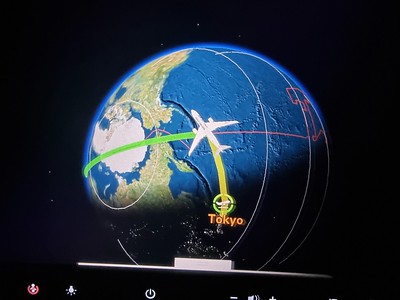
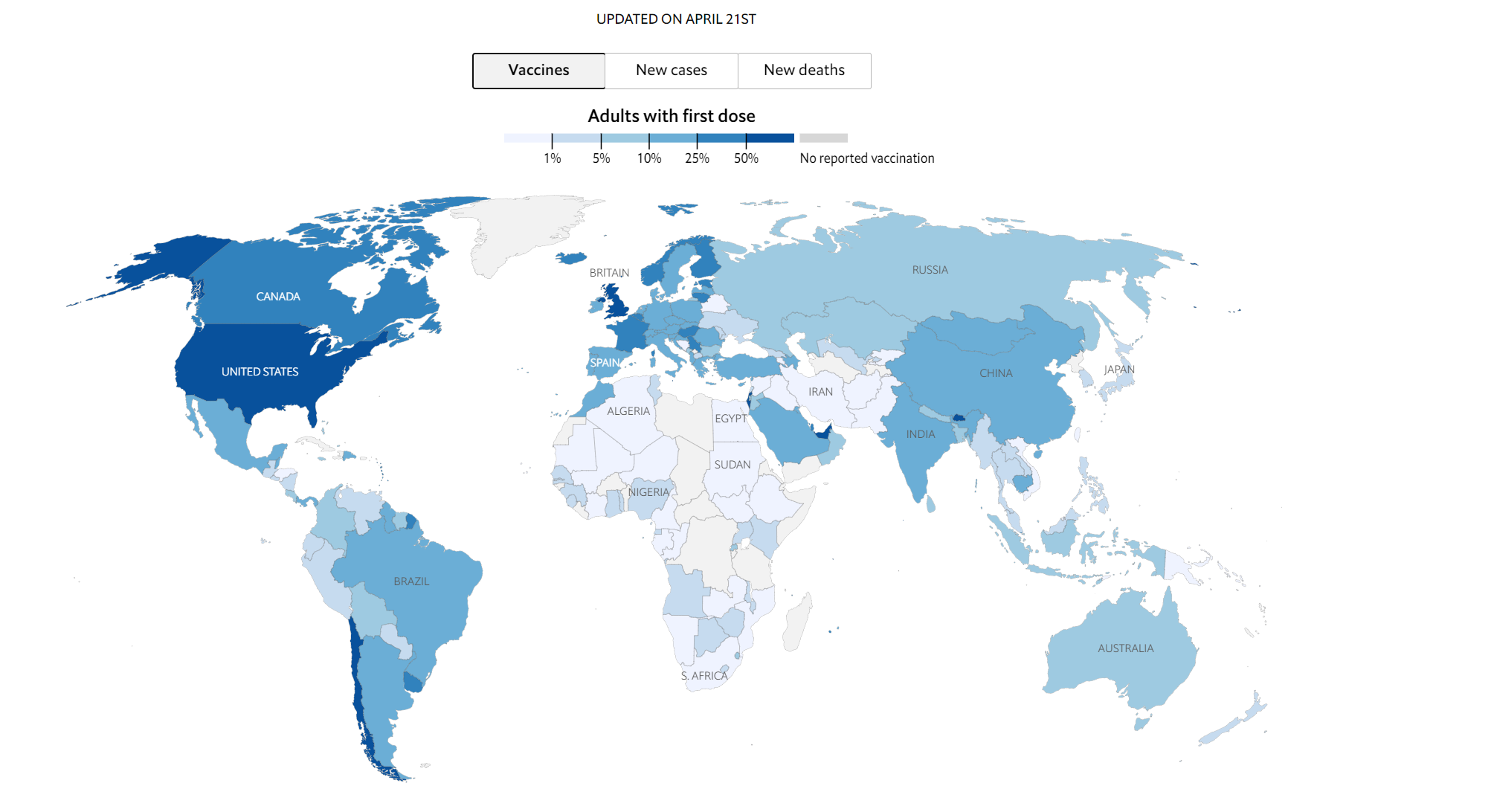
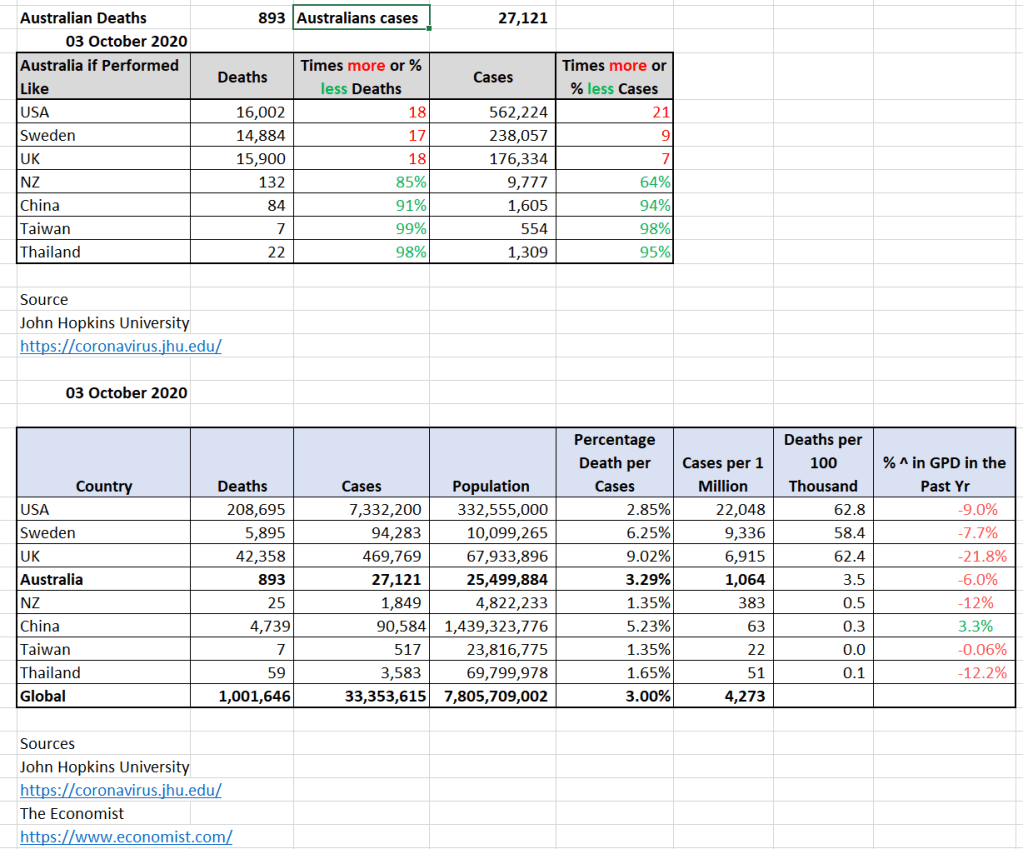
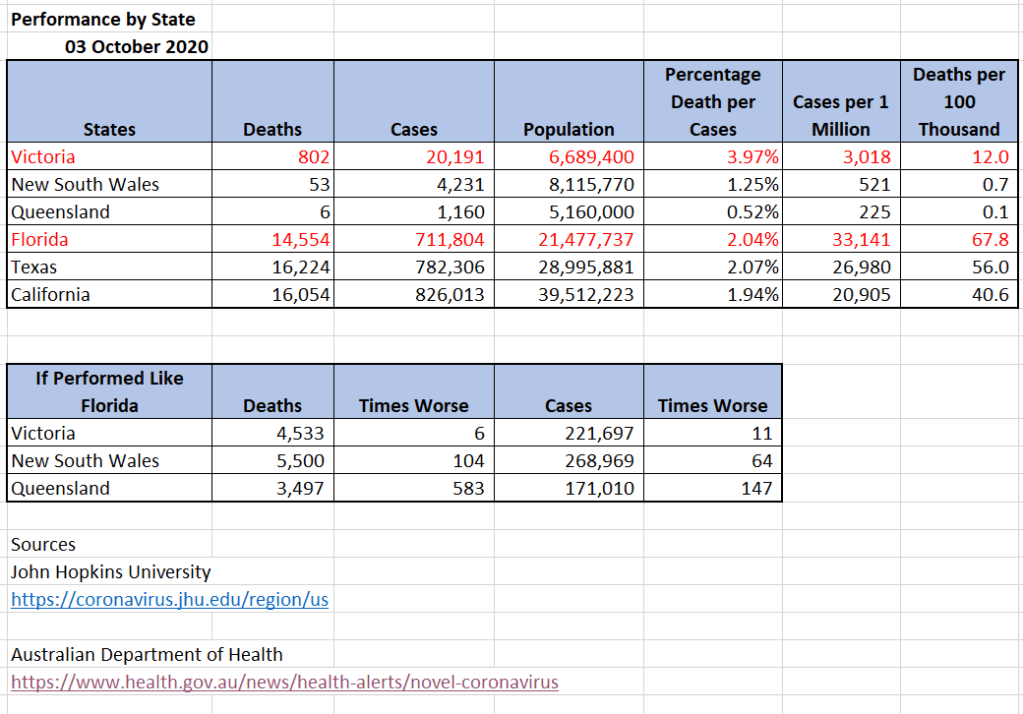

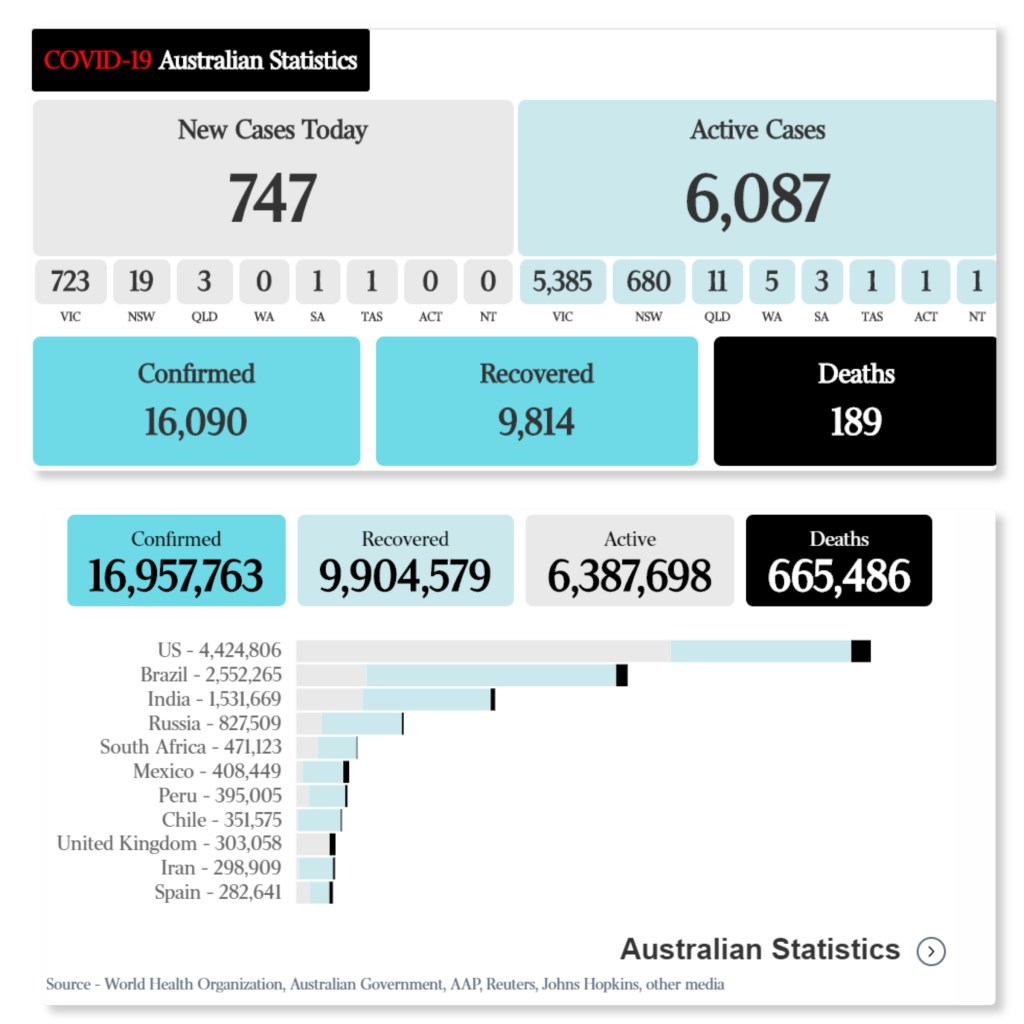
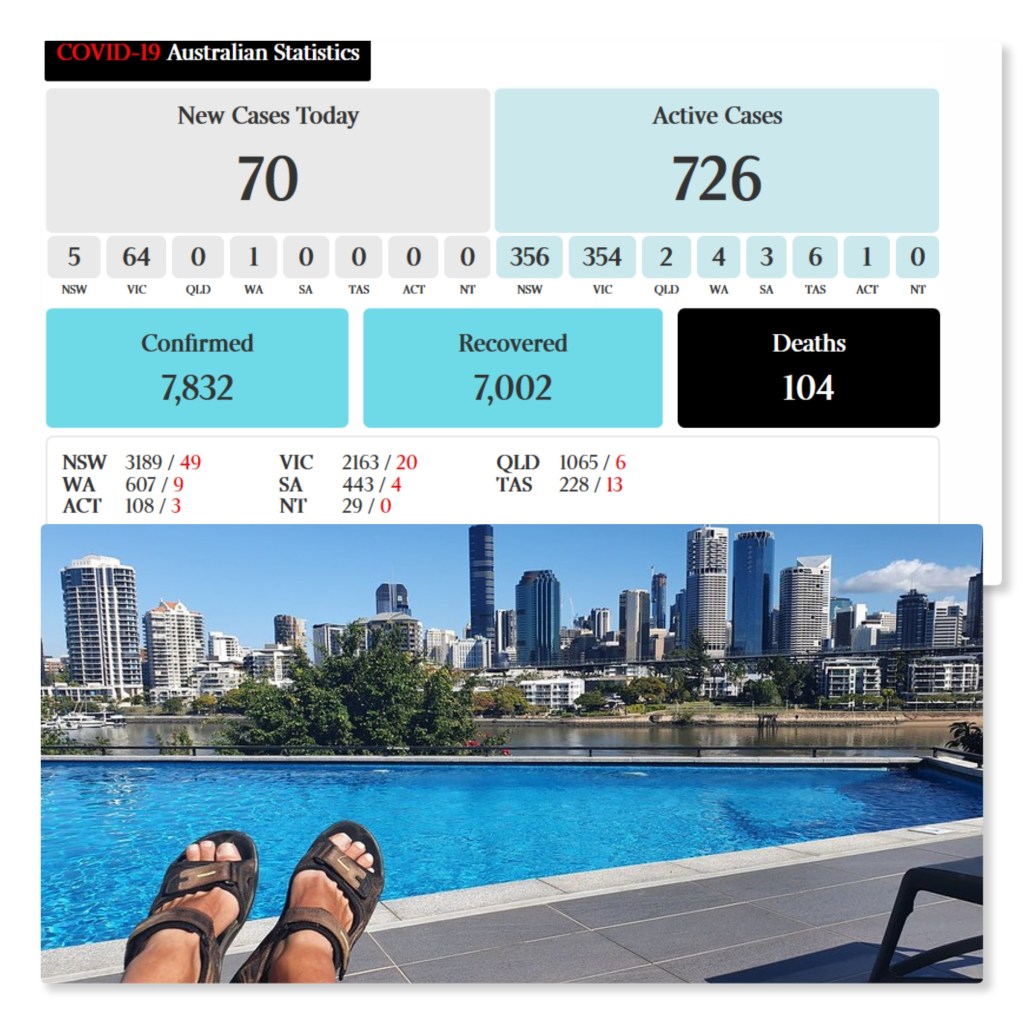
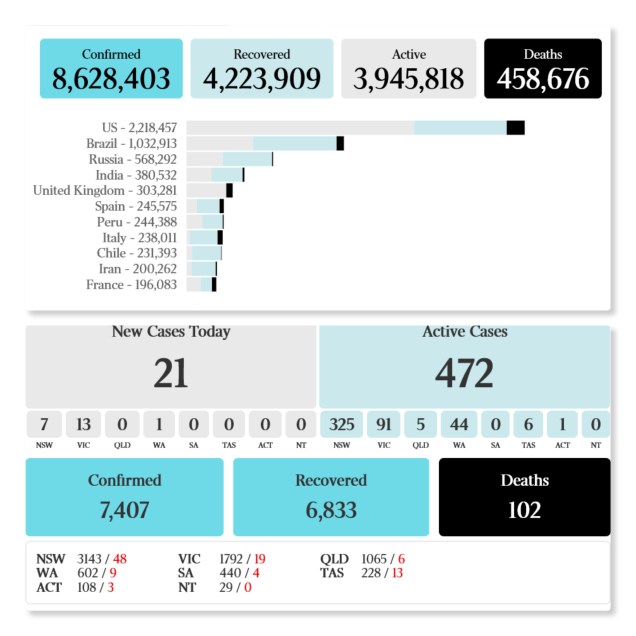
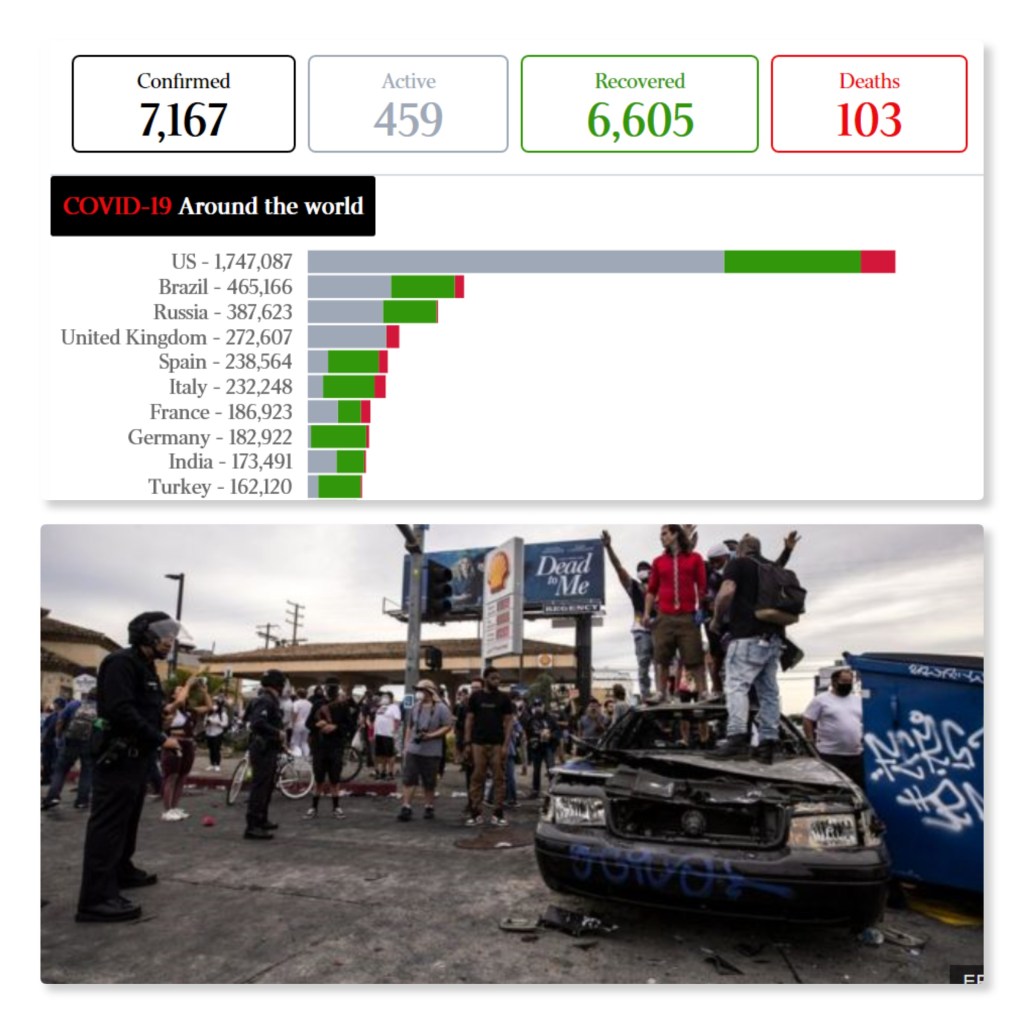

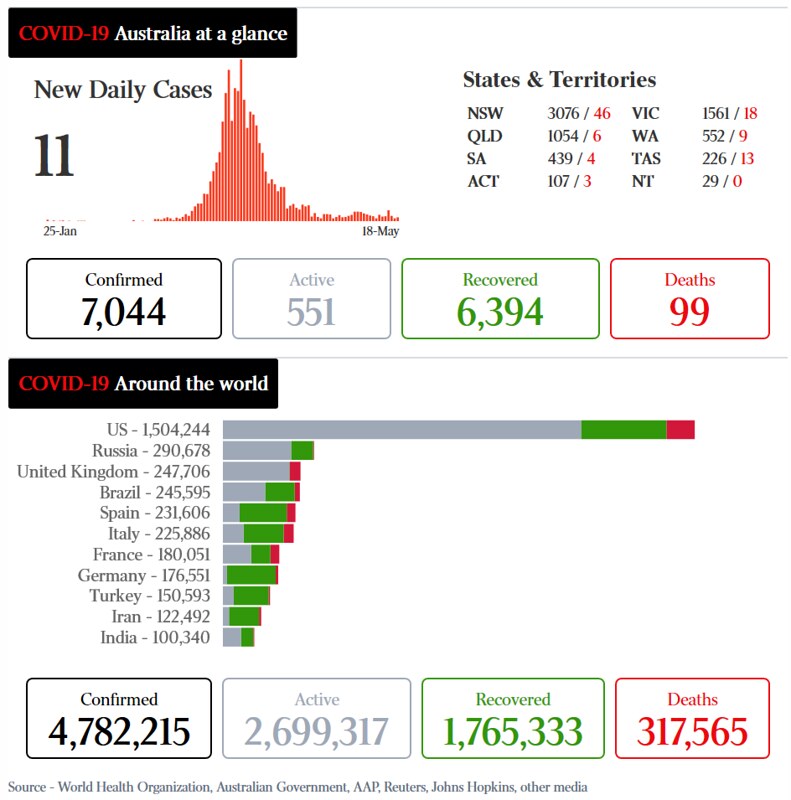
 billrider2013