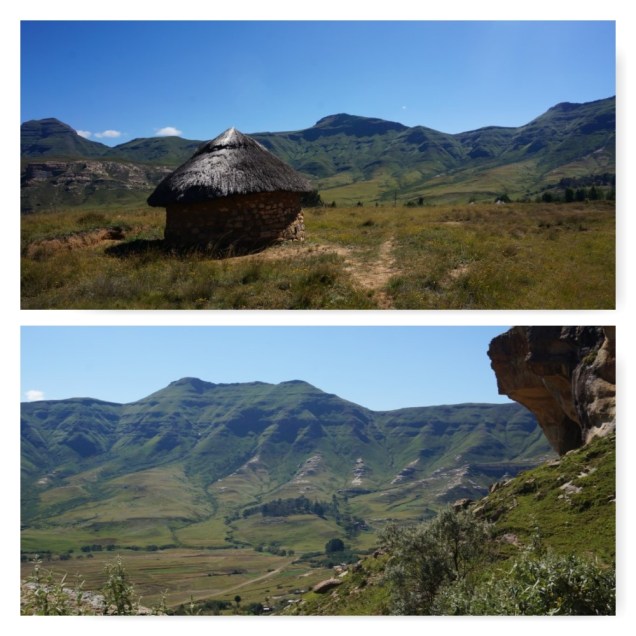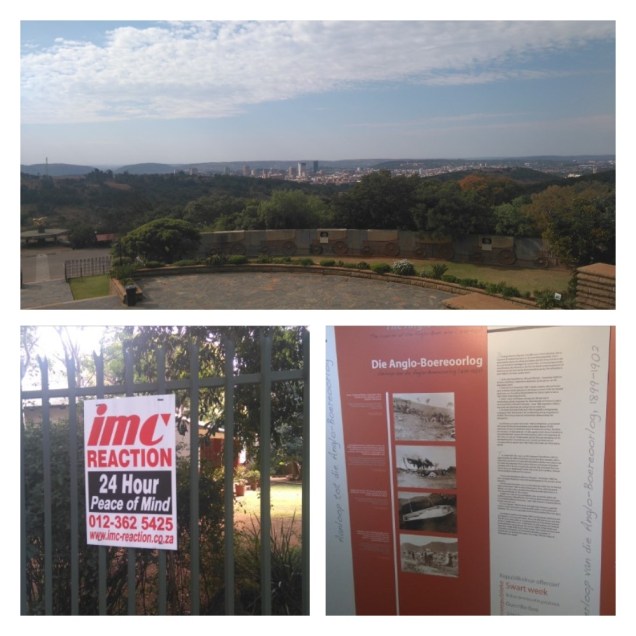
Pretoria

Pretoria

It was a long trip from Chobe back to South Africa.

I had decided to stay in Pretoria rather than returning to Johannesburg.

I had booked into a hostel in the suburb of Hatfield.   The mini bus dropped me off at the hostel. The place turned out to be yet another house that had be converted into a hostel. Others that I had stayed at were in Port Elizabeth, Cape Town, Durban and Johannesburg.  It was a large rambling house with a pool and servant’s accommodation.  I suspect my room was formerly a servant’s room.  It was very small.

Delivered Meal

It was after dark by the time that I was checked in and settled into my room.  The owners told me that “the best way to get a meal at this time of the night was to order a delivered meal…it was too dangerous to walk in the streets at this time”.  I was getting used to this in the RSA.

Guard on Duty

I woke up fairly early.  I noticed someone wandering in the yard outside my room.  It turned out to be a security guard.  It is so sad that the hostel sees the need for such measures.

Gautrain

The next day I decided to check out some of the city.

The hostel was very close to the Hatfield train station which is part of the Gautrain network.  This is a very modern train line that links Pretoria with Johannesburg and the O. R. Tambo International Airport.

I walked up to the station.  As was often the case in the RSA, I was one of very few people walking in the street.  I was certainly the only white person.

I noticed that all of the houses had razor wire, electric fences and signs with the names of the 24-hour security companies that the owners had employed.

Downtown

I took the train into main Pretoria station. I was heading to Church Square which is the centre of the CBD – the Martin Place of the city.

I asked a bloke, who also got off the train, the way to Church Square. He told me that his car parked nearby and that he “would give me a lift”. I asked “how long would it take to walk?”.  He said “it would take less than ten minutes”.  When I said “I would walk”, he looked at me at little curiously.

I walked away from the station to the square.  It was a crowded street.  I felt safe, but I did notice that I was the only white person on the street.  This is in city where ‘whites’ account for over 50% of the population.

At first sight, Church Square is impressive. Victorian era building surround the square – banks and public offices.

A closer look reveals that it is very ‘faded’.  There were also a lot of seemingly destitute people lying on the grass.

I quickly walked around the square and the surrounding shops.  I was a bit of a curiosity.

Forced to Eat McDonalds

I was hungry and needed to eat.  The only place I could find was McDonalds. That about says it all.

Boer Monument

The next place I wanted to see was the Voortekker Monument.  This was built by the Afrikaans South Africans to the commemorate the ‘long march’ of the Dutch Boers from the Cape Province to the Transvaal between 1835 and 1854.

The monument is not far from the CBD.  Not surprisingly there is no public transport to the place. I ordered an Uber Taxis.  The driver didn’t seem to be too keen to chat to me when I told time where   I confirmed where I was going.

The Voortekker Monument is a strange place.  There are strong religious over tones. As most know, the Boers were Lutherans.  They were very pious and conservative.

Nearby to the Monument, there is a museum with exhibits about the Afrikaners time in South Africa.  It covers the Apartheid period. There is one section the celebrates the Afrikaners ‘achievements’.  These include being successful at rugby, Zola Budd (remember the girls who ran in the Olympics in bare feet) and the armaments industry that developed during the period of trade sanctions during the latter part of the Apartheid period.

Uber Drivers not Keen

It took me three attempts to book an Uber taxis from the Monument back to the railway station. The first two drivers called me and asked me to cancel my request.  One said was “too far from where he was”.  The App showed he was less than 10 minutes away.

The third driver seem to be pleased that I was Australian.

Good Restaurant

Back in Hatfield, I went to a restaurant that was recommended by the people who owned the hostel. Like many places I had eaten in while in the RSA, it was very good, and reasonably priced.

I walked back to the hostel in the fading light.

Old Lady fearful of the Future

The next morning, I walked to the nearest shopping centre for breakfast.  I came across an older woman walking her Scottish Terrier.  I was surprised to see a white person the street, let alone on older woman walking alone.

We had a brief chat.  She told me that “she didn’t walk far from her house, but the dog needed to get out”.  She said that “her children had moved to the UK, but she was too old to move”.  She said that she “feared for the future of the country and the young people (take that to mean young whites) who could not leave the place”.

Train to Airport

The wife of the family that ran to hostel drove me to the Gautrain station where I caught the train to the O. R. Tambo International Airport.

Next was Doha en-route to Rhodes in Greece.

Flickr Link

https://flic.kr/s/aHskA5QhUW

About Church Square

https://en.wikipedia.org/wiki/Church_Square,_Pretoria

About Boer Monument

https://en.wikipedia.org/wiki/Voortrekker_Monument

About Gautrain
https://en.wikipedia.org/wiki/Gautrain

Chobe Safari

Chobe

We left Victoria Falls about mid-morning.

The border crossing back into Botswana was singularly uneventful.  It was then a short drive to the town of Kasane.

We set up our tents and had a late lunch.

Into the Park

After lunch a 4WD came to pick us up and take us into the Chobe National Park. My cousin, Dr S the elder, had told me that the Chobe Park was a must do.  As always he turned out the be correct.

The part of the park we visited is on the Chobe on the border with Namibia.

Lots of Animals   

We entered the park before 3.00 p.m. and headed towards the river.  I took one photo and then my Sony Camera, which was only 18 months old, stopped working.

It wasn’t long before we came cross some elephants.  One came very close to the vehicle as it passed us and headed to the river.  Check out the GoPro video on Flickr.  The guide was a bit worried.

In quick succession we saw more animals, including hippopotamuses in the river, more elephants, zebras, loads of antelope, and wildebeest.  We then came across some buffaloes.

It was all happening.

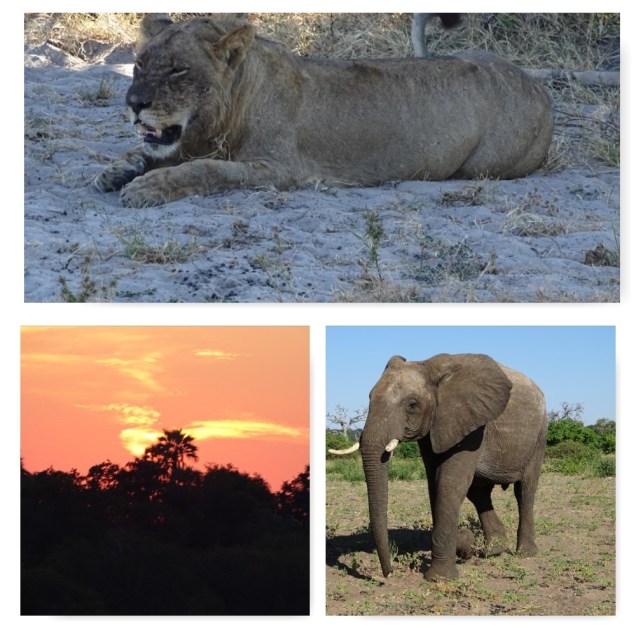
Lions Close Up

As we followed the river, the guide spotted some lions close to the water.  He drove a head.  One the lionesses came close to the vehicle.  Unfortunately, the wide angle of the GoPro does give a real indication of how close she came.

We continued on the guide spotted another lioness in the bushes.  She was eating something.  The guide said it look like a piece of buffalo. He said that “this pride often takes buffaloes. They are very good at hunting a group.  Up to four of the pride work together in an attack”.

As we continued along, we came across more of the lions in the pride.  They were above us on hill.  As we watch a buffalo ran at one them through some bushes.  The guide said that “buffaloes and the lions hate each other.

Rush to the Gate

By this time, it was getting late.  We had to be back at the park gate by 6.00 p.m.

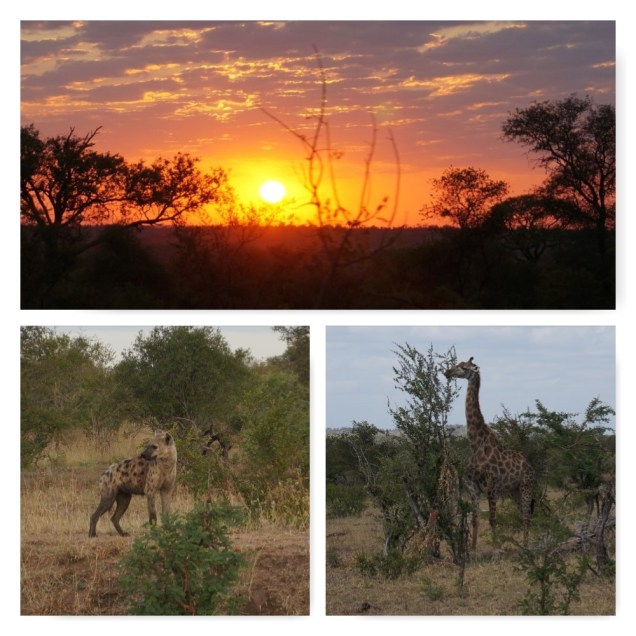
The guide put his foot down as we sped along the sandy track by the river.  We stopped briefly to see the very spectacular sunset.

Copying some Pictures

It was a pity about my camera.  I was, however, able to copy some photos the German Professor in our party took.  They are on the Flickr like.

Flickr Link


https://flic.kr/s/aHskztJgsh


Garmin Link


https://connect.garmin.com/modern/activity/1168149812


About Chobe National Park


https://en.wikipedia.org/wiki/Chobe_National_Park


Walking across the border into Zambia

Zambia

I have mentioned that when I crossed from Botswana into Zimbabwe, I paid for a ‘double entry’ visa.  The reason I did this was so that I could go across into Zambia when I was in Victoria Falls.

Border Fetish

I have to admit to having a bit of a ‘border fetish’.  I suspect that this is probably due to being born and spending most for my life on the ‘island continent’. Naturally we do not have a land border with another country. This can also be said for the other place where I have lived for some time- the UK.

I have been across some interesting borders.

Remembering the Border between East and West Berlin

A very interesting border was between East and West Germany in the divided city of Berlin.  I first made that border crossing in 1983.  In October 1984 I went to East Berlin on a Department of Foreign Affairs trip.

I stayed in hotel near to the ‘Wall’ on Friedrichstraße.  I did not like the food in the ‘East’. I decided that I would eat as often as possible in the West.  This involved crossing the border at the Friedrichstraße train station.  After eating a good meal, I would return across the border at train station or at Check Point Charlie.

Leaving Zimbabwe

The road to the border is quite busy up the point where you enter the Victoria Falls National Park.  After that it is quite quiet.  There are not too many people making the crossing.

Getting through the Zimbabwean border control was uneventful.

The Bridge

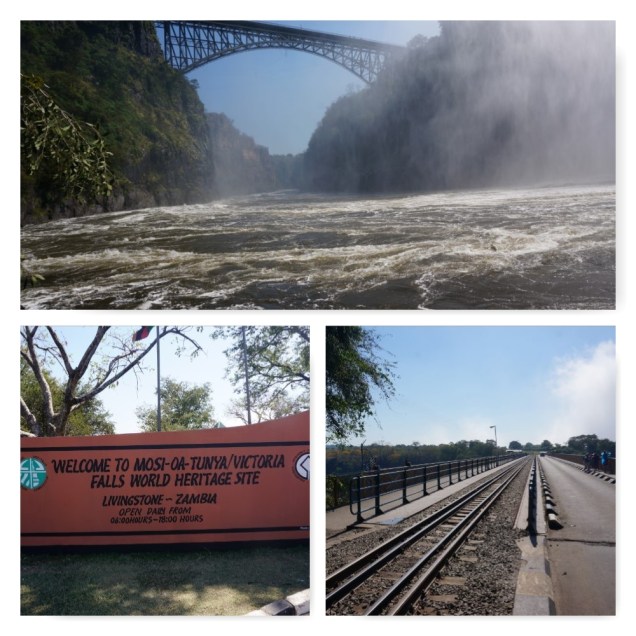
After passing through the border crossing, it is not far to the bridge over the river.

The bridge was the brainchild of Cecil Rhodes and is part of his grand and unfulfilled Cape to Cairo railway scheme.  It was constructed by the Cleveland company.  They built the Sydney Harbour bridge and the much smaller bridge over the Tyne river in Newcastle in the north east of England.   That bridge is the same design as the Sydney bridge, but one eighth the size.

They also built the arch for the new Wembley stadium in London.

Given its age and the lack of maintenance, there are strict limitations of the use of the Victoria Falls bridge by trains and heavy vehicle.  Most of the crossings appear to be by foot or bicycle.

The falls are very close to the bridge.

Into Zambia

Getting through the Zambian border control was quicker than the Zimbabwean side.

Boiling Pot

I didn’t have too much time available.  I had thought about taking a taxi into Livingston, but I didn’t have enough time to do that.

I decided to walk down to see the famous ‘boiling pot’.  It is the point in the ‘Second Gorge’ where the Zambezi River Gorge makes a sharp right turn and has carved out a deep pool which is about 150 metres across.  Check out the video.  It is amazing.

It is quite a steep walk down to the ‘boiling pot’.  The return climb added to my Fitbit floors.

Victoria Falls Hotel

After crossing back to Zimbabwe, it dropped into the Victoria Falls Hotel. It is very up market and super expensive.


Flickr Link

https://flic.kr/s/aHskAD9zLg

About the Bridge

https://en.wikipedia.org/wiki/Victoria_Falls_Bridge


Zip Line at Victoria Falls

Victoria Falls Zip Line

There are a number of activities on offer at Victoria Falls.  These include ‘high-wire’ activities.  These are: bungee jumping, bridge and gorge swings, zip line and flying fox.

The place is, of course ideal for these activities.  It has the iconic Rhodes Bridge which links Zimbabwe with Zambia. There are also the series of gorges that zig zag away from the falls.  These ae very deep with the Zambesi river flowing at extreme speeds below.

I booked myself in to do the zip line.  I was told that it was half way between do the flying fox (very lame) and the gorge swing.  The Swiss Nurse in our party booked herself into doing the gorge swing.  The English bloke and the young Canadian girl booked to do the bridge swing.

I arrived at the Lookout Café at the appointed time to do the zip line.

Norwegian Girls Argue

The taking off points for the zip line and the swing are a short walk from the café.

When I arrived someone had just jumped into the gorge on the swing. Their friends were watching.  They turned out to be a group of Norwegian girls.  When the ‘swinger’ emerged at the top of the gorge there was lot of excitement and animated discussion in Norwegian.

The girl who had just done the swing was shaking like leaf. She told me that “that was just so scary, but so good”.  She tried to stop her hands from shaking by holding them together.  It was to no avail.

Next to swing were two of her friends.  They were doing a tandem swing – tied together.

There was an awful lot of carry on before they finally jumped.  Their screams could be heard above the sound of the water.

It takes some time before the ‘swingers’ are brought back to the top of the gorge.

Even before they were at the top of the gorge the voices of the girls could be heard.  They were clearly having an argument.

As they were being unshackled, the argument continued.  Their friends were standing next to me and were in hysterics.  The ‘swingers’ walked to towards us and switched from speaking Norwegian into English: “we were supposed to jump at the same time….it was your fault the we didn’t… no it was your fault…can’t you count to three?…..”.  It went on and on.

Apparently because they didn’t jump at the same time, they immediately started to spin and could not stop spinning. Not only did they have a 120 plus metre free fall drop followed by the swing, but they were also spinning like a top.

After they had calmed down, I asked them “why did you switch to speaking English.  They told that they I assumed that I would be able to understand English and that it would have been rude to keep speaking Norwegian.

It was all very amusing

My Turn on the Zip Line

Next it was my turn to do the zip line.  It is like a flying fox, but drops down into the gorge and up the other side.

I was told by one of the operators that I would be travelling at 80 kilometres per hour.

The photos and the video show what happens.

It is a bit of thrill, but not nearly as scary as the swing.

The video shows how quickly it is all over.  It does however understate how low to the water the line goes.

You can see from the photos and the video that one of the operators came to collect me.  Some people who have seen the photos assumed that something went wrong and I was being rescued.  That was not the case. It is simply how the thing works.

Swiss Nurse Jumps

Next to do the swing was the Swiss Nurse from our party.  As I have previously noted, she is a very assuming girl.  Some of her comments before and after the swing were priceless.

There is a great shot of her on Flickr at the start of her free fall.

There is also a video of her reaction after the jump.

French Bloke is a Show-off

After the Swiss girl had jumped, it was the turn of a French bloke.  He had booked to do the two swings, the bungee jump and the bridge and the zip line.

He was clearly a serial jumper, having done these sort of jumps around the world.  He asked me to take a ‘slow motion video’ of him leaving the swing platform using his Apple Phone.  To my amazement I actually did a good job of taking the video.


Flickr Link (Videos)

https://flic.kr/s/aHskzTozur

Flickr Link (Photos)

https://flic.kr/s/aHskA7NAzk


Wild Horizons Link

http://www.wildhorizons.co.za/

Helicopter Ride over Victoria Falls

Victoria Falls Helicopter


In the evening of our first night at Victoria Falls we had dinner at the camp.  Our guide and driver, David confirmed that he is also a really good cook.

An Upsetting Song

After the meal a group of blokes in ‘native garb’ appeared.  They danced and sang some songs – some in the local language and some in English.  The last song was “Swing Low, Sweet Chariot”.  I know that this is an American negro spiritual song, but it is also sung by English Rugby supporters. This can be very upsetting for a Wallabies supporter.

Wake up for the Helicopter Ride

One of the activities that had booked to do in Victoria Falls was a helicopter ride.  My cousin Julie had sent me an email telling me that is a ‘must do’.

A mini bus picked me up at the camp gate we headed to the heliport.

Remembering a previous ride

This was to be my second ride in helicopter.  The first was when I was working for Caltex. The company operates a pipeline that runs from the Kurnell Refinery through Silverwater and up to Newcastle. Part the environmental conditions for the operation of the pipeline is that it has to be subject to periodic visual checks. This done from the air. I had opportunity to take a ride in the helicopter than performs the checks.

We flew from Bankstown airport across the harbour and up the coast to Newcastle.  I can recall that the helicopter we incredibly noisy.  I also remember that it was quite a different experience to flying in light plane.

Buying an Upgrade

The mini bus arrived at the heliport and  we taken into a building.  The other passengers, and Swiss couple and French man and woman, had arranged to have ‘up-grades’. It was explained that this involved an extended flight that would include flying over the gorge downstream from the falls and a trip up the river.

It decided to take the upgrade.

The flight

Once the payments we made for the up grade were made, we were off.

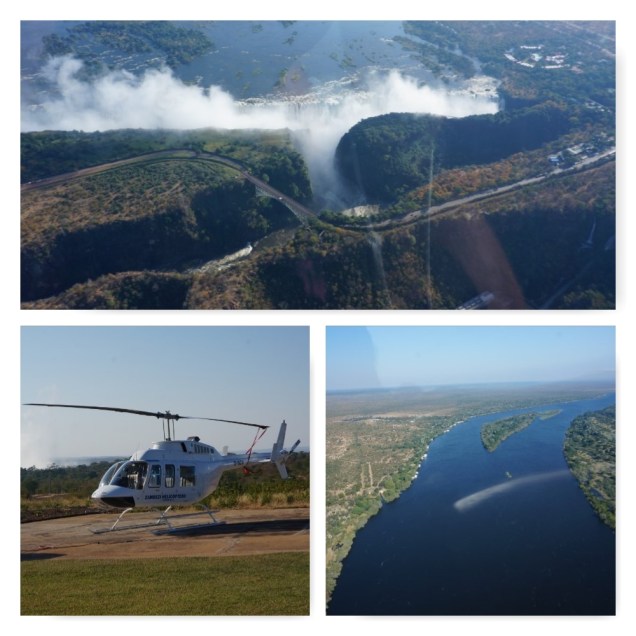
We headed straight to the falls.  It was an amazing experience. You really get to see the falls in a different perspective than you experience on the ground.  You see the wide river leading to the falls, the spray billowing into the sky, and rapid flow of the water through the tight gorge zig zagging downstream.

We made a couple of passes over the falls before following the path of the river down the gorge.

The last part of the flight involved flying up the river.  We then headed slightly away from the river to see some herds of Zebra and elephant. At various times the pilot made some very sharp turns and swooped down so we could get a better view.

Unfortunately, my photos and videos probably don’t do this part of the trip justice.

Good Tip Julie

To sum up: cousin Julie was right.  The helicopter ride was great.


Flickr Link (videos)

https://flic.kr/s/aHskA1kVBp

Flickr Link (photos)

https://flic.kr/s/aHskwPHHpr

Getting Wet at Victoria Falls

Victoria Falls

After crossing the border from Botswana into Zimbabwe we drove to past the Victoria Falls Rest Camp where we were to stay.

Souvenir Sellers taking a Risk

We drove down a dirt road to see a large tree.  It was fairly interesting.  However, what was more interesting was a group of blokes who emerged from the bushes.  David our guide  explained that they were “illegal souvenir sellers”.  Apparently anyone wanting to sell souvenirs in the official markets in the town has to pay a high fee.  These characters get around this by plying their wares in this road.

David explained that using this location comes with risks.  Firstly, they ae liable to be caught by the police and secondly they run the risk of being attacked by a wild animal.  David told the in the last month one of the sellers was attached and killed by an Elephant.

After seeing the tree, we returned to the camp.  Selous has ‘permanent’ tents set up in the camp. This saved us having to pitch our tents.

Lots of Activities on Offer

Over breakfast our guide David explained a bit about the town of Victoria Falls.  He said that it “was very safe”.  There are a large number of police and they are “looking after the tourists”.  He also said that, like the rest of Zimbabwe, there are a lot of ‘secret police’ informants’ basically spying on the people and looking out for critics of the government.

After having breakfast, David introduced to a representative of Wild Horizons, a travel and ’experience’ operator in Victoria Falls.  There was a bit on offer: river cruise, helicopter rides of the falls, bungee jumping, zip-line, flying fox and bridge and gorge swings.  Each of the party bought something to do.

Victoria Falls

Once we had our ‘activities’ sorted, it was time to see the falls.  We walked through the town to the entrance of the National Park.

We paid the fee and entered the park. There is a display giving details of the falls and comparing them with the other big falls – Niagara and Iguassu.  These comparisons are also at the link below. There are lots of ways to determine which are the biggest falls.

Spectacular

I was with the German speaking girls. The Swiss nurse was very amusing the whole trip.  She was in good form this day.

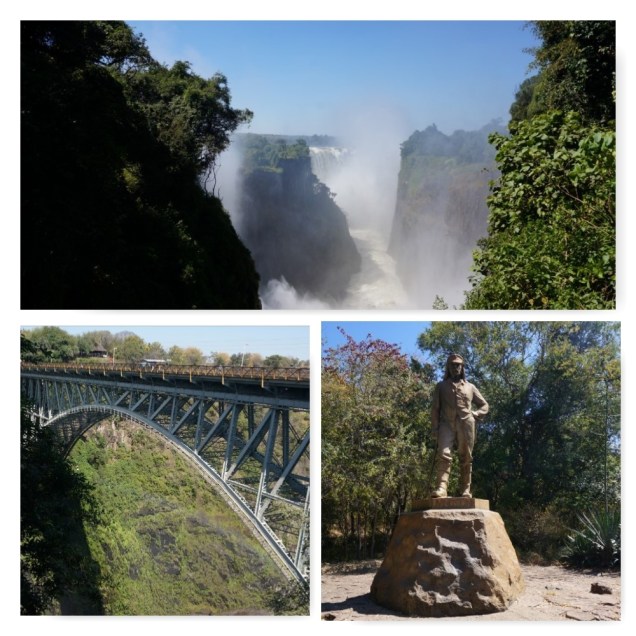
There are a number of lookout points (I think 16 in all).  Each gives a different perspective of the falls.  You can see the river prior to the falls, one of the gorge falls and the main falls).

At a couple of the view points for the main falls, you get very wet. Check out the Flickr video.

Statue of Livingstone

There is a statue of the ‘European’ discover of the falls, David Livingston.  He named the falls after Queen Victoria.  She must have more places (e.g. the State of Victoria), streets and parks etc. named after her than anyone else in history.

The Bridge

At one point in the park, you get a very view of the famous Rhodes bridge that crosses the Zambezi River and links Zimbabwe with Zambia.

Very wet

I was still saturated when we left the park.  I took the short to the Gorge Lookout Café for lunch. It was the most expensive meal I have had for months.  Having to pay in USD made it a double shock.

Being offered Million Dollar Notes

On the way back to the camp after lunch, I was approached by numerous characters want to sell worthless Zimbabwean bank notes.

These notes are from the period of hyper-inflation up until 2009, when the country switched to the USD.

There is now talk that Zimbabwe will introduce ‘bonds’.  These will be tied to the USD and will come in paper form.  They will effectively be money.  They have already introduced small denomination ‘bond’ coins used in giving change.

I suspect that the paper ‘bonds’ will result in the high levels of inflation again.

Remembering my Trip in Mid 2016

As I walked along, I remembered my first visit to Zimbabwe in 2016.  This was part of a Foreign Affairs trip that took in London, Lisbon, Madrid, Lagos, Nairobi, Addis Ababa and Dar Es Salaam.

I was due to return to Australia after Dar  Es Salaam.  However, before I was due to leave, I received a cable instructing me to fly to Harare. There had been a fraud committed at the High Commission.

I didn’t see much of the city apart from the inside of the hotel, the High Commission and the residences of the staff.  However, I meet some ‘white’ locals and was able to walk the streets.

This was the early days of the Mugabe regime and the place was yet to fall apart.

Another memory of that trip was trip a precipitous fall in the AUD that followed Paul Keating’s ‘Banana Republic comment.  My recollection is that the AUD was worth USD 0.75 when I left and got my Travel Advance.  After the comment which was made when I was in Addis Ababa it fell to USD 0.53.


Flickr Links (photos and videos)

https://www.flickr.com/gp/twwilko_photos/76816U

About Victoria Falls

https://en.wikipedia.org/wiki/Victoria_Falls

Keating’s Banana Republic Comments

http://www.theage.com.au/news/business/20-years-from-keating-what-price-a-banana-now/2006/05/14/1147545209134.html

Victoria Falls Days 1 and 2

To Botswana and into Zim

After the Kruger Park part of my tour I stayed in hostel on the outskirts of Johannesburg. There was some discussion with Eugene in the Selous Safari office as to when I would be picked up for the trip to Victoria Falls.

The owner of the hostel confirmed my thoughts- “Eugene is a dill”. The owner told me that “he has never old him the correct numbers to expect to be staying at the hostel – surely that can’t be difficult”.  It seems that Eugene finds most things difficult, including telling the time.

Anyway, it was finally agreed that I was to be picked up a 5.00 a.m. The driver, David arrived 10 minutes early.

We headed into the Maboeng Precinct to collect some more passengers. They turned out to be an English Bloke in his early twenties who works for Transport for London, a young Canadian student, a Swiss nurse and German dental technician.

Off to Pretoria

We head out of Johannesburg for Pretoria.  Once into the city, it immediately reminded me a bit of Canberra.

We went into the suburb where a lot of the embassies are located.  Our next passenger was German bloke who is an Economics Professor.  He was in Pretoria delivering some lectures at the university.  He was taking advantage being in RSA to do this safari.

Long drive

With all the passenger on board we headed north towards the Botswanan Border.  It was a very long drive. The journey was broken with meals stops, comfort stops and a stops, short of the border, to buy some supplies.

Crossing the Border

Crossing the border was uneventful, however I did notice that the window for the Diplomats was also where the ‘Retirees’ were processed.  I guess these two groups have similar characteristics.

Rhino Sanctuary

It was late in the evening when we arrived at the Khama Rhino Sanctuary where we were to stay the night.

David checked us in at the office at the main gate.  We then drive on a very sand track to the camp ground, which turned out to be over 3 kilometers from the main gate.

We had to pitch our tents. This was a bit of a slow process in the dark.  Once that was done, David cooked a meal.  This was a great effort considering he been up since before 2.00 a.m. and had driven all day.

Wake up to be the Animals

We were woken up before dawn.

One of the park Rangers arrived in 4WD.  We were off to see some rhinoceroses at other animals. It was quite a long drive through quite dense low trees and bushes before we emerged in to an open area.

The Ranger pointed out a rhinoceros in the distance. He said that we would see it later and we drove on. We came across some Zebra and lots on antelope.

As we continued on we came across some wilder beast. One much to the amusement of the Swiss nurse decided to relieve himself.  This was a very long process.

We turned back to the where the Ranger had spotted the rhinoceros.  Has had fully grown horn.  There is no need to take the horns off in the park, as there is no poaching.  The Ranger told up the “the military deal with poaches”.  I think we can guess what ‘dealing’ means.

As we moved on we came across a herd of springboks.  At various times they would suddenly start to run in one direction, leaping into the air as they went.  They would then turn and head back to where they had come from.  The Ranger explained that they were “teaching the young how to run and jump.  This is how that they escape from lions and leopards.

We then came across two young rhinoceros.  One was on the ground.  The other was nudging it.  The Ranger said the one on the ground was a female and the other, a male, was trying to get her to stand.  It was funny to watch.

As we headed back to the camp, we crossed lots of different tracks.  It would be very easy to get lost in the park.

Back at the camp, David had cooked breakfast.  It was really good.

Heading further North

After breakfast we were back in the bus and heading north.  It was another long day of driving.

We stopped for lunch at a shopping centre.  The most popular place to eat seemed to be Wimpy.  This was because it had internet Wi Fi , not because of the food.

Elephant Sanctuary

Our camp this night was at the Elephant Sands resort.  This is a fairly flash place. We had a meal in the restaurant.  It was very good food.

The main entertain was a ‘Bush Baby’ a.k.a Gagalao – tiny monkey.  It was very tame and played with the guests.

Very Early Start

We had a very early start in the morning.  David explained that he wanted to get to the Zimbabwean border as soon as possible to avoid being delayed.

As we approached the border, we came across a large number of trucks.  These trucks were headed to Zambia.  The Zambian border is very close.  David explained that trucks the trucks have to wait up to a week to cross the border as there is no bridge and there are delays on the ferry.

Border Crossing  

The border crossing into Zimbabwe turned out to be relatively painless.  You are required to purchase a visa in USD.  There ae a number of prices, depending where you are from.  Surprisingly Australia is in the cheapest category. The UK and EU citizens pay the mid-range.  Much to the horror of the Canadian girl, there is a special higher price for them. Somehow the Canadians must have upset Mugabe.  I suspect it was Harper.

I bought a ‘double entry’ visa.  This would enable me to cross over to Zambia while we were in Victoria Falls.

Once from the border we were soon at Victoria Falls.

We had breakfast and we ready to head off to see the falls.

Flickr Links

https://flic.kr/s/aHskwNWfSj

Link to Khama Rhino Sanctuary

http://www.khamarhinosanctuary.org.bw/

Elephant Sands

http://www.elephantsands.com/

Bush Baby

https://en.wikipedia.org/wiki/Galago

Kruger National Park


Kruger

I had booked a tour to the Kruger National Park with Selous Safaris.  My dealings with Eugene in the office did not give to me too much confidence in the company.

The bloke seemed to be a bit of dill.  He seemed that he could not deal with more one issue in a single phone call i.e. make the booking, pay the deposit, pay the balance and receive details of the pick arrangements.  All these steps required separate phone calls and/or emails.

I subsequently found in discussions with others, that I was not the only person who found it difficult to deal with Eugene.  In fact, everyone I spoke to found it difficult to deal with him.

It is fortunate that Eugene has a minor role on the company.  The guides and the drivers I dealt with were excellent.

Very early start

I had to get up really early to start the tour.

A small car appeared in the street outside the hostel.  The driver asked for “Thomas”.  That is first name in my passport.

I immediately assumed that the car would be taking me to the tour bus.  As it turned out, the only people on the tour were myself and a young Austrian girl called Hanna.

Fog

The driver, Joe-Joe (a double barrelled first name), explained that he would be taking us part of the way to the Kruger National park, where we would be met by another driver who would taking us the rest of the way.

It was relatively easy to get out of Johannesburg given the early start and fact that it was Sunday.

The road was wide sometimes six lanes. At one point we came across some very thick fog.  Joe-Joe explained that accidents as a result of the fog were frequent. I could see why.

Stop for breakfast

We stopped for breakfast in a service station.

As we continued on, we passed by some very large coal fired power stations.  Tony Abbot would love seeing them.

As we travelled north the road changed from dual carriage way to progressively narrower and narrower roads.  The condition of the roads also declined.  There were signs warning of pot holes.  Those signs are there for good reason; there were lots of pot holes.

Slow puncture

We stopped at service station to get some petrol.  The Joe-Joe checked the pressure in the tyres.  As he suspected, we had a slow puncture in the front offside tyre. He decided to continue on to where we would be meeting the Selous bus heading from Kruger back to Johannesburg. The driver of the bus would be swap with Joe-Joe and take us on Kruger.

We met Moses the other driver about 20 kilometres further on.  Not fixing the ‘slow puncture’ turned out to be the classic ‘hospital pass’.  It was now a ‘fast puncture’.  Moses stopped in the next town to get it fixed.

The camping ground

We finally got to the camping ground where we were staying at around 4.00 p.m.  The place is outside the Kruger National Park and is next to two ‘private’ game parks that adjoin the National Park.

The Selous company has ‘permanent’ tents at the camping ground.

Once settled in, we headed off to an Animal Rehabilitation Centre not far from the camping ground. Before touring the centre, we were given a lecture on why it had been established and the work that it does.

Animal Rehabilitation Centre

The centre is privately funded and looks after animals that have been rescued.  They have typically been injured by poachers or hit by vehicles on the roads.  Many of the animals have been caught in snares.  Most of the animals cannot be released back into the wild because they have become accustomed to humans.

Cheetah

After the lecture we were taken on a tour of the centre.  The first stop was an encounter with a Cheetah. It has been rescued as an orphan and has reared at the centre. Naturally it is used to humans. Apparently Cheetahs do not see fully grown humans as prey.  This particular animal was very tame.  It was brought out of its enclosure placed on a table.  The visitors were encouraged to pat it.  It seemed quite happy to be patted, and purred like a domesticated cat.

Badgers and other Animals

The next stop was an enclosure will a badger.  The African badgers are much than those found in the UK.

Next we were taken to see some eagles and vultures. It was sad to see them locked up in cages, but I guess they are still alive.

We also saw two lions and two leopards.  The leopards were very lively.  I was amazed how difficult it was to see them when they climbed into a tree.

The last stop was to see some Wild Dogs.  Apparently they are really under threat in the wild mainly as a result of disease.

Early start

Back at the camp, we had early dinner.  We were to awake at 4.30 a.m. Waking up that early isn’t in my skill set.

The drive to Kruger Nation was very chilly.  It was a good job that we were provided with thick blankets. We entered the park through the Orpen Gate.

Our guide Lloyd, explained that we would be travelling as far as we could to maximise the chances of “making sightings” [of animals].

We headed off and soon saw lots of antelope and giraffe.  Lloyd told us that it was “not usual to see so many giraffes in the same area.

At one point we came across a hippopotamus in a river.  They rarely get out of the water during the day.  This doesn’t make them very good photo opportunities.

We stopped at point that overlooks a major river that runs through the park.  At this time of the years that river is dry.  However, it does have water holes.  These attract elephants.  We saw two groups of elephants making their way down the river.

Lunch

We stopped for lunch at camp in the park.  As well as being our guide, Lloyd was also our cook.  He did a really good job.

The camp we had access to the internet.  I received a Facebook message from ‘George from Georgia’ who I mentioned in my Coffee Bay post. George had also been on the same Kruger Park Safari.  He was enquiring as to who was my guide.  I messaged back the it was Lloyd.  It would appear that George and Lloyd got on well.

Don’t Take Directions from an Afrikaans Woman

As we left the camp after lunch, Lloyd stopped the 4WD to chat with some women in a car.  He asked have they had “had any sightings”. He switched to speaking Afrikaans.

As we drove off, Lloyd told us that the women had seen some lions and had given him the directions where to go.  He did say however that “the direction didn’t seem right”.

We continued down the road and turned right where the Afrikaans women had told us to go. They had said that the lions were near a bridge.  After a long drive we came to a bridge.  There were no lions to be seen and there was no other vehicle in sight. Other vehicles are a sure sign that there is something interesting to see.

Lloyd came to the conclusion that “we had been sent to the wrong bridge”.

We retraced our steps to the point where we had tuned right and this time we turned left.  We soon came across a large number of vehicles near a bridge.  We had found the lions.  There were in the distance, but still interesting to see.

Buffalo

On the way back to the gate on our way home we saw a large group of buffalo.  We you see them wandering along. It is difficult to appreciate that they are very dangerous.  They do, however attack humans and kill.

Back late Dinner

It was dark by the time that we got back to the camp.  We had dinner and an early night in preparation for another early start.

Great sun rise

As we headed back to the National Park, we drove towards a great sunrise.

Hyena Clan

As we entered the park, Lloyd spotted a hyena.  He stopped the 4WD.  As it turned out, there was more than one animal, it was clan.  There were some on one side of the road, and others on the other side of the road.  They were very active.  Lloyd told that “they may be two clans having a bit of an altercation over their territories.  Animals sometime use roads as boundaries to their territories.

As it turned out, the hyenas seemed to be all members of the same clan.  However, it was interesting to see a large number together and the hear then communicating with their unique, ‘laughing’ calls.

Rhinoceros

Shortly after seeing the hyenas, we saw a rhinoceros.  It was a bit far off.

After than we drive for a long time without seeing much except some buffalos.

Lunch

We stopped for lunch at a camp.  Over lunch we chatting to South African visitors.  They told us that they were regular visitors to Kruger.  One bloke said that “it becomes additive; you never tire of seeing the animals”.

They also said that you can go for days “without seeing much and then suddenly you have a lot of interesting sightings”.  They told us the on this visit they had seen a “white lion and a leopard and its cub.

Not much to See

After lunch we drive a lot without seeing too much except some giraffe and baboons.

Rhinoceros Reserve

We got back to the camp in the late afternoon.  The plan was to visit a rhinoceros reserve near to the camp. Lloyd received a call from the reserve. They told him the “that there has been a poaching incident” and our visit would have to be delayed.

Apparently “incidents are common in the reserve”.  The owners however, “do not tell much about what happened.

After a couple of hours, were told that we could enter the reserve.  By this time, it was very dark. There was also storm brewing.

Shortly after entering the reserve we saw some rhinoceros and buffalo feeds on saw straw that the operators of the park put out for them.

We then drove around for about an hour.  Lloyd had a spot light and pointed out some animals.  He also explained that the cats, like the leopards “did not like the rain and wind and would have gone to ground”.  There was no much chance of seem them given the brewing storm.

Chat about the state of the RSA

Back at the camp we had dinner and few wines.  Lloyd was not working the next day and didn’t have to have an early night.

After a few wines he opened up about thoughts of the state of the RSA.  I will probably include something about that in a later post.

Blyde Canyon

We had a fairly early start to our trip back to Johannesburg.

The route took basically the same we took to get to Kruger, however on the way back we stopped at Blyde Canyon.  It is not as big at the Grand Canyon in Arizona, but it is very spectacular.

Early Night

I was dropped of a hostel in the outer suburbs of Johannesburg.

The owner of the hostel thought it was important that I knew the colour of the other guests.  Apparently there were “four whites, two coloureds and four blacks”.  The blacks were in the same room”.

I had a very early night as I was due to wake up at 4.15 a.m. for the pick for the Zimbabwean part of the safari.

Flickr Links

https://flic.kr/s/aHskBP22dM


https://flic.kr/s/aHskA5RXtY


Johannesburg and Soweto

Johannesburg

The Baz Bus left Drakensberg about mid-day. We headed west and up.

After passing through the Drakensburg mountains we were on the high plains.  Again the landscape was broad acre farming reminiscent of western NSW.

Dodgy Service Station

We stopped at a service station about 100 kilometres from Johannesburg.  The driver suggested that we “do not use the ATM in this place”.  In some respects, I think that warnings like this are a bit over the top. However, they must be based on some experience.

When we did stop, I went into the service station to ‘use the facilities’.  I did note that ‘the facilities’ had a guard.  Maybe the ‘do not use the ATM’ advice was valid.

Traffic Jam

I had mention previously that the Baz Bus drivers were keen to get into Johannesburg as soon as possible.  This was so that they could beat the worst of the peak hour traffic.

Well it seems that ‘peak hour traffic’ lasts much more than an hour.  It seemed to take us for forever to get from the outskirts of the city to the Brown Sugar Hostel that is about 5 kilometres from the CBD.

I had booked a single room at the hostel.  This turned out to be at cottage at the back of the main building.  The main building is an old house, properly better described as a mansion.  It is big enough to easily covered into a hostel.  The place has a pool, albeit it needs a bit on maintenance.

I was told by the manager of the hostel that the house used to be owned by the Mafia.  I guess that is true.

The staff advised that no evening meals were being offered “because it was Thursday”.  They didn’t explain what the relevance of Thursday was with respect to cooking or not cooking meals.

They said that they could order a take away meal from a “local outlet”.  I ordered chicken and vegetables.  It arrived in 10 minutes. It must have been ‘very local’.

Into Maboneng

I spent the morning doing ‘administrative stuff’, including trying to sort out my annual Superannuation contribution. I am wondering why I pay any fees to the fund. They seem to as close to completely incompetent as it is possible to get.

It was late in the afternoon when I finally headed into town for ‘lunch’.  I had heard about the ‘Maboneng Precinct’.  It is an area near to the CBD. It is not unlike other cities – London, Sydney and Melbourne –  an area near to the CBD’ that has fallen into decay and is now in the process of being ‘gentrified’. The reason for the fall into decay in Johannesburg’s case are probably a little more complex than is the case with other cities.

Using Uber

Anyway I used Uber to take me from the hostel to the Maboneng Precinct.  Having to use Uber is  an example of an issue with travelling in the RSA.  Albeit it is a short distance from the hostel to the Precinct, I could not walk. I was forced to use an Uber taxi.

Just as an aside, the ‘taxis’ service is run from San Francisco,  and for tax purposes the company is domiciled in the Netherlands.  The cars used by the Uber drivers are German – Mercedes and Audis.

The thing is an excellent example of the impact of globalisation.

On my way up from Durban, I had listened to a podcast about your ‘social made reputation’. Uber was given as an example.  Apparently, the drivers rate the customers in the same way that the customers rate the drivers

On the ride to the Maboneng Precinct, I asked that driver what my rating was.  He told me that it was “5 out of 5”.   I guess that is pretty good.

The route into town took past the Ellis Park Rugby stadium.  Like many stadia nowadays, it is sponsored by Emirates Airlines.

Good Meal

The Maboneng Precinct has lots of trendy restaurants.  The one I picked was very good.  It also served good craft beer – Butcher’s Pale Ale.

City Tour

Next day I decided to take a hop on hop bus tour of the city. These are often a good way to acquaint yourself with a new city.  In Johannesburg’s case you really do not have an option.  It would be very difficult, actually impossible, to get around the sights on foot and public transport.

I took an Uber taxi to Park Station, the closest stop for the bus.

The tour took us around the CBD.  The commentary was interesting. It talked about the CBD becoming “vibrant with outdoor stalls and people selling all manner of goods”.  I think another view would be that the previously ‘white area’ had been overrun by the blacks’.

Tall Tower

The bus stopped at the ‘Africa Tower’.  I got off the bus with a Chinese woman.  We were met by a guide who works for the bus company.  He explained that “it was his job to look after us as this was not a safe part of the city”.

The guide explained that the tower was part of complex that included a hotel, that used to be the best and most popular hotel in Johannesburg.  However, this part of the city had changed.  The hotel closed “owing a lot of tax”. The building is now used to house the Taxation Department. A bit of irony there.

The tower is the tallest building in Johannesburg and it is also the tallest building in Africa.  The guide took us to the lift that whisked us to the top of the tower.  The views are spectacular.  To the west you can see the mounds of dirty that were extracted from the goldmines.  They are huge and are actually small hills.  Beyond the hills you can see Soweto.

To the north of the CBD you can see a ‘new area’.  This is where large number of the businesses, including banks and professional services companies have relocated.  To the east you can see Ellis Park. The guide explained that the area better the CBD and the Ellis Park “was dangerous.  A lot of migrants had moved into the area and were squatting in the buildings”.

Football City Stadium

After checking out the Africa Tower, I reboarded the bus.  It took me south and then west out of the city. We passed the Football City stadium which was built for the Football (soccer) World Cup in 2010. The final was played in this stadium.

Next stop was the Gold Reef Casino. This was where I took a detour on a small bus to Soweto.

Soweto

This bus had a guide.  He was a bit of a character.  He explained that he was “born and raised in Soweto and was very proud to live there”.

It was a relatively short drive from the Casino to the start of the Soweto Township.  The road was wide and very busy.  The bus stopped at the sign signifying the start of the township.

The guide explained that “there are over 50 separate districts with the Township”.  He also said that the conditions in the districts vary.  He pointed to the house nearby.  “Many of these houses cost over Rand 1 million (over AUD 100,000).  These houses have electricity, water and sewage. Most have satellite dishes and garages.

As we continued, we passed another area where the guide pointed out some ‘barrack’ style buildings.  Apparently these were where the miner workers were housed when Soweto was first established.  The black workers were brought to Johannesburg from other areas without their families.  They lived in these barracks.

They ae now used by poorer people, mainly immigrants from countries like Zimbabwe.  The conditions in these buildings are dire. There is no running water or electricity.  There are very rudimentary ‘shared’  toilets.

Our next stop was the Hector Pieterson Memorial.  This commemorates one the most infamous events of the Apartheid period. Check out the Wikipedia link.

Significant Houses

Not far from the Memorial, “is the street where two Noble Peace Prize winners lived”.  We got off the bus and walked past Nelson Mandela’s house and the house where Desmond Tutu lived.

The Casino

After leaving Soweto, the mini bus took us back to Casino.  I decided to have lunch there.  Eating and drinking are the only reasons I go to a Casino.

The Apartheid Museum

Not far from the casino is the Apartheid Museum. Places like this are important.  I went to museum in Santiago in Peru which commemorates the atrocities committed by the Military Junta in that country.

Albeit that the Apartheid Museum is good, it does not have the impact of the museum in Santiago.

Mining Walk

I reboarded the bus and headed back into the city.  The next hop off point was an area known as the ‘Mining Walk’.  It is in part of the CBD that is still occupied by large companies.  The ‘mining’ aspect of the place is basically and replicate of ‘shaft tower’ and an old train that transported miners underground.

Wik University

The bus passed the Wik University.  I thought about getting off, but it was getting late.

Trendy Pub

A couple of young bloke on the bus told me that they were getting off at the next stop “because it was a good area to find a place to eat”.

I decided to join them.  The place we stopped at was very lively. It was full of young people.  The blokes told me that they worked for a telecommunications company.  One was from Johannesburg and the other was from Dubai.  We shared a couple pizzas as we drank some craft beers.  The blokes had some interesting things to say about Johannesburg and South Africa in general.

The local pointed out that “you looked around you would think that you were in any first world city – London, Sydney or Berlin”.  There lots of young people of different races (but predominantly white) enjoying a drink in the late afternoon sun.  Everything was relaxed.

However, the local pointed out that “if you were walk more than two blocks in any direction from where we were, it would be almost certain that you would be robbed and possibly mugged”.

Uber Again

After the meal and the beers, I ordered an Uber taxi back to the Hostel.

Moving Hostels 

I decided that the Brown Sugar Hostel was too boring.  I had seen a place in the Maboneng Precinct that looked pretty good. I made a reservation on their web site.

In the morning I ordered another Uber taxis and headed to the new hostel.  It is called Curocity and it’s really good.

I decided to have lunch in the restaurant over the road from the hostel.   It is an interesting place.  It serves Argentinian food – i.e. streaks.  I am not a big meat eater, but I enjoy the occasional steak.

The meal was good. Over a post meal craft beer, I had a chat with the owner.  He told me that he had left Argentina over fifteen years ago and had lived and worked in several countries including the USA and Mexico.  He had come to the RSA and had decided to stay.

A bit About Maboneng

He told me that the redevelopment of the Maboneng Precinct was primarily being done by one company.  It is owned by a Jewish bloke in his thirties.  He is buying up the derelict building and refurnishing them.  The building where the restaurant is housed is an example.  The Argentinian told me that the Jewish guy “had to sort out the security in the precinct himself”.  This involved employing security guards. “It is not possible to trust the police”.

Early to bed

I had an early night.  The next day I was heading to Kruger National Park.

Flickr Link

https://flic.kr/s/aHskvzThji

Maboneng Link

http://www.southafrica.net/za/en/articles/entry/article-maboneng-precinct

Soweto Link

https://en.wikipedia.org/wiki/Soweto

Hector Pieterson Link

https://en.wikipedia.org/wiki/Hector_Pieterson


Drakensberg and Lesotho

Lesotho

Lesotho

The Baz Bus for Johannesburg arrived at the hostel early.  The driver explained that he wanted to get to Johannesburg before the worst of the peak hour.

We drove out of Durban through the western suburbs.  It is a very big city.

Once out of the city we passed through farming land.  It is similar to the Western Cape, with broad acre farms similar to the farms you see in Australia.

Pietermaritzburg

We passed through Pietermaritzburg, the driver joked that “there is no point in stopping here because there is nothing to do?”.

Before mid-day we crossed into the Drakensberg district. This famous for its mountain range.

We stopped at the Amphitheatre Backpackers.  I was immediately taken by the place. The driver told us that we would be stopping for 20 minutes or so.

As I walked in to the reception I ran into George from Georgia. He asked if I was staying there. I said I hadn’t planned to, but I may change my mind.  He said “you should”.  He also said that I “should do the Lesotho tour”.

I spoke to the driver and he called the Baz Bus office to vary my ticket.

I had a simple lunch and spent the afternoon relaxing in the hostel.  It has large grounds and swimming pool.  I was a bit of hit with a Labrador and another dog, who seem to want someone to walk with, albeit we went around in circles.

The hostel put on an evening meal.  Like other places that I have posted about, there were two options – vegetarian and non-vegetarian.

Trip into Lesotho

The hostel offers a tour into Lesotho.

The tour party assembled in the reception area. There were four Spaniards three of who had been competing in the World Underwater Hockey competition in RSA.  There was another Spaniard who was a Doctor.  There was French girl who was travelling extensively through African doing a mixture of paid and volunteer work. There was an American bloke from Chicago who had been developing computer systems for Obamacare. Finally, there were two Germans – a young woman who was living in Pretoria with were boyfriend who was on a posting working for BMW.  The German bloke with her was a family friend from Munich who was on a world trip.

We left at 7.30 a.m.  The guide who works at the hostel explained it would be a long day.  We drove towards Harrismith and then to Phathaditjhaba before heading into the mountains to the border crossing at Montantsa Pass.

The road up to the pass was ‘as rough as’.  It is a goat track that is in the process of being rebuilt. We passed at least four  different gangs working on the roads.  The gangs seemed to consist of at least 50 workers.  There seemed to be 50/50 men and women working on the gangs.  They had some machinery e.g. cement mixers and trucks, but most of the work was being done with picks and shovels.

At the top of the pass, we came to the border control.  We submitted our passports that were duly stamped by the immigration officials.

We then headed down the hill into the valley on the Lesotho side of the Drakensberg range.  The road was very steep.  Fortunately, the improvement to this part of the road have been completed.  It is covered with concrete blocks or poured concrete slabs.

At the bottom of the hill, we crossed river that the guide explained, is “the official border between the RSA and Lesotho.

School

After a short distance, we stopped at what turned out to be school.  I had noticed that the first row of the seats of the mini bus was full of gardening equipment – forks, spades and cement and boxes of seedlings.

These turned out to be gifts from the owners of the Hostel to the school.

Principal’s talk

We were invited to go into the class rooms to meet the children and watch their lessons in progress.  That was an interesting experience.  The children were clearly a accustomed to having visitors, but still seemed somewhat apprehensive about the experience of being watched.

The guide then told that the Principal would give us a talk about the school. She was speaking in English, but it was very difficult to understand what she was saying.

Some of things I was able to glean from what she was saying included: the school was not funded by the government – the parents paid fees and the Hostel where we were staying also provided support with books and equipment, a lot of the children had been impacted by the HIV/AIDs epidemic that is ravaging the country – some had lost a parent, others were orphans, the “lessons were in English” – albeit a form of English that was not easy for others to understand.

Walk to Rock Painting

After the Principal’s talk, we headed up a path into the hill behind the school.  It was a real goat’s track.

Our destination was rock formation where we were to see some rock paintings.

Before seeing the paintings, the guide told us a bit about Lesotho.  I knew that It was an independent country in the middle of the RSA, but very little else.

The guide explained that it was originally inhabited by the San people who were nomadic.  Over time other tribes move into the area and established permanent settlements.

The major turning point for the people in the area was the Boer War.  The English were pushing the Afrikaans off their land and they in turn, were moving into what is now Lesotho.  The native people appealed to the British for assistance and the British declared the area as a British Protectorate.

When the South African Union (the forerunner to the RSA) was formed, the people of Lesotho decided to remain separate from the Union. The country was granted independence from the UK in 1996.

The country is very poor.  As noted above, it is ravaged by HIV/AIDs.

After lunch the guide showed us the rock painting that were nearby.  Apparently there are better examples in the Natal National Park, however these ones were interesting to see.

Beer

We walked back down the hill into the valley.

We passed a number of huts until we came across one with a white flag.  The guide explained that the villagers use flags to communicate to others that they have items for sale.  A red flag says that there is meat for sale, a green flag is for vegetables, yellow is for corn.

A white flag indicates that the people in the hut have some beer for sale. It takes three days for the beer to be brewed.  Once it is ready for drinking it has to be drunk and finished off in one day.

We stopped to taste the beer.  A couple of the locals had clearly had enough, but were keen to keep drinking.

Traditional healer

We got back to school and boarded the bus.

Our next stop was the house of a ‘Tradition Healer’.  She was an ‘elderly woman’  (probably in her forties).

The guide explained that she would say somethings and he would translate.  The upshot of what she said included: she was a healer because her ancestors had picked her, she was confirmed as healer in a ceremony where she danced all night with a cock (bird variety) on her head and the cock didn’t fall off, she gets her knowledge of which treatments to use (herbs and animal parts) from her ancestors, they speak to her when she is in trance after smoking a herb (take that as marijuana).

After her chat, the healer took questions. In response to these question we learnt that: the most of her patients had sexually transmitted diseases including HIV/AIDS, she works injunction with the clinics that administer ‘western medicine’, when she gets sick she goes to another traditional healer.

Traditional food

After leaving that healer we headed back towards the border.  The guide was worried that it was getting late and that we would not be back at the border crossing before it closed at 4.00 p.m.

We stopped briefly at another house for a tradition of meal of corn ‘porridge’ and vegetable.

This place has a small solar panel and was the only house in the village with electricity.

Over the border before 4 p.m

We crossed over the border back into the RSA.

Phone Call

We stopped in Harrismith to get fuel.  While the bus was being fuelled, the Spanish Doctor called a hostel in Johannesburg to book accommodation for himself and his companions. He had his phone on speaker phone.

Albeit the doctor could speak very good English he spoke with a very strong accent.  The bloke at the hostel did not have very good English and spoke with strong African accent.

The ‘conversation’ between the two of them was hilarious. There was constant misunderstanding and Doctor resorted to spell words out e.g A for Africa, B for buffalo, N for Nigeria.  His selection for words to indicated the letters add to the confusion.

The other passengers, including myself, were in hysterics.  The German woman had tears running down her face.

At the end of the ‘conversation’ it was agreed that the Spanish Doctor would make to the booking on -line.  As the American bloke observed, “technically you have yet to make a booking”.

I only wish that I had recorded to the whole episode.

Interesting Conversation

Back at the hostel we had a communal meal.  There were some very interesting conversations covering a wide range of topics, including security issues when travelling Africa, the EU migrant crisis and the USA election.

Flickr Link

https://flic.kr/s/aHskyCiWKa

Garmin Link

https://connect.garmin.com/modern/activity/1141267610

About Lesotho

https://en.wikipedia.org/wiki/Lesotho