Cape Town – other

Cape Town

I have posted three other pieces about my time in Cape Town. This one fills in the gaps.

Flight from Singapore

I flew from Singapore on Qatar Air. They along with Emirates are the ‘go to’ airline for the cheapskate traveller heading east from SE Asia.

My neighbours on the flight to Doha were a middle aged couple for from Kent.  He was in the trucking business and they had just been on a cruise that took them from “Singapore and back to Singapore”.  They “got off in Penang, but didn’t get off in Thailand”.

I asked them what they thought what would happen in the ‘Brexit referendum’.  He told me that England was “going to the dogs because of the all the migrants”.  I said that it was a “big issue in Australia”.   He told me that he “heard about Tony Abbott”.  I said “he was an immigrant having been born in England”.  I also noted that Rupert Murdoch was a “serial migrant, having migrated to the UK and then to the USA”.

Curiously the bloke decided that the film was more interesting than talking to me.

Keeping on Walking

I bought a FitBit in Brisbane at the beginning of January.  It has made me aware of moving and not moving.  It is sometimes difficult to walk the recommended 10K steps per day.  During the layover in Doha, I walked around as much as possible.

BIG Hostel

I had made a reservation with the BIG Hostel in Green Point.  It was very highly rated on the booking site I use.

The staff at the hostel recommended a ‘backpacker’ shuttle service from the airport into the city.  There was a bit of a mix up finding other people that had booked the service.  Being a bit delayed is not an issue for a retiree.  The Rand 200 fare was very reasonable.

The hostel turned out to be really good.  It was in two houses that had been converted into a hostel with a mixture of dormitory and private rooms.  The staff were very helpful.

Green Point is one of the better suburbs in Cape Town.  It is where the World Cup soccer stadium was built and is only a couple of kilometres from the Waterfront area.

Notwithstanding that Green Point is a good area, the staff advised that it is not safe to walk around the streets after 8 p.m. at night.  This probably being a bit risk adverse, but it is an indication of what it is like in Cape Town.

All the houses in the area have security fences and alarm systems.  Many of the fences have razor wire.  Over the days that I was there, I noticed that it was usual to find broken glass in the street in the mornings.  This was caused by cars being broken into.

Restaurants and Craft beer

The hostel was less than 800 metres from ‘Main Road’ that leads from the CBD along the coast to the beach side suburbs to the east.

There are a lot of restaurants and some bars of the road.  There was one bar that served some really good craft beer.  It is disappointing that it is not recommended to walk the short distance from this area to the hostel after dark.

Walking to Waterfront

Notwithstanding the security issues after dark, it is safe to walk around this part of Cape Town during the day.  This seems to be true for all people including single women and older people.

I often walked from the hostel to the Waterfront area.  It is a really great area, will lots of restaurants, bars, cafes and shops.

On my second day, I had lunch at a great fish restaurant in the Waterfront.  I got a Messenger call from an old school mate who had recently travelled from Nairobi to Cape Town.  It was great to chat with him.  The internet connect was very good and the restaurant was quiet.  As it turned out, that was one of the few times where I had good internet and the place was quiet.

It would appear that good internet speeds are rare in South Africa.  Where the speeds are good, e.g. in an up market restaurant, the place is often noisy.  This has made Skype and Messenger calls problematic.

Comedy Club

My mate suggested that I check out the Comedy Club for “good beer, good food and a laugh”.  It was good tip.  I had a great night.  There were four acts and a very amusing Afrikaans compere.

Rugby at Newlands

On the first Saturday, that I was in town, I went to see the Stormers play the Bulls at Newlands.  The game was ‘sold out’, but I managed to buy a ticket at half time.

It is a good stadium to watch rugby.  The stands are very steep and you are close to the action.  There was a good mix of people in the crowd. I was under the impression that rugby was still the preserve of the whites.  It was encouraging to see lots of other faces in the crowd. There are also a lot on non-white players, however this seems to be to taking time to find its way into the national team.

It was strongly recommended by the staff at the hostel that I take a taxi to and from the ground.  There is a train, but this is “not for people like you”.

Long Walks

When I was in Cape Town I took and number of long walks along the coast to the east.  This took me to Camps Bay and other up market suburbs.   The people living there live very well.  I noticed that a lot of the houses and apartments being advertised in the real estate windows featured ‘staff quarters’.  That says a lot.

I was amazed by the number of really up market cars in Cape Town.  These included Bentleys, Maseratis as well as the usual Mercedes and Range Rovers.

I took the occasion Citi Bus.  I was typically the only white adult on the bus.  There the occasional white school children, but most the passengers were non-white.

Flick Link

https://www.flickr.com/gp/twwilko_photos/N1Yam4


Climbing Table Mountain

DSC05547

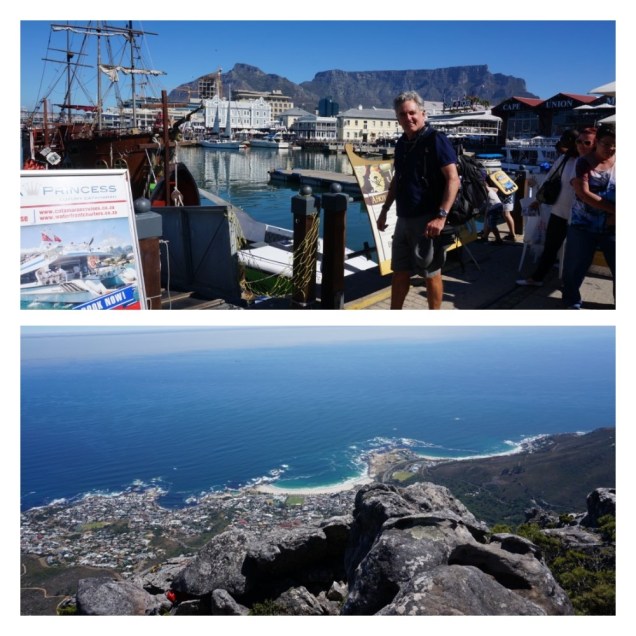
I went to the top of Table Mountain on my second day in Cape Town.

That time I took the cable car.  It was a great day with clear blues sky and no wind.  The cable car itself is interesting in itself.  As it moves it rotates 360 degrees.  This enables everyone to have an equal opportunity to enjoy the views.

The top of the mountain is, as you would expect, very flat.  It is also quite wide, at least 500 metres across.  I spent about 2 hours walking around checking out the various viewing points.  It is a very spectacular place.

German girls wanted to walk to the Top

My plan was always to walk to the top of the mountain.  There were a few days when the top was covered in cloud and/or, it was too windy for the cable car to operate.  The non-operation of the cable is an issue in that, although I was confident of being able to climb up the mountain, I was certainly not confidential that my old knees would be able to cope with the walk down.

The staff at the hostel always wanted to know what people were doing.  Part of that was to put groups of people together.  It most cases this was for safety reasons.

When I told me that I was planning to walk up the mountain, they told me that there were three German girls that were also planning to climb the mountain on that day. We formed a group.

One of the girls had been using Uber.  She ordered a car and we headed off to foot of the mountain.  The 20-minute drive ended up costing up 80 Rand (less than AUD 8) – amazingly good value.

The Walk

The first part of the climb was a two kilometre walk from the bottom cable car station along a road to the start of the walking track.  As we walked I found out a bit about the German girls.  Two were friends from Hamburg.  One wasn’t feeling too good as a result of a heavy cold.  The other, older girl, was from Munich and told us the she was an experienced ‘trekker’.

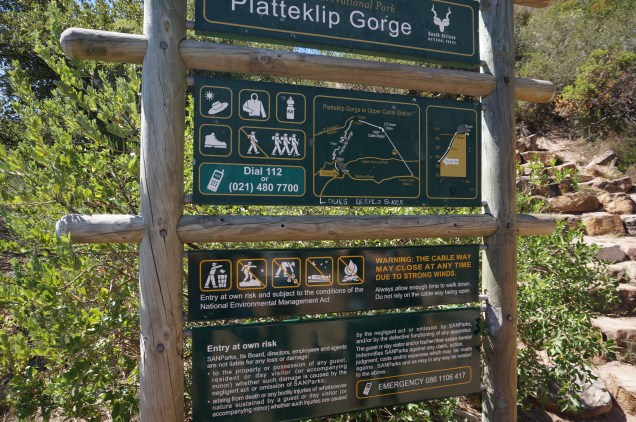
A sign marks that start the walking track to the top via Plattwklip Gorge.  The sign advised that it took one hour to get to the gorge and another hour to get to the summit.

We hadn’t gone far when it became obvious that the two younger girls were struggling.  In particular, the girl who wasn’t feeling too good, was finding it really tough.  There was a lot of chatting in German.  The older girl told me that she had advised the others “simply take their time and walk at their own pace and that we would meet them at the top”.

As we headed off, it was clear that the older girl was really “an experienced trekker”.  Actually she could have given a mountain goat a run for its money.  I really struggled to keep up and decide to go at my own pace.

There were a lot of people on the track.  It was notable that even after over thirty minutes, no one was heading down – everyone was heading up.  Spurred long by the “experienced trekker”, I was overtaking other walkers and didn’t look like being overtaken by anyone else.

As it turned out, I was never more than 20 metres or so behind my pace maker.  At various points she stopped to wait for me.  At one point she stopped to chat with an English couple who were resting a shady spot.  This was a good idea, given the strong sun.  The couple were hilarious – they were arguing like ‘cat and dog’.  The wife was blaming the husband for “forcing [her] to climb up this impossible track…..he must have known how difficult it was and why didn’t he tell her………”.  He completely ignored her and when he heard that I was Australian he  simply what to ask about my thoughts on rugby and cricket.   This infuriated his wife.  My German companion tried to calm things down by saying she thought that “the track would get easier further along”.

As we left that arguing couple, I asked my companion what made her think that the “track would get easier”.  She told that it would probably get “more difficult”.  I did say anymore.

Finally at the Top

After two hours we were finally at the top.  I was wearing my FitBit.  I noted that it calculated that I had walked up 240 storeys.  I assumed that was about right, however it seemed lot more than that to me.

We wandered around the top of the mountain for a while.  At one of the viewing points, we came across for English girls who were doing handstands.  They asked us to photograph them.  They were ‘cards’.  They were travelling together and had decided to be photographed doing handstands at the all the ‘tourist spots’.

The German girl was keen to wait to make sure her countrywomen made it to the top safely.  We stopped off in the summit café for a beer. A couple of South Africa ‘lads’ joined us.  They didn’t pick our table because they saw me.  A rather interesting conversation ensued.  They were intrigued why we had walked up the mountain together.

Other Girls Make it

After about 30 minutes later my companion received an SMS.  The other German girls had made it to the top and were at the cable car station.  Slow and steady does work.

We took to cable car to the bottom.

Flickr Link

https://www.flickr.com/gp/twwilko_photos/TTwgB3


Cape of Good Hope

DSC05533
I had decided to travel along the Garden Route to Durban by the Baz Bus. This is a company that specialises in the backpacker market.

When I booked my hop on hop ticket from Cape Town to Durban, I was offered a tour to the Cape of Good Hope. I took up the offer.

The bus picked me up at the hostel at 8.30 a.m. I was introduced to the other passengers. They were the usual eclectic lot – Germans, Dutch, French, Brits and Australians.

More Seals

We headed out of Cape Town along the coast. The first stop was Hout Bay. We were offered a boat trip to see some seals. It may sound that I am blasé about seeing seals. I have seen lots over the past 2 years in Tasmania, California, Chile, the Galapagos Islands, and now here.

Simon’s Town

Next stop was Simon’s Bay which was established by the British as a naval base. It is still a naval base, obviously run by the South Africans. The guide pointed out one of the six South African submarines. There seem to be doing as well as Australia on this front, at least in terms of numbers.

The town is on False Bay. The bay got its name because the sailors looking for Cape Town Harbour, often found themselves in the ‘false’ bay by mistake.
We stopped to see a Penguin colony. Again I like I am over ‘penguined’ at the moment. Having not long been to Phillip Island in Victoria

Funny Stories

We left Simon’s Town for Cape National Park. There was a lot of road works and progress was slow. A number the passengers started to chat about their travels. Two girls from Melbourne were particularly amusing.

They had been on a ‘truck’ trip from Nairobi to Cape Town. They told of some very close encounters with wild animals including a hippopotamus. It “scared the shit out of” them.

They also told a very funny story about sky diving with a Norwegian girl who was also on their truck. They were videoed and photographed on the way down. One girls said that her face was so “contorted in the photo that she could hardly recognise herself”. She also “doubted if her mother would have recognised if it was her”.

However, the “Norwegian looked as though she a just won Miss World and was about to collect her trophy – what bitch – ha ha ha”.

Bike Ride

We arrived in the park and the driver stopped the bus. The bus was towing a trailer with twenty bicycles. All the passengers with the exception of one took the option of a short 10 kilometres or so ride to our next stop for lunch.
It was good to be on a bike again after such a long break.

I had my Garmin, but as often the case when don’t put by glasses on, I managed to turn the timer off rather than on.
I was however, wearing my FitBit. When I synchronised the device in the evening, I was impressed to find that it had worked out that I had been riding a bike for 25 minutes or so.

A Dutchman’s view of Afrikaans

After the ride we stopped for lunch. I was simple – sandwiches and fruit – but very good.
I chatted with a Dutch bloke who had some interesting things to say about the Afrikann South Africans and their language.

He described Afrikaans as being “baby Dutch”. I look this as being the same as ‘pigeon English that is used in Papua New Guinea. I told him that Fire Escape in pigeon is ‘long stair hurry up go outside’. He told me that Afrikaans is similar . He said that Battleship is in Afrikaans is ‘the ship that is not afraid of anything’

I am not sure that google translator knows about that, but it makes a funny story.

Lighthouse

The next stop was lighthouse on Cape Point. Apparently there was a problem with the lighthouse in that because it is located at the top of the cliff, it is often covered in fog. As a result it did do what it was supposed to do, that is be seen by ships. Another lighthouse was built lower down the hill.

Cape of Good Hope

We piled back onto the bus to be taken down to the Cape of Good Hope.
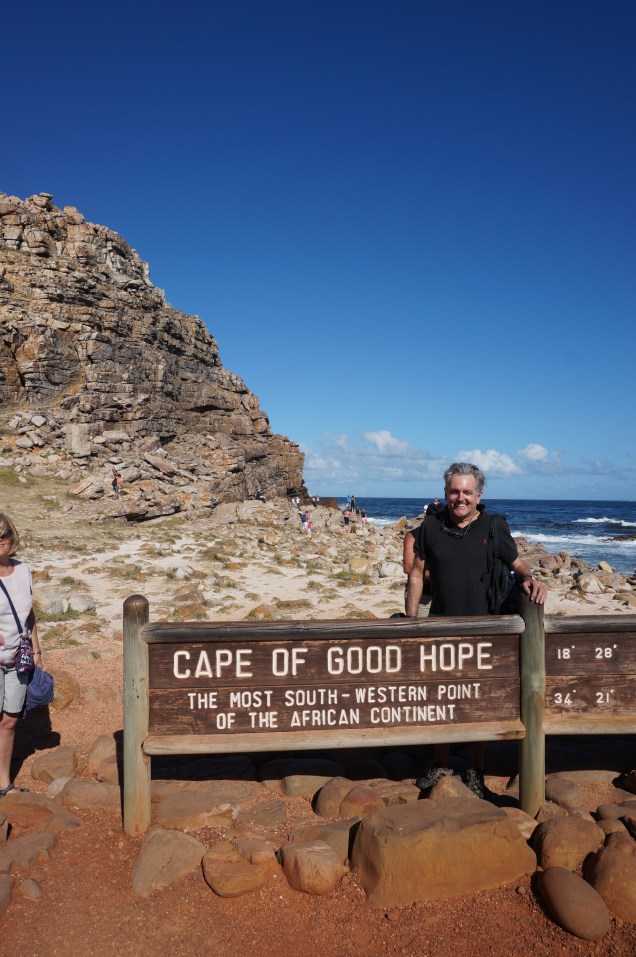
We all had the obligatory photos take. As usual a bunch of German tourists ignored the queue. They are amazing. I have taken to telling them: “don’t mind us, just think of this line as Poland in 1939, just walk right in and feel at home”. It upsets them and so it should.

Slow Trip Back

I was a slow trip back in the Cape Town peak (two) hour traffic.

Flickr Link
https://flic.kr/s/aHskvERSfA

Black Township

DSC05495

When I am travelling I like to read books about the places that I am visiting. Typically, these are books written by travel writers. These are not travel guides, but are books written by writers about their travels, in the style of Bill Bryson or Paul Theroux.
On this trip I a reading ‘Cape Town to Kruger – Backpacker Adventures in South Africa and Swaziland’ by an Irish bloke called John Dwyer.

One of the things that he did during his time in Cape Town was a visit to a ‘Township’. I decided to do the same.

I organised the tour through the hostel. My guide arrived in ‘reverse African time’ – twenty minutes early. The guide ‘James’ told me that he wanted “to get going because of the traffic”. We headed into town where we picked up three Americans from another hostel.

Forced Removal of Blacks

As we were leaving the CBD, James stopped the van and pointed out a sign which said ‘District Six’. James explained that this area was particularly significant in the history of Apartheid. In 1982 the white controlled government declared the area of District Six and as a Whites Only Area’. The over 60,000 Black people living the area were forced to leave and their houses were demolished.

He also explained the operation of the ‘Pass Laws’. I mentioned these laws in my previous post about Robben Island.

James explained that all Blacks had to carry a ‘Pass Book’ at all times. The Pass Book’ detailed where they could live and work. For example, the Pass Book may say the holder could live in Langa Township (where we were headed) and work in the CBD of Cape Town. However, the holder may could only be the CBD during certain hours. The police would routinely stop Blacks in the street to check their Pass Book. It the holder was in the wrong place for at the wrong time, they would be detained. Repeated offenders would be placed in gaol.

Hospital

As we continued on towards the Township. The road passes that main Cape Town Hospital. This is where Dr Christiann Barnard performed that first heart transplant in 1967.
This is somewhat surreal give what follows.

Langa Township

Our first stop in the Township was a community centre. James explained that it was an initiative designed to provide unemployed people with skills and meaningful work. There didn’t appear to be too much going on.

There were a couple of women and bloke doing some pottery. Some of the items were being made for the Maryland University.

There were some other handicrafts for sale. One of the American blokes bought a model a bicycle made from wire.

While we were in the centre the American girl told me that see had been working on a project for a local Telecommunications company in Port Elizabeth. She was working on the project because the company was linked to Ericsson, with whom she worked in California.

The project “was not going well” and she had decided to leave. She was spending a couple of day in Cape Town before flying home. She also said the one of the reasons she decided to leave South Africa was the “extreme racism” she was forced to witness.

Living in a Container

Leaving the centre, we walked down street into the Township itself. We stopped at a shipping container. James explained that we were going to meet the person that lived in the container.

He opened that door and we looked in. We were introduced to the person that lived in the container. She was a disabled woman in her forties. It was very confronting.

Ex-Policeman

Our next stop was a large hall. James explained that the hall was used for accommodation. It had been divided into small rooms that were occupied by mainly single men. I also had showers and toilets.

Leaving the hall, we were taken into a shack the was in lane behind the hall.
We were introduced to its owner. James told us that he “would tell us about his life” and that we were “free to ask him any questions”.

The guy told us that he 65 years old. He was brought up in small town to the west of Cape Town. His parents were poor and he was forced leave school when he was 14. His first job was a messenger for a clothing store. When he was 18 he applied for a job as policeman. It was long process including taking examinations and medicals. In the end he was successful and joined the force.

After a short period of training, he was transferred to Cape Town.

He told us that he had lived in Langa most of the time he was in the Police Force. It was a little unclear how long he had lived in the shack, but he told us the he had built it himself. He started with one room that he built “overnight”. Once he “had claimed his spot, that was his”. Overtime he had expanded the shack to include three rooms. One is for this daughter. He told us that his wife died in 2009.

The shack has no toilet or running water. He and his daughter bring water from the hall next door. They also use the showers and toilets in the hall.
I asked him if he got a pension for being a former policeman. He told that he received a pension of 1,020 Rand per month. That is less than AUD 100 per month.
He told us that he was on the waiting list for one of the government ‘flats’ that are being built in the Township. He told us the he was not sure when it would be his turn to get a flat. However, he was “confident that he would get one”.

Stopping for a Beer

Leaving the shack, we took a very short down a lane to a place for a beer.
James explained that this was where the locals met to “chat and have a drink”. There were a number of blokes sitting around. There wasn’t too much chat – one was comatose the others were on the way.

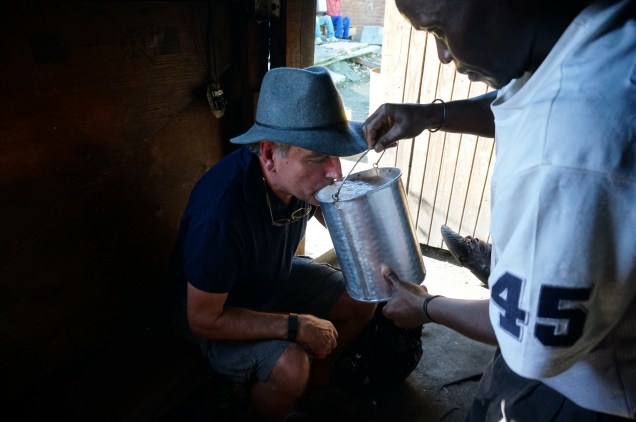
We were introduced to the ‘Mistress Brewer’. James explained that the brew was made of fermented maize. I asked where the maize came from? He told me that it now comes from “Shoprite, the Supermarket in the Township”.

Apparently the brew takes 3 days to ferment and is then ready to drink. I assumed that in the absence of any refrigeration, it is drunk on that day.
We were offered to opportunity to drink the beer. The two American blokes declined. The girl had a go. So did I. We drank it out of a bucket. I am writing this over 24 hours later. I assume I won’t have any after effects.

Different Levels of Housing

After the beer tasting, we went on a short walk. We passed some two storeyed builds. The American girl told me that the buildings did not look dissimilar to the housing that is provided to the “lower ranks of the USA military”. She told me that she knew what that was like “because her sister was married to an Infantry Man”. She said that the “USA doesn’t look after its Servicemen”.

We were taken into one of the buildings. There was a small room with bunk beds. James explained that the room was occupied by three families. The parents slept in the beds and the children slept on the floor.
As we left, the American girl said that while the building looked the same as her Sister’s place, the sleeping arrangement were “better than that”.

We then returned the mini bus.

Some New Buildings

James drove us passed some new buildings, some of which were still under construction. He explained that these were being built by the government and the plan was to “move people from the shacks in to proper buildings over time”.

We then passed some cottages. James explained that these were ‘Bank Houses’. They had been built by their owners with loans from banks. Most were owned by ‘professionals’ e.g. teachers and government workers. Some had cars parked in the front yards. These places also had satellite dishes. I asked if they there was any robberies of these houses. James said that it was rare. “Most people respect the owners and the fact they were the “same as them”.

Immigrants

James then took us into another area than was far poorer than anything that we had seen so far. It was on the fringe of the Township, near the highway to the Airport. He explained that this was where the “immigrants were”. These are people from Zimbabwe and elsewhere in Africa that “have come to South Africa for a better life”.

It is really grim.
Check out the video of Flickr.

Flickr Link
https://flic.kr/s/aHsksdAauv

Link to Christiaan Barnard
https://en.wikipedia.org/wiki/Christiaan_Barnard

Robben Island

DSC05425
Robben Island

One of the places I really wanted to see while in Cape Town was Robben Island. It is the location of the infamous prison where Nelson Mandela and other political prisoners where held during the apartheid years in South Africa.

As you would expect, it is a place of great significance for South Africans. It has been accorded World Heritage status by UNESCO.

The people at the hostel recommended that I book ahead to get a ticket. My tour started at 1.00 p.m. The boat to the island was not what I expected. It appeared to be a ‘working’ boat, with limited places for the passengers to sit.

Prison Ship

The trip out to the island took about 50 minutes. There was quite a large swell. As we drew into the harbour on the island we could see a number of other boats. They all looked like your typical harbour cruise boats.

Once on the island we were directed to a line of buses. Once on board we were greeted by our Guide. He looked like a young Nelson Mandela. He asked which boat brought us to island. Someone old him it was the “Dias”. He explained that the Dias was one of the original “prison boats” that were used to transport supplies to the island. It was also used to transport the prisoners to the island.

Tour of the Island by Bus

The bus took us past the prison and to an area which the guide explained was the site of a leper colony. The island housed the colony up until the 1930’s. It must have been dreadful to suffer from leprosy in those days. I note that it has been determined that leprosy has been determined to not be very contagious. I guess that leper colonies were a bit of an overkill.

Robert Sobukwe

The bus then stopped at a house. The guide explained that house was where a political dissident by the name of Robert Sobukwe was held in solitary confinement. He was famous for leading the resistance to the ‘pass laws’. This was system under apartheid wherein the Blacks were issued with identity passes that were used to restrict where they could live and travel within the country.

The Guide told us that as part of his solitary confinement Sobukwe was not allowed to talk to anyone, including the Warders that were guarding him. Towards that end of his incarceration he was visited by the anti-Apartheid activist, Helen Suzman. The guide said that he met Suzman when she visited the island shortly before her death. She told him that Sobukwe told her that he was “forgetting how to speak”. What an extraordinary form of torture solitary confinement is.

Lime quarry

The tour took past the Lime Quarry, where the political prisoners were forced to work. The Guide explained that the educated prisoners used the “relative freedom” while working in the quarry to teach the illiterate prisoners to read and write. He also explained that the dust and glare at the quarry caused eye damage to the prisoners.

Penguins and Great View

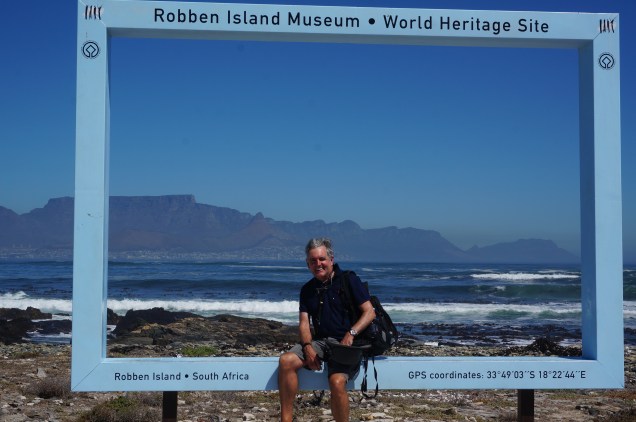
We stopped for a short break the northern end of the island. From this point there is a great view of Table Mountain. You can also see some of the local penguins. Apparently their numbers are declining and no one is sure why this is occurring.

Large guns

Heading back to the prison we passed a large gun, one of three that were placed on the island during WWII. Of course these guns never fired a shot in anger.

Prison

The bus dropped us off at the prison. We were met by our next Guide. This gentleman was really interesting he was a former political prisoner.

The Guide explained that the prison had several blocks. The prisoners of different categories were held in separate blocks. There was a block for the ‘Coloureds’ (mix race) and the Indians. The ‘Blacks’ were held in separate blocks. The ‘Leaders’ like Nelson Mandela were held in a separate Block.

The first block that we entered was where the guide was kept. The ‘cells’ were large. Up to 20 men were held in the cell. The prisoners slept on blankets placed on the floor. There were no beds. This practice ceased under pressure from the Red Cross and it was causing the prisoners to contract TB.

The next block was where more ‘dangerous’ prisoners were held. This block has single cells. On the walls of the cells are cards will short stories written by the inmates. They are all harrowing.

Guide tells of his Personal Experiences

While we were in this block, the Guide fielded questions from the group. This was very interesting.

He told us about the controls that the Warders placed over their communications will the outside. The sending and receiving of mail was very restricted and all mail was read and censored. He told us about one particular Warden with whom he become friendly. This

Warden took the Guide’s letters and smuggled them off the island and personally sent them to the Guide’s family. He also encouraged the family to send him letters that he passed to the Guide.

The Guide told us the “the Warden is still alive and is one of his best friends”.
The last part of the tour of the prison was where Nelson Mandela was held. There is a quadrangle next to the block. The Guide explained that in the corner of the quadrangle was one of the spots where Mandela hid the manuscripts for his book ‘The Long March to Freedom’. Where the original fence was being replaced will a stone wall, the manuscript was discovered. Mandela had to re-write that part of the book.

Clever use of a Tennis Ball

The Guide also told us about the tricky thing that the ‘Leaders’ used to communicate with the other prisoners in the adjoining Block.

They used to play tennis in the quadrangle. They cleverly placed written messages inside one of the tennis balls. During the course of the game they would hit the ball over the wall into the next block. The prisoners in the next block would reply to the message and throw that ball back over the wall.

Apparently this went on for years. Notwithstanding the Warders saw the ball going over the wall and being returned, they never twigged that it was being used for communication.

Mandela’s Cell

The final stop on the tour was Nelson Mandela’s cell. I always find it a bit eerie to visit a famous place in history. This is one of those places.

Flickr Link

https://flic.kr/s/aHskutQjUK

About Helen Suzman

https://en.wikipedia.org/wiki/Helen_Suzman

Long Walk to Freedom

https://en.wikipedia.org/wiki/Long_Walk_to_Freedom

Singapore

Singapore 2016 09
I am back Singapore 49 years since my first visit. That visit part of trip to the UK with my parents. We sailed to Naples on the P&O liner the Canberra and headed across Europe by train. After spending time in England, we flew to Geneva. The return flight to Australia was from Frankfurt was by QANTAS. The plane stopped in Rome, Cairo, Karachi, Calcutta and Singapore.

How aeroplane travel has changed.

1966 Visit

I have quite a good recollection of our stay in Singapore. We stayed in the Sea View Hotel. As the name suggests, it was in the coast. I have searched the internet, but cannot find are reference to the hotel. I assume that it is long gone.

As readers of this blog will probably know, my father was a British soldier and was captured by the Japanese in the fall Singapore in February 1942.
For those that don’t know his story, it can be found at:

A Guest of the Japanese Government – My WWII Story by Ron Wilkinson © 1999

I recall that Dad hired a car so we could get around Singapore. We visited the Army base in the Changi district. The base was still under British control. Later in 1967 the British announced that they would be leaving Singapore.

Dad wanted to see the Selarang Barracks. This place is famous in the fall of Singapore in 1942. The Japanese wanted all the captured soldiers to sign an instrument agreeing that they would not attempt to escape. The British and Australians refused to sign. The Japanese forced over 17,000 of the prisoners in the square within the Selarang Barracks.

There was limited water and virtually no  toilet facilities. There was also no protection from the sun. In a short time it was clear the disease would spread. The soldiers agreed to sign. I understand most of the soldiers used false names like Micky Mouse, Donald Duck and Adolf Hilter.

I have a vague recollection seeing the barracks and Dad talking to some British soldiers.
I have a more vivid recollection of the trip back to the hotel. We got lost. Dad spotted a van with the name of the hotel on its side. We followed the van, clearly on the assume it would lead us to the hotel.

The van stopped in front of a timber building. The driver and passenger went into the building. Dad followed them. He soon returned to the car. He told us that the place was a bar and he could find the driver because “they all looked the same”.

We waited for some time. Finally, the driver and his off-sider returned. Dad spoke to them and they led us back to the hotel.

Another recollection was driving across the causeway into Malaysia. I recall that we drove north into Johor. We stopped to see some rubber trees. Somewhere there is slide of me looking at tree that was being milked.

I also have a vague memory of us having lunch at Raffles Hotel. I can certainly recall Dad talking about having a drink in the Long Bar before being captured.

I can also remember the airport when we left to fly to Darwin. It was very small and there certainly weren’t any air bridges. I can recall that we bought a pair in binoculars.

Singapore Booms

Starting around 1967 Singapore embarked on an extraordinary period of economic growth under the leadership of Lee Kuan Yew.

First DFAT Visit in 1984

I joined the Department of Foreign Affairs in September 1984. My first trip was to Moscow, East Berlin and Bonn. I travelled with a crusty old ex Air Force bloke.

In those days the QANTAS QF1 flights to London stopped in Singapore and Bahrain. We stopped off in Singapore on the way to London. Our hotel was on the corner of Scott Road and Orchard Road. It is still there and is called that Marriott Tang Plaza. I am not sure what is was called them.

By 1984 much of Orchard Road had already been developed. There were lots of hotels and shopping malls. Over the years that number of malls has increased.

We only stayed overnight before flying on London. I can recall by colleague taking me to a rather dodgy bar across the road from the hotel. I certainly doesn’t exist anymore.

On the return trip from Frankfurt, we again stopped over in Singapore. This time we stayed at Raffles. I recalled that I had had a bit of the discussion with my crusty old colleague about my desire to stay there. His view was that it was “old place” and modern hotels were better. This was typical, he was a dickhead.

Anyway, I must have one that argument. Raffles was on the Department’s list of preferred hotels so there was no reason why couldn’t stay there.

I have checked the prices for Raffles today. It costs SGD 1070 (about AUD the same) per night. The Marriott Tang Plaza costs SGD 480. That “old place” must be doing something right.

Returning from Kathmandu 1985

My next visit to Singapore was in March 1985. This was the final stage of the trip to India and Nepal. I have talked about that trip in my posts on my recent trip India.

After being in India we flew to Kathmandu where we stayed for over a week. We flew out of Kathmandu to Bangkok. This was a really bizarre flight.
We were not long into the flight when there was a load screaming sound. The sound stopped. The pilot then made the usual announcement that “we will be flying at 30,000 feet”. That was all very well, however, when I looked out of the window, I could see the side of a mountain with no snow. My knowledge of geography told me that Mt Everest was 29, 000 ft high. Something didn’t compute.

At one point an air hostess ran down the aisle crying. The screaming sound started again. The pilot then told us that there was a problem with the air-conditioning and we would be returning to Kathmandu.

As it turned out, the plane did not turn around. We continued on to Bangkok, seemingly very slowly.

I was very glad to land in Bangkok. I recall that we were over an hour late.

After a brief stopover we flew to Singapore.

We stayed at Raffles. My colleague has just reminded me (via Skype) that “while it was a great hotel, the rooms were a bit tied”. That probably explains why the hotel was with the budget for the DFAT preferred hotel list.

Working in Singapore in July 1985

Later in the year the same Foreign Affairs colleague and I spent three weeks working in Singapore. This was part of trip that included Bali, Jakarta and Brunei.

This time we stayed at the Marco Polo Hotel. The hotel was located in Taglin Road near to the Australian High Commission (AHC) on Napier Road. The British High Commission and the American Embassy are located on the same road.

The National Library of Singapore web site has a reference to the hotel:

“Marco Polo Hotel, built in 1968 on Tanglin Road, was one of Singapore’s famous landmark. It was so well-known that many popular personalities chose to stay there in the 1970s …Thee hotel interiors boasted of jade, green onyx, marble and teak carvings. It also had a roof-top restaurant. Lobby lounge girls dressed in cheongsams added to the exotic look of the hotel and it was well-known for its high quality service”.

Albeit, we were working we were able to see mot that Singapore had to offer at the time.
One night we went to Bugis Street. The street was famous for being frequent by ‘Lady Boys’. The government was not keen on this ‘activity’ and announced that that street would be closed down. The First Secretary from the AHC took us to there on one of its last days of its operation.

He told us that one of the “tricks that the Lady Boys do is to pick pocket your wallet”. Sure enough that is what happened to him. The wallet was returned to the AHC the next morning will nothing missing.

After we finished work in Singapore we went to Brunei for a week, before flying back to Singapore, for a couple of days and then back to Australia.
We stayed in the Grand Hyatt in Scotts Road. That place is still going and looks much the same.

Passing through in 1986

My next visit to Singapore was in April 1986. That was in a return trip to England. In hindsight, I wished that I had never made that trip.

With the family 2009

My next trip to Singapore was in January 2009. The trip took in Ao Nang, Phuket and Bangkok in Thailand.

One the reasons for the trip was to enable my daughter to see where her grandfather had been during the war. To that end we when out to Kanchanaburi War Cemetery and the Bridge over the River Kwai.

When we were in Singapore we went to the Changi Museum. It was a good way to introduce my daughter to that part of her grandfather’s life.

I took the opportunity to visit the Fort Canning Battle Box. This is an excellent place to learn about Japanese invasion and the British surrender. My then wife wasn’t interested and my daughter didn’t accompany me.

One of the biggest changes that I noticed to the city between 1986 and 2009 was the train system, the MRT. It had started operation 1987 and by 2009, it cover most of the city and the rest of the island.

Short Visit in 2010

Not long after the trip above trip, I separated from my wife.
In July 2010 I made a short trip to Vietnam. This involved a short stopover in Singapore. I took the opportunity to visit the Ford Factory WWII Museum. This was where the British formally signed the surrender documents in February 1942.

This Museum is currently closed, but will reopen in a few months.
I also took the opportunity to check out some of the ‘lively’ spots in the city. As I noted above the government under Lee Kwan Yue was quite strict. They closed Bugis Street and the whole city gained a reputation for being sterile. This was having an impact on tourism.

Also a lot of the colonial buildings had been demolished to be replaced with modern tower blocks and shopping malls. Other were vacated and were in disrepair.
In an effort to bring some life back into the place, the government decided to keep the colonial building in certain areas and encourage some ‘lively activity’. In particular, they preserved the Chinatown district and the buildings along the river from New Bridge Street to the Harbour. They encouraged bars and restaurants to be established in the area. The financial district is nearby. The plan worked. The cashed up financial industry workers (many of the them ex-pats) started frequenting the bars and restaurants.

In 2010 this was a ‘happening’ area and it still is.

I was shocked to find that the Marco Polo was no more. As the Singapore now tells me:
“The hotel however slipped into oblivion when it was torn down in 1999, and on its site now sits a condominium called the Grange Residences”.

I guess that problem was that it wasn’t fully utilising it land foot print, and wasn’t old enough to have the appeal of a place like Raffles. However I think those “lounge girls” have been missed by many.

Now in 2016

So I am back in Singapore again. I am en-route to Cape Town in South Africa and plan to make my way through southern Africa to Nairobi before heading to London in May.
I flew from the Gold Coast on Scoot, the budget airline owned by Singapore Airlines.
I am certainly not staying in the any pf the hotels noted above. Rather I am staying in a ‘luxury’ hostel in Chinatown. It is the Adler. It is properly described as ‘luxury’. A problem for most ‘women folk’ would be that there are 20 bunks the dorms and you, of course, share showers and toilets. However, the beds are very private with curtains and it is spotlessly clean.

Long Walk

On my first day I went on long walk over Canning Hill and along Orchard Road and on to the AHC. Not too much has changed. There is probably one or two more shopping malls on Orchard Rd since 2010.

Security around the AHC and the American Embassy is more obvious.

An area that has change in the Marina Bay area. This was almost complete in 2010. It is an amazing shopping precinct. It must have every high end luxury brand represented. There seem to be no shortage of customers.

Raffles

On the way back to Chinatown I stopped off at the Raffles Hotel.  I had a Singapore Sling in the Long Bar.

Canning Hill and Fort

The next day I went on another walk and this time did a guided tour of Canning Hill, the Fort and the Battle Box.

It was a reasonable tour. The guide told us about the early colonial days when the East India Company and the history of the Fort. It was established in the early 1800’s as a place to protect the British in the event of a uprising by the locals. They were fearful of an incident similar to the Indian Mutiny .

After WW1 and the advent of airpower that Fort was effectively demolished and the underground bunker the ‘Battle Box ‘ was built. This was used in WWII. The famous meeting between Major General Percival and his fellow commanding officer on Sunday the 15th of February where it was decided to surrender.

If you take the tour get see the room where the meeting took place. There are wax models of the soldiers involved.

Changi Museum

Next day I when out to the Changi Museum and Chapel. This is a very moving place. I left a note in the Chapel in memory of my Dad.

Flickr Links
Singapore 2009
https://flic.kr/s/aHskuCS7zE

Singapore 2010
https://flic.kr/s/aHsktRzVMX

Singapore 2016
https://www.flickr.com/gp/twwilko_photos/TzkK5d

About the Marco Polo Hotel
http://eresources.nlb.gov.sg/infopedia/articles/SIP_913_2005-01-22.html

About the MRT
https://en.wikipedia.org/wiki/Mass_Rapid_Transit_%28Singapore%29
Byron Bay, Brisbane, Noosa and more

Brisbane Byron Noosa

This post fills in some gaps.

I spent most of the summer in Australia. There was a lot of bouncing around. I have already posted about being in Melbourne for the tennis and taking a trip to Phillip Island

Sydney

I arrived back in Australia on the 7th of December, landing in Sydney. It was good to be back.

I caught up with my daughter for dinner. This was great. Lunch with an old friend from my school days was also great.

I also caught up with some of my Friday Night drinking mates at the GPO Bar. It is good to see that this is still a tradition.

Byron Bay

Next stop was Byron Bay. I flew to Ballina and caught the shuttle bus to Byron Bay

I like Byron Bay and have often thought what it would be like to live there. There is a lot going for it. The beaches and hinterland are beautiful. There is always something going on – threatre music etc. It is also relatively easy to get to Brisbane if you need the ‘big city’ thing.

The local council have been very strict on development in the town. Of course it has changed a lot over the past 30 years or so, but not nearly as much as other coastal towns.

In many respects the ‘fabric’ of the CBD streets is much the same. It is just that the use being made of the shops has changed.

There are heaps of cafes and restaurants.

The Beach Hotel hasn’t changed since it was built. They have a very recruitment policy. It was particularly good in 2009. It is unlikely that that standard will ever achieved again.

One of my Bath hosts will attest to that standard.

Friday through Sunday in the place is amazing. There are people everywhere. There are tourists (seeming mainly from Germany, the UK and Scandinavia), young Australians (many from Brisbane), hippies, oldies like me and a few bogans. I don’t know where they all stay.

While I was in town, I caught up with an old school friend who owns and operates a blueberry farmer with her husband in the hinterland. I was great to catch up with her. We not only went to school together, but we lived opposite each other in the same street after we were born. I moved a short distance way went I was one.

Xmas in Brisbane

I headed to from Byron Bay to Brisbane for Xmas.

On the way I stopped off in Tweed Heads for lunch with my Canberra hosts. They were in Tweeds Heads to see their daughter and grandson.

I have a thing a seeing friends in places other than their home town. It is really good to do this in exotic places oversees, but it also good to do it in Australia.

Xmas was at one of my cousins places. It was a great day.
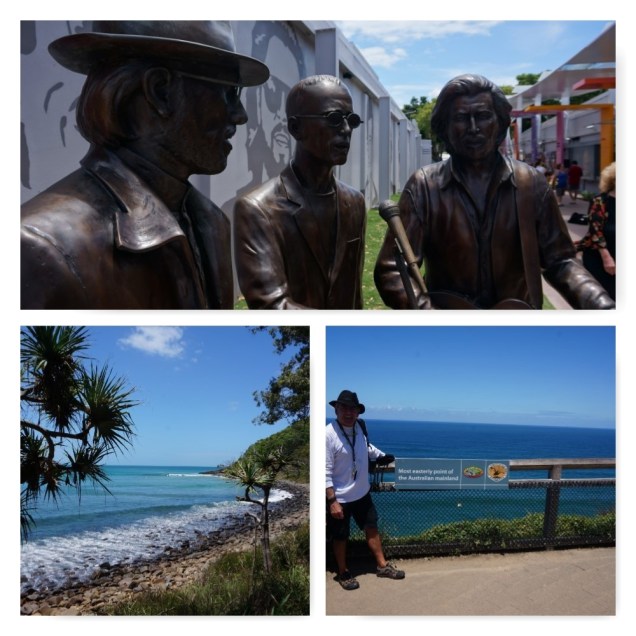
A couple of days after Xmas I went out to the northern beach suburbs for lunch with one of my cousins. She took me to Redcliff. One of the suburb’s claim to fame is that it is where the Bee Gees started their musical career. To commemorate that fact, the local council has built the Bee Gees Alley. Check out the Flickr Link. It was opened by the sole surviving brother, Barry. My cousin was at the opening.

New Year In Noosa

I headed to Noosa after Xmas. I stayed Halse Lodge which is on the hill overlooking Hastings street. It is an old time quest house that was built from the 1880’s to the 1920’s.

It was put on the ‘Heritage’ list in 1997.
It is a classic ‘Queenslander’ timber building.

Noosa was the location of numerous family holidays from 1994 to 2008. I call them the ‘ground hog’ holidays. They all seemed to be much the same. They were still fun though.

I headed back to Brisbane for a couple for a couple days. It was great to catch up the ‘girl with the funny name from Cooma’.

Back in Sydney

I left Noosa and headed back Brisbane and on to Byron and then to Sydney for a couple of days. . I also had lunch with some friends at the Oaks Pub in Neutral Bay. I really like that pub. We ate under the Oak Tree. It was a great lunch with great company.

I also had dinner with my Journalist mate that I went to pre-school with, and his wife. We ate at the Willoughby Hotel. There was a really annoying bloke who was trying to talk to all in sundry. He was the classic ‘village idiot’. My mate’s wife is Croatian. To put the ‘idiot off talking to us, she started speaking Croatian.

It worked, he left us alone.

To Melbourne

I took the train to Melbourne. As I noted above, I have already posted about the tennis and Phillip Island.

Canberra

I took the train from Melbourne to Canberra.

It was great to be back in Canberra. I caught up with some old school friends and their wives for lunch.

We have had a number on these lunches over the years. This was typical of such a lunch. It started at 12.00 p.m. and finished at 11.00 p.m. As people with close friends know, you may not see the close friends for ages, but the conversations start as if you saw them yesterday.

Before the lunch I had a coffee with the journalist who I have posted about writing a Quarterly Essay. She had some very interesting things to say, including some comments on Tony Abbott.

While in Canberra I saw a number of other friends.
There is a real possibility that when I finally stop travelling for a while, I will stay in Canberra. There is a lot going for the place.

Sydney

I took the train back to Sydney. The train is slow, but it is so much more comfortable than a bus.

Back in Sydney, then was another Friday night drink. There are constants arguments as to the venue. I suspect things will never change.
I was great to catch up with my daughter. She always likes to have dinner with me at the same place. It is becoming a bit of a tradition. I like that.

Byron Bay Again

I caught the train to Casino and on to Byron Bay yet again.
Brisbane

After Byron I headed back to Brisbane again. The main purpose was to see my Aunt. She is inexorable heading to the age that she get the ‘telegram’. Let’s hope she does.
I also caught up with a school friend who teach English as a Second Language. She reminded me that I have been promising to do the TESOL or similar course for ages. It will happened. I told that my London host had between me to it.

Gold Coast

My flight to Singapore was leaving from the Gold Coast. I stayed that night in Coolangatta. That gave me the chance to catch up with the aunt of my god daughter. It was good to hear that her father is doing Ok.

Flight

The Scoot flight to Singapore was really good. The Boeing 787 Dreamliner is really good aeroplane.

Flickr Links

Byron Bay

https://www.flickr.com/gp/twwilko_photos/486625

Noosa

https://flic.kr/s/aHskozYZX5

Brisbane – Bee Gees Ally
https://flic.kr/s/aHskrgpYfo

Surfers Paradise
https://flic.kr/s/aHskuWi8Yo

Phillip Island

Phillip Island

I decided to visit Phillip Island. It is so long since I had been there I could not remember the place at all.

Being carless, I had to get to the Island by public transport. This involved a V Line bus. Apparently there has been some recent problems with some wheels on V Line trains. This resulted in disruptions to services. For some reason it was decided, “as an act of good faith”, to make all V Line services free between the 23rd and 31st of January. This is included the bus services that, I assume, were not effected by the train wheel problem. It was all very odd. However, it did make the trip than using the Seniors’ Card.
The bus left from Southern Cross Station and stopped at Koo Wee Rup. What top name for a place that is. You then get another bus that goes on to Phillip Island.

Hostel

My hostel was in Newhaven which is the first place you come to after crossing the bridge on to the Island. The hostel is relatively new and very comfortable.

Free Bus to Penguins

The girl at the reception told me that the best way to get to the Penguin Parade was by the Island Explorer bus. She told me the I would have to make a booking.
As it turned out, I was the only person on the bus. The driver told me that it was a new service provided by the private bus company on the Island, and it was funded by the various tourist attractions. He told me that “it had been slow to take off”. That seemed to be a bit of an understatement.

I arrived at the National Park, where the parade is, before sunset. A large complex has been built to cater for all the visitors. It has displays that provide information on the penguins. The place was packed.
There is a short walk from the complex down boardwalks to the beach where the penguins arrive.

Apparently the penguins can be at sea for between 1 to 17 days. They leave and return to the land at dawn and dusk so they can’t be seen by predators such as sea eagles.
The seats overlooking the beach were packed. There are two sections. One is closer to where most of the penguins land. You have to pay a premium for those seats. Many of the tourists were Chinese, presumably from China itself or Hong Kong, Taiwan or elsewhere in Asia.

The Rangers spoke a loudspeaker about the penguins and what we would expect to see. They said on numerous occasions that photography was forbidden. These announcements were repeated several times in other languages including Chinese.
After the penguins land on shore, they head to their burrows. The trails that they take run past and parallel with, the boardwalks. It is possible to get very close to the penguins.

Some People Don’t Listen

It was amazing the number of people, nearly all Chinese, that took photos. A Ranger near me challenged on particular Chinese guy whose video camera shone a bright light at the penguins. Clearly this upset the birds. He spoke to the guy in Chinese. He late told me that they had been taught to say “stop using your camera” in Chinese for obvious reasons.

However, he said that a lot simply ignore them. He told me that he “had learned to say f&&k off in Chinese, and only wish he could use it”.

Big Rock and Antarctic Experience

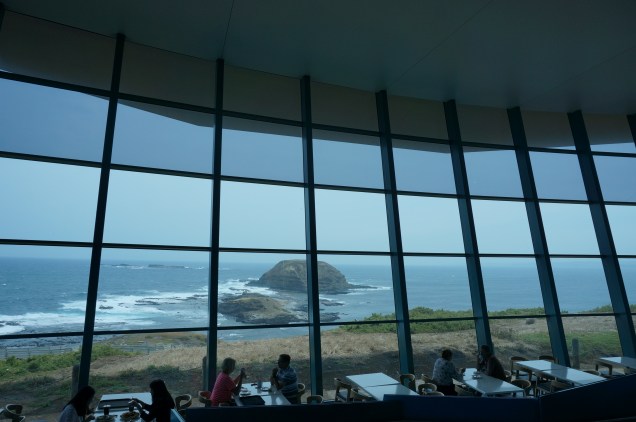
The next day I caught the bus to end of the Island to see Nobbies. This is a big rock separated from the Island itself.

A large complex has been built overlooking the rock. The complex has a cafeteria that serves very good food.

It also houses that Antarctic Experience. This has been developed by the World Wildlife Fund. It is really good. It has displays on the wildlife and other aspects of the Antarctic. It also has a very good audio visual display with videos taken in the Antarctic. Check out the Flickr Link.

Motor GP Circuit

Next stop was that Phillip Island Grand Prix Circuit.
After the penguins, the Island is probably best known for this circuit. It is the venue for the World Moto GP and Superbike Championship races. There are also a lot of car races and classic races for bikes and cars.

As well as these races, the circuit is also used by car and motorbike manufacturers for promotional ride and drive days.

It is also open for the riders to ride their own bikes on certain days. The day I visited the place was one of those days. There were over a 100 riders giving their bikes a run.
There is a motor museum at the circuit. It is very lame. There are also go-carts. They didn’t seem to have too much ‘go’.

Surf Beaches

The bus also takes you to the two main surf beaches on the Island. The place is famous for its surf beaches. Likes Bell’s Beach, they are face the Southern Ocean and the waves and big and relatively consistent.
In the morning before I left to go back to Melbourne I visited the surfing display at the Big Wave next to the hostel. It is only small display and takes about 20 minutes. It has a very video on four walls which worth seeing.

Flickr

https://www.flickr.com/gp/twwilko_photos/cwJ61d

Bus Site

https://www.phillipislandcircuit.com.au/family-fun/771-island-explorer

A Bit of Cricket in Melbourne

MCG
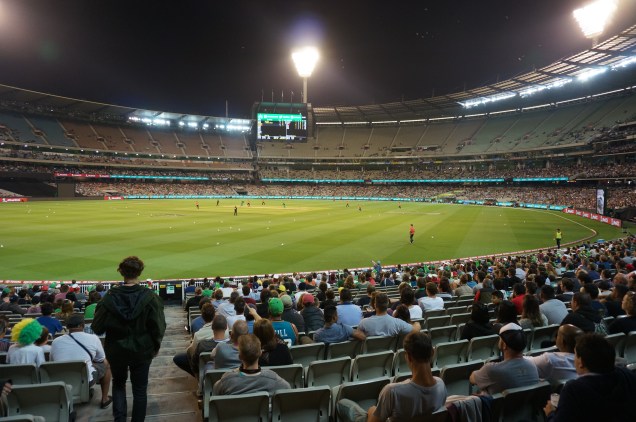
While I was in Melbourne I took the opportunity to see some Twenty 20 Cricket (T20). I have not been a huge fan of this short for of the game, but I am warming to it.

The First ODI

I digress for a moment.

I have mentioned in pervious posts that during the late sixties and early seventies, I visited Melbourne with my parents over the Xmas and New Year period. My Grandfather had moved back to Melbourne and my mother wanted see him for Xmas. Also, at that time my father played in the Australian Veterans Tennis Championships which were played as part of the Australia Open.

As well as going to Kooyong to watch the tennis, we also went to the Test Match cricket which was then played from the 31st of December each year.

In 1971, the Australian Open was move to Sydney and played later in the year. The Veterans still played in Melbourne.

The cricket that year was 1970-71 Ashes tour. The first 3 days of the Melbourne Test were washed out. So they could make some money, the ACB and the MCC decided to hold a 40 over a side (8 ball overs) one-day match. This turned out to be the One Day International (ODI) ever played. I can recall the game quite well. Under Dad’s influence I actually supported England in that series. They had a very good team led by Ray Illingworth. Geoff Boycott was in the team and the English fast bowler John Snow was at his peak.
As it turned out, Australia won the game. It is interesting to hear the players’ comments.

Check out the YouTube link.

The Growth of One Day Cricket

One-day cricket started in England in the late sixties. It was a way of the county clubs to make some more money. The attendances at the four matches had been falling. The one day game was also more suited to TV. It wasn’t long before the one day games was also played at the international level.

In Australia, the one-day game really took off with Kerry Packer’s World Series Cricket. It continued to be popular after cricket was reunited.
T20

Like one-day cricket, twenty/20 cricket also started in the England. The county club were looking for a game that would attract supports of Friday afternoons. The short format was ideal for the English summer evening with the long twilight. The games could be completed in natural light.

The game was taken up in India in a big way. The Indian Premier League (IPL) is huge. The teams are privately owned. The teams include both Indian and overseas players. There is an auction system wherein the teams bid for the players. The top player ‘costs’ over USD 1 million. This is very good money given the season only lasts 6 weeks.
The T20 games as introduced in Australia 5 years ago. It is known as the Big Bash League (BBL). There are two teams based in Sydney and Melbourne, and one team from Brisbane, Adelaide, Perth and Hobart.

There are a mixture of players. Some are drawn from the interstate Sheffield Shield teams, some for lower grade cricket and some ‘marque players’. The ‘marque players’ are typically overseas players. Example include the West Indian Chris Gayle, the South African Jacques Kallis and the former England player Kevin Pietersen.

I went to two BBL in the second and third years of the competition. The first game was at the Olympic stadium in Sydney. This turned out to be a bit of a fizzer due to rain. The second was at the Sydney Cricket Ground. That games was much better, however that crowd was relatively small.

For the first three years, the BBL wasn’t broadcast on ‘free to air TV’. In the fourth year Channel 10 started broadcasting the games. This brought the competition to a wider audience and the attendances at games started to increase.

This year the spectator support for the games really took off. There have been close to capacity crowds at the smaller grounds and over 80,000 at the MCG.
It went to the semi-final game between the Melbourne Stars and the Perth Scorchers. Kevin Pietersen played a great innings for the Stars and they won relatively easily. There was a reasonable crowd, however is was undoubtedly impact by the weather. There was rain all through the day.

I also went to the final between the Stars and the Sydney Thunder. It was a close game. Peitersen again scored well for the Stars. However, Usman Khwaja got the Thunder home with 70 0ff only 40 balls.

The crowd was over 60,00o and they really got into the game, despite the Melbourne was beaten.

Flickr

https://www.flickr.com/gp/twwilko_photos/58S156


To Melbourne and the Australian Open 2016

Melbourne
After spending a few days in Sydney, it was time to move on. I had booked a train ticket to Melbourne. I am really getting into this senior travel caper. The 50% discount on NSW Trains is not to be sneezed at.

The train left Central Station on time at 7.29 a.m. That is an interesting time. Why not 7.30 a.m. Whoever sets the time table must have sense of humour.

The XPT

The XPT train is quite good. The acronym stands for Express Passenger Train. The ‘Express’ bit is a misnomer. The locomotive is the same as the diesel electric ‘125’s built for British Rail between 1975 and 1982. They have a maximum speed of 238 klms per hour. However, as the name suggests, they were designed to operate at 125 miles (200 klms) per hour. This is possible on most of the tracks in the UK.

In NSW, most of the rail tracks have the same alignment they had been they were first built back in the 1880’s. There are a lot of curves. This means that the XPT can rarely travel at over 100 klms per hour, let alone 125 miles per hour.

As the train headed off of received a Facebook comment from a Senior Executive of NSW Rail. He said he “enjoy the 11 to 12 hour trip”. It made me remember that in Switzerland you can set your watch on the departure and the arrival of the trains. In NSW you can confirm the day in your calendar.

Albeit that train is getting a bit long on the tooth, the carriages are quite comfortable. There is also a reasonable buffet, with simple but OK food. One failing is that there are no power points.

At various points the track passes through the countryside, a long way from the Hume Highway and any other roads. This is actually quite interesting and much better than being in a car or a bus on the freeway.

Once past Wagga Wagga the track is fairly straight and the train picks up speed.
Most of the passenger in 1st class are my vintage or older.

I won’t comment on the passengers in 2nd class.

As it turned out, the Senior Executive’s rather vague estimate of the time for the journey was prescient, we ended up over 45 minutes late. This was “due to the heat”, which upset the track. I am not sure where the train could have gone faster.

I Like Melbourne

I really like Melbourne. My mother was from Melbourne. She met my father in Melbourne and they were married in the city. I often visited city when I was growing up. I also visited that place frequently when I worked for Caltex, TNT and GE. Latterly I have been visiting the place for pleasure.

The Open

The main reason for this visit was to catch some the Australian Open Tennis. The Open is a great tournament. The Melbourne Park facilities are first rate. They were built in the late 1980’s to ensure that the Australian Open retained its status as Grand Slam tournament. It has three main show courts with retractable roofs that can be closed if rains, or it gets too hot. There lots of outdoor courts with various seating capacities.
The complex is located next to the Melbourne Cricket Ground. It can easily be accessed on foot from the CBD and is well served by trams and trains.

One the best features of the facility is the large open spaces between the Centre Court (Rod Laver Arena) and the 3rd Show Court (named after a sponsor) . When the Open is being played, this is set up with bars and food outlets and hundreds of deck chairs. There are also large TV screens showing the matches being played on the Centre Court and the other show courts.

In the afternoon, bands play in this area. In the past these bands have included Cold Chisel and Paul Kelly. This year the big star is James Reyne.

Hewitt’s Last Match

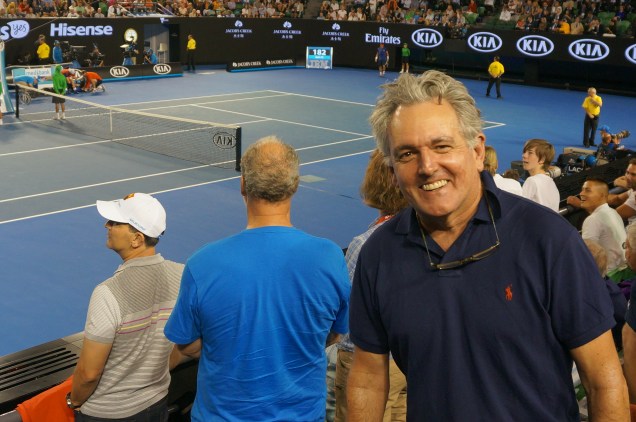
I bought a ground pass with the intention seeing if I could score a ‘returned’ ticket to Centre Court. There was a bit of wait in the line, but I was lucky – I was able to get a returned ‘Corporate’ ticket for the night session. The main match was Leyton Hewitt against Spain’s David Ferrer.

As I walked away from the ticket booth, a bloke who was also in the line approached me. He said that he overheard that I had bought a ticket for “tonight’s session”. He said “how does that work?”. “They told me it was full”. I told him that “I was just lucky”. As we were chatting, three Emirates Air Hostesses walked up. One of them asked if they could take a photo of me with the other two. I obliged and asked her to take a photo with my camera.

About a month ago an ex APEC Taskforce colleague put a photo of a group of Emirate Air Hostesses on his Facebook page. He asked the viewers, “what is the collective noun for a group of Air Hostesses?” I suggested – “An Opportunity”. I know that that is a bit lame, but he thought it was funny.

The above is the explanation to my comment on the profile picture I put on Facebook, if anyone is interested.

The match was OK. Hewitt tried hard, but was well beaten in straight sets.
I won’t comment on the Bruce MacAvaney interview with Hewitt after the match. Check out the video.

Actually I will comment. Now is probably a good time for Bruce to also retire.

Flickr Link

https://flic.kr/s/aHsksjV59H