Outback Adventure – QANTAS Founders’ Museum

After an over 24 hour train ride on the Spirit of the Outback, I was now in a very hot Longreach.

No Tours on Offer
On the morning of my first day, I walked into town. My task was to find out how I could get to Winton to see the dinosaurs and the Banjo Patterson Centre.

The woman in the Visitor’s Centre was very helpful, but she gave me some disturbing news:

“The local tour company normally runs a bus out to Winton and the dinosaur centre every Wednesday. They take people that have arrived by the train. Unfortunately, this week there have been not enough bookings to make the tour viable.

Apparently, most of the people on the train are on a tour organised by a company called ‘Fun Over Fifty’. They have their own bus out here and are apparently doing a trip out to Winton”.

She did make some comments about the impact of ‘big city’ businesses, but I won’t go here.

The upshot of all this was that I called the headquarters of ‘Fun over Fifty’ and was able negotiate to join their trip to Winton which was to take place on Wednesday.

Walking in a Cloud of Flies
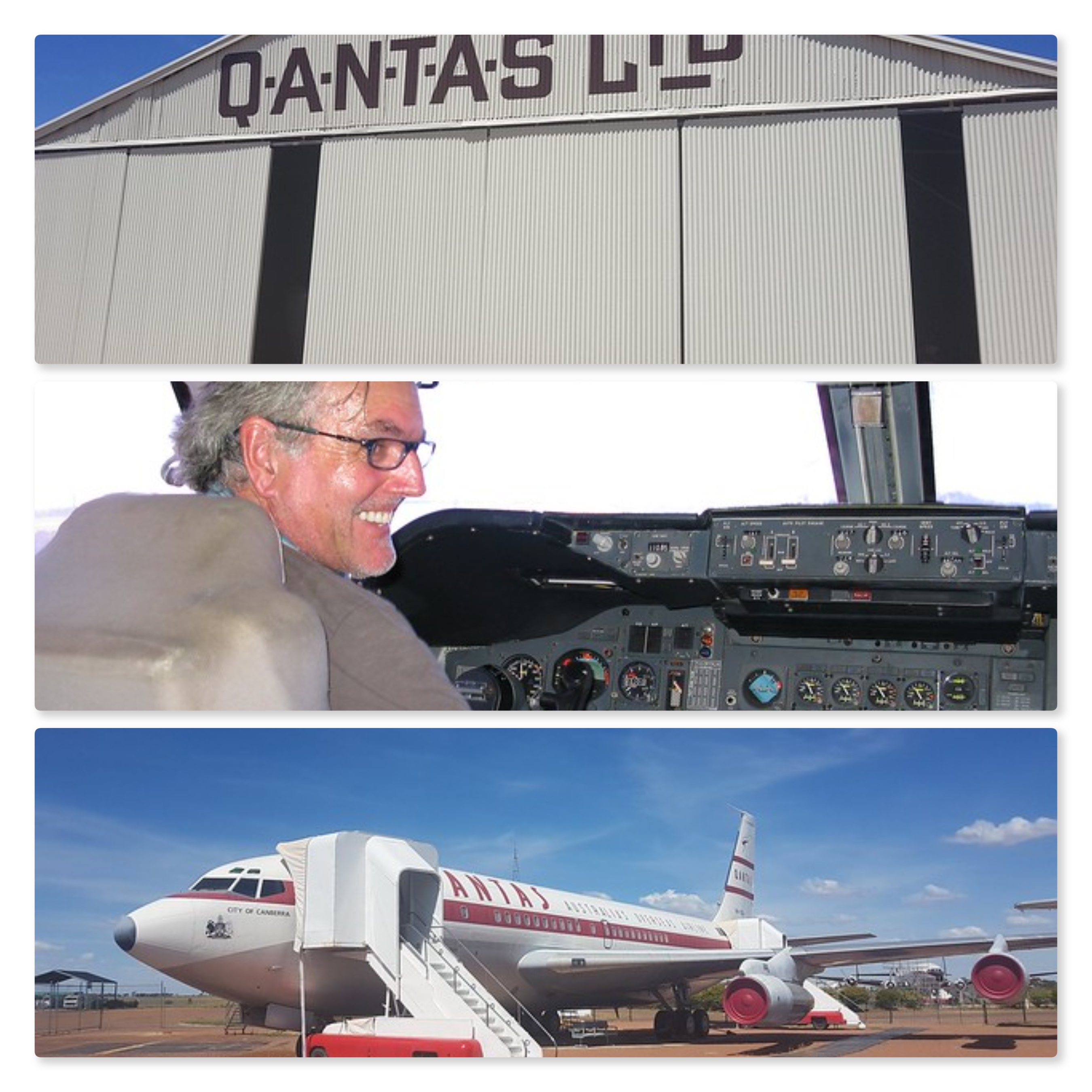
After sorting out the Winton trip, I walked to the QANTAS Founders’ Museum.

By this time the time, the temperature was well over 40 centigrade. It was a relatively short walk but it seemed to take forever in that heat.

As I walked along, I was surrounded by a cloud of flies. I can remember flies when I was growing up in Canberra before the days of the ‘dung beetle’. However, I cannot recall seeing flies on this scale.

QANTAS Founders’ Museum
I think every Australian knows that its best-known airline began its life in Longreach. The Queensland and Northern Territories Air Services company is of course known by its acronym QANTAS.

The airline is famous for all sorts of reasons. It was the was one of the first, if not the first, ‘International’ airline company. The Dutch KLM and British Airways also make that claim. It is also famous for its safety record – remember that line in the film ‘Rain Man’.

I, like many Australians, have had many QANTAS experiences. These were brought to mind when I visited the museum. More about that later.
The museum consists of an exhibition area that explains the formation of the airline by men that served in the ‘air wing’ of the forces who fought in World War One.

When they returned to Australia, they saw the benefit that aeroplanes would bring to the country, the ‘outback’.

At that time Longreach was at the end of the rail line that extended from Brisbane. There was ‘market’ for a transport service beyond Longreach. Aeroplanes could provide that service.

Initially, the main business was carrying mail and ‘barn storming’, however overtime carrying passengers became a significant part of the business.
After the Second World War commercial air travel took off. QANTAS under government ownership was at the forefront of that development.

My Memories of QANTAS and TAA
Many people will know that when government became involved in the airline industry, they owned QANTAS and Trans Australian Airline (TAA).

There was also the privately-owned Ansett Airlines.

I recall what was probably my first flight. It was on a Viscount Electra operated by TAA. The flight was from Canberra to Brisbane from around 1962 or 63.

Moving on, my first overseas flight was on a QANTAS 707 flight from Rome to Singapore in 1967. I had travelled to the UK with my parents on the P&O liner the Canberra. Our return trip included the flight from Rome. I recalled that flight involved stops in Cairo, Karachi, Calcutta before landing in Singapore. We stopped in Singapore for a few days before flying back Sydney. This involved a refuelling stop in Darwin.

There is a Boeing 707 at the QANTAS Founders Museum. Seeing it brought back memories of that trip to the UK.

As was noted by the museum guide, the Boeing 707 was a truly transformative aeroplane. It enabled many people to fly long distances for the first time.

Another aeroplane on display is Boeing 747, another truly transformative machine.

My first experience of a Boeing 747 was flying with QANTAS from Sydney to London in July 1977. This was followed another flight on 747, this time on Cathay Pacific, from Sydney to London via Hong Kong in 1982. There was another 747 flight on my return via the USA the next year. That flight was with QANTAS from San Francisco with a stopover in Honolulu.

In 1984, I joined the Department of Foreign Affairs. This meant I was flying most months of the year for next 4 and half years. Many of these flights were on QANTAS 747s. I can also recall flying on an Air India 707 from Lagos to Nairobi.

One of the pleasures for flying for ‘Foreign’ was traveling Business Class. QANTAS was the first airline to introduce ‘Business Class’. Of course this was copied by other airlines.

After I left the Department of Foreign Affairs, I joined Caltex. That job also involved overseas travel. Most of that on a QANTAS 747. I was often able to use frequent flyer points to upgrade to first class.

Extra’s on the Tour
The Museum offers a number of versions of their tour. I took the one that included being able to sit in the cockpit of the 747, going into the ‘hold’ and a walk on the wing. It is a little bit expensive, but worth the extra cost.  You also get more time with the guides who are very informative.

Lockheed Constellation
As well as the Boeings, the museum also has a Douglas DC3 on display. They have also have Lockheed Constellation which is in the process of being restored. The Constellation was the most popular aeroplanes for long distance air travel before the arrival of the Boeing 707.

One of my uncles was a medical scientist. In the 1950’s he did a lot of work with the World Health Organisation (WHO). This involved a lot of international travel to Europe and the USA. These trips were on a QANTAS Constellation. I have memories of my mother being very impressed by the fact that her brother ‘could get all the way to New York in a matter of days’.

Other Stuff
As well as the above mentioned aeroplanes, the museum also has pre-war planes that QANTAS used. These are stored on the original QANTAS hanger.

There are also other exhibits in the main museum building. These include audio visual displays with information on the founders of the company and other notable men and women in the early days of the aviation industry in Australia.

There is also a theatre which shows a short film about the history of QANTAS.

Flickr Link
QANTAS Founders’ Museum
https://flic.kr/s/aHsmzqfqHn

Outback Adventure – The Train Out

QR Train Collage
I have travelled quite a bit in Queensland, however, I have never been into the true ‘outback’. For some time, I have wanted to go to Longreach. This year I decided to do it.

Booking the Train
I had prior experience with Queensland Rail when booking a trip to Hervey Bay after Christmas.

This was an interesting experience to say the least. Curiously, the QR ‘Travel Centres’ were closed on every day from Xmas until after the new year. That meant dealing with the telephone ‘service’ which was undermanned. It was not possible to use the on-line service because it does not do ‘seniors’.

This time the issue was the bike. QR does recognise that there is such a thing as a folding bicycle. For them a ‘bicycle is a bicycle’. This also means that it has to put and a ‘bike box’ with its peddles and handle bar removed. Of course, this is completely unnecessary if it is a folding bicycle.

I won’t bore with the details of the discussions I had with QR over this issue. The discussions went on for several days. The upshot was that a comment was put on my reservation stating, “Brisbane Customer Service has given permission for a folding bicycle to be carried in a bag”.

On the Train
I boarded the train around one o’clock. As I made  my way to my compartment, the first thing I noticed was the ‘curvy’ corridor. Check out the Flickr photo.

The first ‘Eating Event’
Once away, train headed north out of Brisbane.

It wasn’t long before we were offered ‘afternoon tea’. This was to be the first of a seemingly endless series of ‘eating events’ they were to be offered on the journey.

Fun over Fifty
The afternoon tea was served in the dining car. I noticed that the people at my table were wearing ‘name tags’. It turned out that they were part of an organised tour run by a company called ‘Fun over Fifty.

It seemed that many on the tour had joined the tour ‘unknowingly’.  They had booked the trip in response to an advertisement in the Royal Queensland Automobile Club (RACQ)  magazine without looking at the ‘small print’. Anyway, this tour accounted for most of the people in the ‘sleeping class’ on the train.

Move into the Club Car
After afternoon tea, most of the passengers moved into the ‘Club Car’. This a bit ‘old world’ with  leather lounge type seats. It is no wonder that the train is so long. The passengers spent time in their compartments, in the dining room and in the club car.

That is a lot of ‘moving real estate’ for relatively few passengers.

Chatting with English Couple over Dinner
It didn’t seem long before we all back in the dinning car for dinner.

The meal was excellent.

Over dinner I chatted with an English couple. They were also part of the ‘Fun over Fifty’ tour. They told me that they had been booked on another tour that was cancelled.  They were offered this tour as a replacement. I was yet to meet anyone who had ‘actively’ booked on the tour.

The English couple told me that they lived near Maidstone in Kent in the South East of England.. I told them that I knew Maidstone and other parts of Kent quite well. I wont bore you with all the details, but we found that we had some ‘connections’.

In summary those connections are:

I told the couple that In September 1983 I met a girl in the nightclub in Maidstone.   The club was called  called the ‘Warehouse’. This caused the wife to laugh. It appeared that they could have been in that nightclub that night.

The girl I met came out to Australia in 1985, however our relationship didn’t last.

I told that couple that girl lived in a village called Upchurch which is near to Maidstone.

The husband told me that he knew Upchurch well. He had played at private golf club in Upchurch for some years in 1990’s before they temporarily moved to Spain.

That golf club was owned by the above-mentioned girl’s father. The husband  knew the owner, the girl’s father, quite well when he played at the club.

I told the couple that I had gone to the nightclub with some people who were living in Maidstone at the time. This included a couple who later moved to Tunbridge Wells. I am still in contact with the wife of that couple.

The daughter of that family has married a local musician called Fred Clark. The English couple told me that they are Fred Clark fans and often go to his gigs.

I guess all that is an example of ‘six degrees of separation’.

Good Night’s Sleep
After dinner and few drinks in the club car, I headed to my compartment. The seat was quickly converted into a bed by the attendant.

I was soon asleep as the train rattled on into the night.

Heading West
During the night the trained passed through Rockhampton and then turned west.

We were well inland by the time I woke up.

Breakfast was served not long later. It was very good.

Barcaldine
The train stopped for a sometime at Barcalbine. This is famous for its ‘Tree  of Knowledge’. This commemorates the ‘shearers strike’ of 1861. That strike led to the formation of the Australian Labor Party.

As we rattled along we had lunch – another good meal.

Due to the heat, speed restrictions came into play. This meant we arrived into Longreach a couple of hours late.  This is not a big issue on a train journey that takes over 24 hours when it is ‘on time’.

Short Ride to Accommodation
It was a short ride to my accommodation. Even though it was almost dark, it was still very hot – around 35 centigrade.

As well as the heat, the other thing that was obvious were the flies. These were going to t a constant companion for the next few days.

Mosman Resident
Two of the other quests where I was staying had also travelled out on the train. They were an Englishwomen and her German girlfriend.

It turned out that the Englishwomen lived in Mosman. They were very interesting to talk to.

Flickr Link

Train to Longreach
https://flic.kr/s/aHsmBR1VHS

Barcaldine Link
https://www.environment.gov.au/heritage/places/national/tree

Down to Victoria and Taking the Brompton on Railtrails

Rail Trails
It was time to leave Sydney and head to Melbourne. As is my want nowadays, I decided to take the train.

Very Hot
All went well on the train until we passed Yass. The temperature started rise sharply. You could actually see the heat. The sky was simmering.

As we approached Wagga Wagga the temperature was over 40 centigrade. The woman sitting next to got off in Wagga and was replaced by another. My new travelling companion was quite forthcoming regarding the heat. Said she it was ‘like a bloody oven’.

As we passed The Rock, and headed to the Victorian border, the temperature got even hotter. It was now over 43 centigrade. An announcement was made that train was now subject to ‘speed restrictions’ due to the heat. The top speed was to be 80 klms per hour, which is less than half the normal travelling speed on this part of the track. As such train was expected to arrive in Melbourne over two hours late.

A little while later another announcement was made informing us that, “the air-conditioning in the buffet car had stopped working. As a result, the buffet would be closed for twenty minutes before opening again for twenty minutes. This would continue until it was to close just before arriving in Melbourne”.

We were also informed that due to the heat, “there would be no hot meals because it was not possible to use the ovens. However, hot pies and sausage rolls will be available as they can be heated in the microwave”. This was followed by the comment, “why anyone would want a hot pie on day like this, I can’t imagine”. This was met with laughter throughout the train.

The train finally limped into Southern Cross station well after ten o’clock

Some Tennis
I really like being in Melbourne at this time of the year. It is when the Australian Open is being played. I caught some of the tennis.

I also saw a very funny ‘one man show’ about John Newcombe (the Newk). It was a great night – excellent company and a good show.

Some Rides
It was great having the Brompton in Melbourne. I went on few rides including a ride from the CBD to Williamstown. This took me past places that I visited when I worked for Caltex and TNT.

Down to Geelong
After a few days in Melbourne, I took the train to Geelong. I stayed at the Deakin University Campus at Waurn Ponds. This was close to where some friends I had arranged to visit live.

There were a lot of blokes wearing cricket gear in the residential college where I was staying. I asked them, “what completion are you competing in”. They didn’t answer. I thought, how bloody rude are they’? A bloke who was obvious part of the group told me that, “cricketers are deaf”. I felt a ‘bit of a shit’.

Bellarine Peninsular
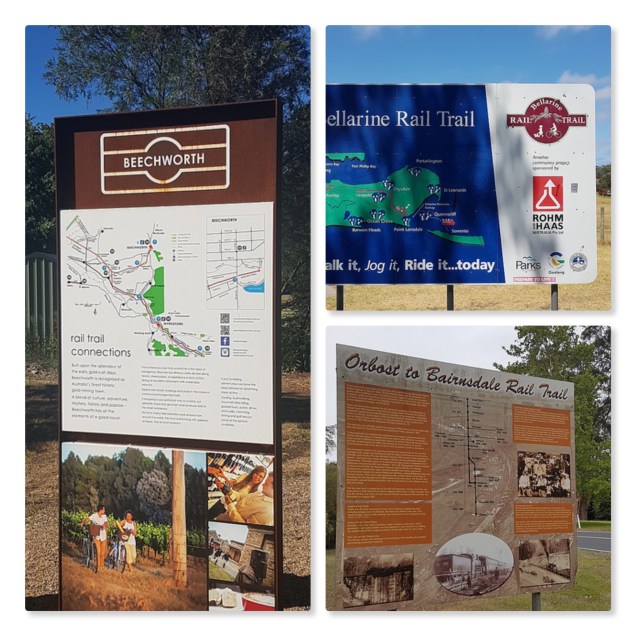
One of the reasons for traveling to Geelong, was to take the Brompton on the Bellarine Railtrail. This runs from South Geelong to Queenscliff. The trail doesn’t run through a particularly interesting area.  However, the destination is actually a nice little town with some very good Victoria era buildings including the Grand Vue Hotel.

I have ridden on the trail rail twice before on the Badboy.

It was interesting to see how the Brompton did in comparison. The trail is a mixture of sealed surface and hard packed gavel. The Brompton performed well on both. The reduced number of gears compared to the Badboy was not an issue as the Railtrail is very flat.

I took the bus from Queenscliff back to Geelong. This of course wasn’t an issue as I simply folded the bike and hopped on board.

Catching up London House Mate
I took the train from Geelong back to Melbourne.

I had arranged to meet up with a New Zealand bloke that I had shared a house with in London in 1979. He is a very interesting character. He and his wife stayed in London for a number of years before moving to Melbourne where they established a Travel Agency.

One of their specialities was trips to the USSR before the end of the ‘cold war’.

I arranged to meet him at his office in town.

When the office closed, we drove out to his house in Upper Ferntree Gully near the Kakoda Track Memorial Walk. It was great to catch up and chat about ‘old’ times.

Hot Train to Bairnsdale
The next morning, I took the train into Southern Cross Station and then caught a regional train to Bairnsdale. It was incredibly hot.

At Bairnsdale, I caught a bus that took me onto Orbost, I checked into The Commonwealth Hotel. This a classic ‘country’ hotel.

The North East Gippsland Railtrail
In the morning, I headed off on the NE Gippsland Railtrail. This was the third time that I have ridden on this trail. The last time was in March 2018.

This was to be the first that I rode the Brompton on an unsealed surface while fully loaded.

They were times when the ride was a little tricky, but for the most part the bike performed well on the surface.

Nowa Nowa
I stopped in Nowa Nowa and checked into the Tavern. This turned out to be a must better experience than staying in the Caravan Park as I did the previous year.

One of the features of the Tavern is a great collection of VW Combi memorabilia. Check out the Flickr photos.

Rain after Nowa Nowa
It rained very heavily overnight. As I  headed on towards Bruthen, I found it hard going on the soft surface.

I made it to the famous Nowa Nowa viaduct. This is the biggest timber bridge on the railway. Checkout the Flickr photos.

As I checked my front bag, I realised that I had left something important back at the Tavern. I needed to return to Nowa Nowa to collect it.

Fortunately, there were a lot of tourists visiting the viaduct. Most of them were driving 4WD’s. I found a young couple who were heading to Nowa Nowa and were willing to give me a lift.

Bus to Bairnsdale
After that little episode, I decided to ‘whimp out’ and take a bus to Bairnsdale. This meant missing some of the Railtrail, but given the wet conditions, it was probably a good idea.

I stayed in the Terminus Hotel. This is yet another ‘classic country’ pub.

Back to Bruthen
The next morning, I was back on the Brompton and on the RailTrail to Bruthen. This part of the is largely sealed. Where it is not sealed, the gravel surface is hardpacked and very well maintained. It was easy riding.

I stayed in the Bruthen Hotel. It is okay.

I had hoped to have a meal and a beer at the Bullant Brewery, however it was unfortunately closed.

Bus to Omeo
Next day, I took the bus up to Omeo via Dinner Plain. Again this proved the benefits of the folding bike. This is not a very good cycling road, with a very narrow (or no) shoulders. It is a dangerous road for touring cyclists.

I stayed in the Golden Age Hotel. This very ‘up market’ for a country pub. It clearly gets some ‘snow’ business in the winter.

Staying in  the pub reminded me of a ride in January 1976. That ride was from Canberra to Melbourne on trail bikes. The visit to Omeo prompted me to ask one of mates on the ride for copies on the photos he took. They are in a link below. I hope to post about that ride soon.

Bus to Hotham
The next morning, I checked out of the hotel and wandered down to the bus stop to catch the bus to Mt Hotham.

The only other passenger on the bus was a woman who was traveling to Bright to do some shopping. She told me that she “liked shopping in Bright, as opposed to Bairnsdale, because it took all day”. I guess that is a better reason than none.

Big Storms
As we passed through Dinner Plain, it started to rain and the clouds were very dark.

My plan was to ride from Mt Hotham down the mountain to Harrietville and onto Bright. However, conditions were giving me second thoughts.

It was really pouring down with rain when we arrived at the transit station in Mt Hotham. The bus driver assured me that the weather would clear soon.

To cut a long story short, the weather did no clear. In fact, it got decidedly worse including lightning and thunder. I made my way down to only eating establishment that was open. It was packed. There were about ten cyclists in the place and I was told at least six had taken taxis down the mountain.

Car Ride to Bright
The staff in the place suggested that I ask around to see if anyone could give me lift down that mountain. A short time later another cyclist arrived looking very wet and cold. He told me that it was “seriously scary out there, particularly the lightning”. He had called his wife in Bright and told her to come up and collect him.  He said they could give me a lift.

It was sometime before she arrived.

As we drove down that mountain, we chatted. The wife told me that she was brought up in Papua New Guinea in the 1960s and 70’s, before ‘independence’. Her father was Swedish and was working in PNG as an Australian Patrol Officer. It was all very interesting.

When I arrived in Bright I checked into the Alpine Hotel. It is going through a serious refurbishment.

I had dinner at the Bright Brewery. I visited this place when it first stated over 10 years ago. This business appears to be going really well.

Bright to Beechworth
The next part of the ride was on the ‘Murray to the Mountains Railtrail’. This follows the old railway line that went from Wangaratta to Bright. It was very popular in the late 1800’s and early 1900’s when Melbournians used it to get into Alpine region and stay in places like Mount Buffalo.

One of the  original reasons for it to be built was to service the gold fields around Beechworth

The trail out of Bright follows the Goulburn river. This is a beautiful part of the country.

After Myrtleford, the trail heads west past some wineries.

As I rode along, it started to get quite hot.

At Everton, I turned north up the ‘spur line’ to Beechworth. This is along steady climb over 16 klms. The Brompton is not ideal for this type ride, but it did okay.

Beechworth is a great town. The historic streetscape has been preserved.

I stayed in the Tanswell Hotel.

Run down to Everton and Into Wangaratta
The next morning, I headed back down to Everton. I was a cool morning and the slope made it an easy and quick ride.

From Everton the trail is basically dead straight until you hit the Hume Highway. It is then short ride into Wangaratta.

I stayed in Wangaratta over night before taking the train to Wodonga and the bus onto Canberra.

Flickr Links

Bellarine Peninsular

20190123_160444

The North East Gippsland Railtrail

20190126_123329

Murray to the Mountains

20190131_172358

Melbourne Ride 1976

VIC-07

Garmin Links

Bellarine Peninsular
https://connect.garmin.com/modern/activity/3323392953

The North East Gippsland Railtrail
https://connect.garmin.com/modern/activity/3330553570
https://connect.garmin.com/modern/activity/3334141010
https://connect.garmin.com/modern/activity/3338899036

Murray to the Mountains
https://connect.garmin.com/modern/activity/3344252167
https://connect.garmin.com/modern/activity/3346473082

Riding the NE Gippsland Railtrail in 2018

East Gippsland Rail Trail

Grafton and Yamba

Yamba
After a week in Sydney it was time to head north.

I decided to take the train as it is by far the most comfortable option.

Train to Grafton
There was a short wait at the Central Station due to the fact that one of the XPT’s locomotives had to be replaced. One of the NSW Trains staff commented that “this was not a surprise given the age of the trains”. The XPTs are well past ‘their use by dates’ and are due to replaced in 2020, if all goes to plan.

The XPT is based on the ‘125’ trains in the UK. These trains are still being used on the Great Western line and the North East line as a result of delays in the electrification of the tracks. Albeit they are old trains, they are still pretty good.

The train was mostly full all the way to Coffs Harbour. This bodes well for the future. It is clearly a service that is needed. It was almost empty from Coffs Harbour to Grafton. The staff told me that most people prefer the earlier train if they are going that far.

Day in Grafton
I was booked in the Crown Hotel which is next to the Clarence River I have in this hotel a few times. It is a classic country hotel. The rooms are simple, but clean. It has a great balcony over looking the river.

I spent a day in Grafton. There is much to do there but is a pleasant enough town.

Ride to Lawrence
The next day I headed out of town on my Brompton. This was the first time that I had ridden it ‘fully loaded’. This meant with the 30 litre front bag packed with my computer and other ‘heavy stuff,’ and the 50 litre duffel bag full of my clothes.

The arrangement worked well. The bike does not handle very differently than if does without the bags. Keeping the weight as low as possible seems to be the key.

The route to Lawrence took me on the inland side of the Clarence River. It is a wide river at this point notwithstanding  that it is only 394 kilometres long.

It is a very pleasant ride past diary and sugar growing farms. The road is narrow, but not busy.

Lift into MacLean
Shortly after the village of Lawrence there eis a ferry that crosses the river to the road that takes you into MacLean. This road is very busy.

As I waited for the ferry, I got into a conversation will a bloke driving a Ute. He was interested in the bike. He also turned out to be a cyclist and offered to give me lift into to town. He said that he never rides on this road when it is busy.

It was simple to unload the bike, fold it up and put in the back of the Ute. The Brompton has passed its second test.

Bus to Yamba
I had a about an hour’s wait in MacLean before catching the bus to Yamba. I had decided to take the bus on this leg because that part of the road is even worse for cyclists that the road into to town from Lawrence.

As I waited for the bus, I chatted with an older bloke and his daughter. He told me that he was a retired panel beater. He said that “he suffered lead poisoning” as a result of years working will leaded paint. He said that it has made him very sick and there was no cure. The whole thing clearly upset him and his daughter. I know there are a lot of jobs that are dangerous to your health. I suspect it was known that lead in paint was injurious to health low before the people who were being impacted were informed.

The bus ride into Yamba was a simple exercise. I placed the folded bike on the floor where wheel chairs go. The bags were placed on the luggage ranks.  The Brompton has passed its third test.

Yamba is a Top Spot
I like Yamba. In some respects, it is still a ‘well kept secret’. It is not as popular as Byron Bay or Noosa. However, this may not stay that way. It has a lot going for.

While I was in Yamba I went on a couple of rides on the bike.

Previous Posts
There are links to previous posts about travelling in this area below.

Flickr Links

Grafton
https://flic.kr/s/aHsmxEbG45

Yamba
https://flic.kr/s/aHsmoEVCvA

Links to Previous Posts

Grafton to Brisbane April 2018

Grafton to Brisbane

Long Ride 2013

SYD2BNE Days 9 to 12

Garmin Links 

Grafton
https://connect.garmin.com/modern/activity/3223359127

Yamba
https://connect.garmin.com/modern/activity/3229746025

My new Bicycle

Brompton 2

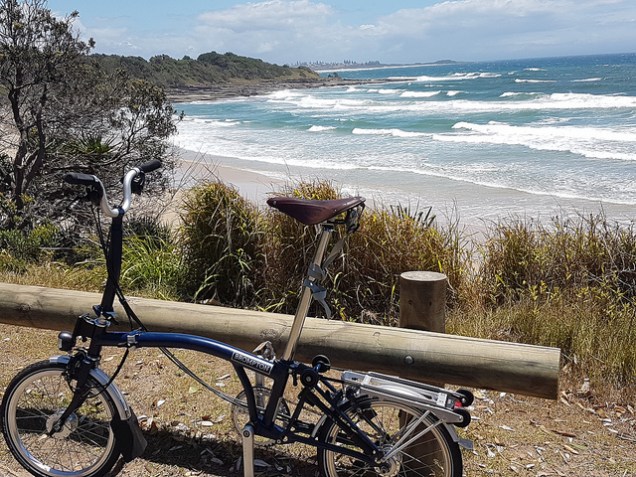
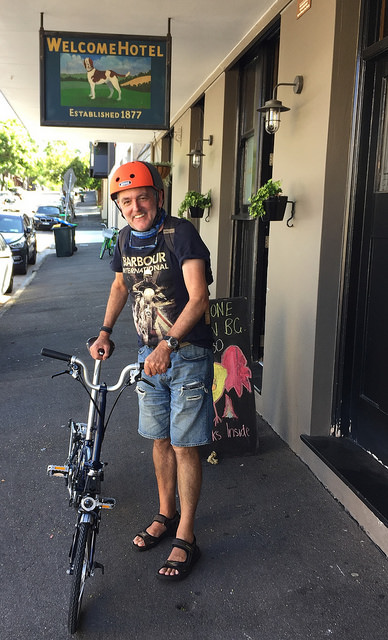
I am now the proud owner of a Brompton folding bicycle.

Very Popular in London
I have been aware of these bikes for some time. They are very popular in the UK, in particular London where they are made. Most people use them as commuter bikes. They very handy for a short ride from home to a train station where they can be folded and carried onto the train. There are no restrictions as when and where they can be carried on trains. At the other end they are simply unfolded and are ridden to the place of work. In their folded state, they easily stored, for example, under a desk.

Using them for Touring
On my travels around the UK and Europe on my Badboy which has been modified for touring, I have been coming across more and more people touring on folding bikes. The majority of these are Bromptons. I have chatted to the owners of these bikes about their experiences.

The reason the owners give for using their Bromptons for touring is ‘convenience’. Travelling on a bicycle in the UK and Europe is becoming more and more problematic where it involves the use of public transport.

Carrying bikes in the UK
In the UK, there are restrictions on when you can take bicycles on commuter trains. They cannot be carried on trains during peak hours. It is also difficult to carry them on ‘long distance’ trains. You have to book a ‘slot’ at least a day in advance. Also, as the older trains with freight compartments are replaced, the available ‘slots’ are fewer in number. The new trains only have a couple of places for bicycles.

Travelling with bicycle on a bus in the UK has never been a option. City buses and ‘Greenline’ buses that operation in country areas have never allowed bicycles to be carried onboard. Unlike many areas in the USA and buses in the ACT, these buses do not have bike racks on the front.

The ‘coach’ operators required that bicycles are ‘boxed’, if they will permit them to be carried. Often, they don’t even permit bicycles at all.

Carrying bikes in Europe
Arrangements for carrying bikes on public transport in Europe are generally better than in the UK. In France, there are usually plenty on places for bikes on ‘regional’ trains. This is also the case in Germany, Austria, Switzerland, Belgium and Holland. It not so good in Italy.

However, it is becoming more difficult to travel with a bicycle in Europe on ‘long distance’ trains. Most of the ‘long distance’ routes are serviced by ‘high speed’ trains. In Germany for example, there are no places to carry bikes on the ICE trains. In France, the new TGV trains only have two slots. These have to be booked at least a day in advance.

Folding Bikes an Option
The people I have chatted to have found folding bike to be a viable option to normal touring bikes for travelling in the UK and Europe.

They told me that that “they obviously have their limitations”. Obviously, they cannot carry as much luggage as a touring bike. Also, they are not as comfortable to ride and are clearly not designed to be ridden for 100 kilometres or more in single day.

However, most said things along the line, that: “they carry enough if you are prepared to travel light”, ”, “they are great for getting from the train station to your accommodation in your destination city”, “they are perfect for sightseeing”. And of course, “there are rarely, if any problems, taking them on public transport”.

The Situation in Australia
I have ridden my ‘touring bike’ a lot in Australia. Over the years, I have ridden virtually everywhere I want to ride in Australia. This includes: the coastal route from Sydney to Brisbane, the same ride with some ‘inland’ diversions. The Victorian coast, including the Great Ocean Road, The Mawson Trail in South Australia, the Alps and the Murray River, South East Western Australia.

I have enjoyed these rides, but parts of them have not been so good. The biggest problem about riding in Australia is that there are a lot of ‘bad bits’ between ‘good bits’. For example, there are a lot parts of the Sydney to Brisbane where you are forced to ride on a dual carriage motorway. In other areas, for example, along the Murray River, the roads are very narrow with no shoulder.

Checking out the Bromptons
When I was in London in late September, I visited the Brompton shop in Long Acre near Covent Garden. This is their ‘flagship’ shop with all of the models they sell.

I checked them all out including the configuration that is the best for touring. They are all pretty much the same. The ‘touring’ model has six gears (a three-gear hub and high and low derailer), a rack, dynamo lights and higher handlebar.
I took the demo bike for a ride. It is rather strange at first. The small wheels make steering very quick. Also, the bike is very light. However, after less than five minutes you get used to it.

Some more Research
After leaving London, I flew to Helsinki and travelled through the Baltic States. I occasionally looked up the Bromptons on the internet. In particular, I was interested in see how people had used them as touring bikes.

I was amazed how much stuff there is on the net about using Bromptons as touring bikes. Some people go ‘the whole hog’ including carrying camping equipment.
By this stage I had pretty much decided to buy one.
I made contact with the Australian agent for the bikes to discuss availability and pricing.

The Deal is Done
There was a bit of ‘to and throwing’ with the Australian Agent while I was travelling is Sri Lanka.

This ended in a phone call. He was very persuasive. At the end of the call I had committed to buying a blue Brompton with the ‘touring’ specifications. The price was based on the agent’s belief that the Australian Dollar would continue to depreciate against the British Pound. Even though I thought he was wrong, I agree on the price.

Taking Delivery
I finally arrived back in Sydney at the beginning of December.
I fronted up to the bike shop in Redfern and took deliver of the Brompton and the other bits and pieces I needed. These were: a front bag, tool kit, lightweight lock and a helmet.

First Ride
My first ‘real ride’ on the bike was from the CBD to Balmain for a lunch. It went well.

Setting up the Luggage
The only other thing I had to do was to set up the arrangement for carrying my luggage.
The heavy stuff, i.e. computer and other electronic stuff goes in the front bag. The ‘bulky’ stuff goes on the rack at the back. My research on the internet had suggested that the biggest bag you should use is 50 litres. I had bought a NorthFace duffel bag which seem to be ideal.

All I had to do was fix it to the bike. I had seen a video on YouTube showing how this can be done. It involved tying an aluminium tube about 20 centimetres long to the back of the Brooks Saddle. The shoulder straps of the bag are placed over the tube. The bottom of the bag is held to the rack by the straps attached to the rack. The shoulder straps are tightened to hold the bag steady.

The arrangement seemed to work. I was all set to go.

Train to Grafton
The first leg of my ‘touring’ on the Blue Boy Brompton was a train trip to Grafton.

I will post about my experiences.

Flickr
https://flic.kr/s/aHskNRyk61
Garmin
https://connect.garmin.com/modern/activity/3213237309


Cricket in Sri Lanka

Galle Cricket
I decided to travel to Sri Lanka before I left England for the Baltic States. I had often thought about travelling there and finally decided to do it.

Vague Memories of 1966
I was briefly in the then Ceylon in late 1966 when I travelled to the UK with my parents. We were on the P&O ship the Canberra. This was a scheduled ‘passenger’ voyage from Melbourne to Southampton, albeit we got off in Naples.

The ship stopped off in Colombo for day and a half. I have a vague recollection of the stopover.

After leaving Colombo, the ship passed through the Suez Canal. As it turned out this was the last time this happened before the canal was closed due to the ‘Six Days’ war.

ODI in Colombo
Anyway, getting back to 2018, as it turned out, my visit to Sri Lanka coincidental with the England Cricket Team’s tour of the country.

By the time I had arrived, the Englishmen had already won four of the five One Day Internationals (ODIs). This final match was being played in Colombo. I decided to go at the last minute.

I took a Tuk Tuk to the ground. The driver dropped me off at a point that turned out to be almost exactly opposite to the main gate and ticket office.

I was immediately surrounded, by a group of blokes, all trying to sell me a ticket. The group got larger as I made way around to the main gate. I walked up to the ticket office where I was told, I my complete amazement, that it was “not possible to buy a ticket”. I was told that I should buy a ticket off “one of the men behind me”.

This seemed very strange as I had no way of knowing what a legitimate ticket was and what wasn’t.

As I stood there pondering what to do, I heard a bloke with a English ascent say “I think I may be able to help you”.

It turned out that he was at the ticket office with his Sri Lankan wife to collect tickets they had been given. She spoke to three or four blokes trying to sell me tickets and picked one she trusted. I handed over the required Rupees and took the ticket.

I ended up sitting with the English bloke and his wife. He is from Birmingham and albeit, he is in his fifties, he is still playing competitive cricket. As he proudly pointed out, he bears a remarkable resemblance to Ian Botham, the English all-rounder. He has some very interesting things to say about all things cricket both in England and Sri Lanka.

As it turned out it was a bit of dud, match. The Sri Lankans batted first and got off to excellent start. They were only a couple of wickets down after 25 overs and then powered on to get 366.

When the Englishmen came out to bat, the conditions has changed completely. The lights were on and the humidity had shot up with rain threatening.

The ball was swinging all over the place. The Englishman lost with only runs on the board. They lost another on 28. They then consolidated, but the match was already lost.

After about 15 overs, I decided to give a day and go to the Cricket Club Café, about 2 kilometres away, for a late dinner.

Just as the Tuk Tuk arrived at the café, the heavens opened. The Englishmen were 9 down for just 132 and the match was decided using the Duckworth-Lewis formulae. The result was England’s heaviest ODI loss ever. I suppose I had witnessed some sort of history.

Train down to Galle
There was nearly a two week break between the ODI series and the start of the ‘real stuff’, i.e. the Test Matches. I went to the ‘highlands’ and the ‘north’ of the country during this time. More about that in separate post.

I decided to go to Galle for the first Test Match. This meant catching the train heading south along the coast from Colombo. It was not possible to reserve a seat, you can only buy them ‘on the day’.

When I arrived at the Colombo Fort train station, I was confronted by a long queue of mainly grey haired, or bald, Englishmen waiting to buy tickets. Clearly, they were also heading to Galle.

The system is that everyone, who wants a ticket is sold one. There is no relationship between the tickets sold and the number of seats on the train.

When the train arrived, there was clearly going to far more passengers than seats. We all piled on. The locals and ‘non-English Cricket Supporter’ tourists were clearly bemused (or stunned) to see so many old and middle-aged men and some women on the train.

Anyway, everyone found a spot somewhere and the train head off down the coast. We stopped frequently and at one point I managed to score a seat used by a departing passenger. The line goes very close to the ocean at various points and is quiet spectacular.

Guest House
I had had some problems trying to book accommodation in Galle, clearly because of the cricket. I ended up booking two nights in a guest house about 2 kilometres out of the town.

I took a Tuk Tuk to the Guest House. It was different to say the least. This put it this way, the Booking.com description was less than completely accurate.

After checking in, I headed to the luxury hotel across the road for lunch.

Day on the Fort Wall
Next day I walked into town for the first day of the cricket.

Not surprisingly, the ground was sold out. A lot of the tickets were taken by the 12 or so, organised England supporters’ groups. These groups include the famous (possibly infamous) ‘Barmy Army’. When I was Colombo, I meet a English bloke who had some experience with these groups. He told me that some were charging over GDP 5,000 for these tours. That seems to be a total rip-off, albeit you are given the opportunity to have dinner with ex-players like Ray Illingworth and David Lloyd.

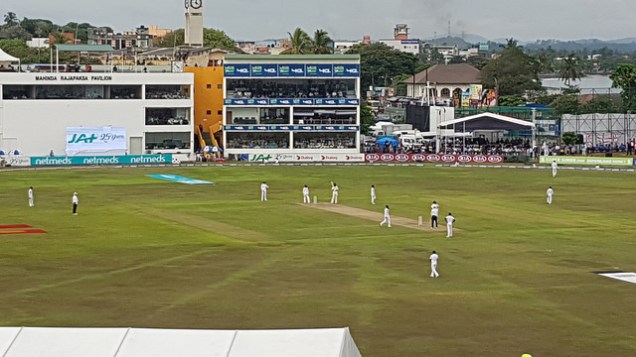
Given I couldn’t get into the ground, I was ‘forced’ to watch the cricket from the top of the wall of the Fort. This isn’t a problem given it is so close to the ground. In fact, it is just like watching from the stands at the Sydney or Melbourne cricket grounds.

There were lots of England support on the Fort. I recognised some from the train.
As you can imagine there was lot of banter and amusing comments.

I got into a conversation with a couple from near Bolton near Manchester. They were including a bit of cricket as part of holiday in Sri Lanka. They invited me to join them and some of their friends for lunch. We found a restaurant a short walk from the ground.

As far as the cricket was concerned, England had already lost 4 wickets and it looked as though their losing record away from home was going to be kept intact.

However, in the afternoon, England played well with their new Keeper, Foakes making the conditions look easy.

After the cricket, I checked out some of the accommodation, and found a vacancy for the next day in place in Pedlar St.

Moving into the Fort
The next day I moved into the guesthouse I had found. The ground was still sold out, so I spent some more time watching the cricket from the Fort, albeit it was very hot. I spent most of the day in the Fort area including a long lunch.

Final Days
I managed to get into the ground for the final days. The cricket was very good. The England opener Jennings scored a century in the second innings to help set up an England win.

Set a difficult target, Sri Lanka finally fell to the three-pronged England spin attack. The match finished late on the fourth day.

Possibility that Test Cricket will be Moved
There is talk that Test Cricket will be moved from the current ground to a larger, purpose built 30,000 plus arena outside of the town of Galle.

Because of its UNESCO heritage status, there are limits to the developments allowed to the Fort ground. In fact, the stand at the end opposite to the Fort needs to be demolished to comply with UNESCO requirements.

It will be a real pity if Test Cricket is no longer played at the ground. It is unique, being so small. It is great how it possible to watch from the Fort Wall.

Also, it is really good to be able to walk such a small distance into the Fort area, will its restaurants and boutique hotels.

Flickr Link
https://flic.kr/s/aHsmvpdUNf

UNESCO Site
https://en.wikipedia.org/wiki/Galle_Fort

Scorecards
5th ODI
https://www.bbc.co.uk/sport/cricket/scorecard/ECKO43487
1st Test
https://www.bbc.co.uk/sport/cricket/scorecard/ECKO43491


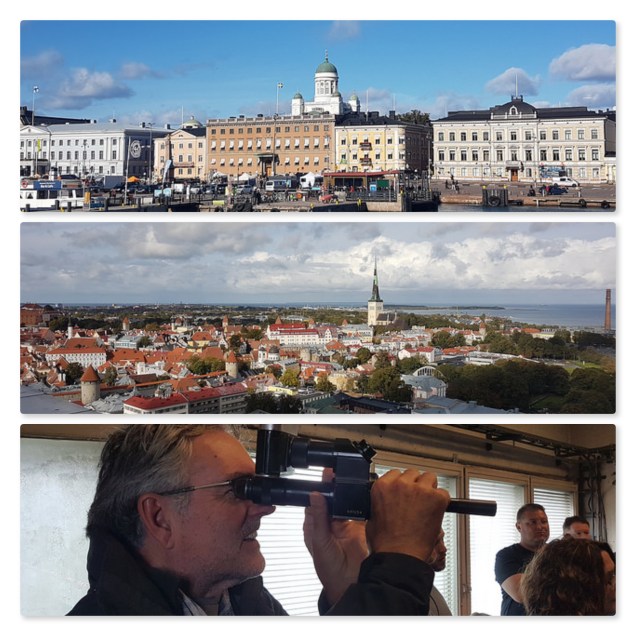
Helsinki and Tallinn

Helsinki and Tallinn
September was almost over and it was time to leave London and start heading back to Australia.

I had backed up my camping gear and some other stuff and took them and the ‘Badboy’ to my lockup.

Next morning, I headed out to Gatwick for my flight to Helsinki.

Flight to Helsinki
I flew on Norwegian Air, the same airline that I took from Orlando to London back in May. It is a budget airline but seems to have reasonable service albeit it crams its passengers into the planes.

I was seated in the front row. The person in the next seat was an extraordinary tall young woman. We exchanged pleasantries at the start of the flight, but she seemed rather aloof. During the course of the flight, the attendants came and spoke to the young woman and asked to have photos taken with her. I suspect she was a well-known sports star, albeit unknown to me.

It was raining when we landed. For some reason the plane parked away from the terminal. The walk down the steps to the waiting bus was decidedly chilly. Clearly, autumn had well and truly arrived in Finland.

Once through customs and immigration, I took the train into central Helsinki. The train was fast as I expected it would be.

From the train station, I took a tram towards the harbour and found my hostel.

Out to an Island
The next morning, I decided to go out to Suomenlinna which is an island, a short ferry ride from the city. It is UNESCO listed and has played a significant part in Finnish history.  This  included being a Russian naval base. You can read about it by following to link below.

Wind
Probably the most memorable experience on the island for me was the wind. It was incredible. Check out the Flickr link especially the photo of my hair being flattened and the video of the wind.

Salmon
The next day I went for a walk around the area close to the hostel. I had lunch on the harbour at one several stalls selling grilled salmon. It was amazing good. I also checked out the churches and other points of interest.

My overall all impression of the city was that its is very prosperous and clean.

Ferry to Tallinn
My next stop was to be Estonia.

The ferry to Tallinn was to leave at 8.30 a.m. When I arrived at the terminal here were a large number of people waiting to board the ferry. Most of the people were in the café/bar. Most these were drinking beer, not coffee.

We were all soon on board.

This was when the serious drinking started, seemingly everyone onboard was keen to have a drink. It was all quite bizarre.

The trip over to Tallinn only takes two hours.

As we left the ship I noticed a lot of the passengers were pulling ‘rolling suitcases’ that were obviously empty. A lot of these people didn’t walk far. Near to wharf there was a ‘supermarket’ selling mainly alcohol and some food. The passengers with the empty suitcases made ‘beeline’ for the supermarket.

I was to later learn that this a frequent occurrence. Alcohol is very expensive in Finland. Many people take the ferry across to Tallinn for the sole purpose of  buying cheap grog. They stock up with the grog  and head straight back home again.

Into the Old Town of Tallinn
It was a relatively short walk to my hostel which was on the edge of the ‘Old Town’.
After checking in, I went for a bit of an explore:

The Town area, is maze of cobblestone alleys, many church spires and well preserved fortresses and turrets.

The central point of the old town is Raekoja Plats and the 13th century Town Hall which has a tall spire that is topped with an iconic bronze statue of a young boy which guards the city and is known as Old Thomas.

High on hill above the Old town is Toompea Castle and the Alexander Nevsky Cathedral, which is an important Orthodox building.

On my walk I spotted a ‘gastropub’ type place. It looked like a good place for dinner. It took me ages to find it again. When I finally found it, my initial thoughts proved to be correct, it was very good.

Soviet Tallinn and the KGB Headquarters
The next morning, I went to the Tourist Information Centre and booked into a ‘Soviet Era Tour’. I have been on these in other cities, including Warsaw and Budapest. I find them fascinating.

The tour guide was a young student. Naturally, he has no memory of the Soviet occupation, but has a good of knowledge of the time. A lot of this is based on what his parents and grandparents told him.

The tour took us to various places in the Old Town which were signification during the Soviet area. These included areas that were bombed by the Soviets and buildings where they had offices and where key Russians and Estonia Communists lived.

The guide also described life under the Soviets, including food shortages and how luxuries such as cars and holidays were allocated to the people. Much of this information was based on what his family members had told him.

As we walked towards the harbour, the guide pointed out the location of the KGB Cells where dissidents were held and tortured.

The last stop on the tour was the ‘Tallinn Centre’ which was built for the 1980 Olympics. It is huge indoor arena. The place is derelict and you cannot go inside. It was really shoddily built.

After the tour, I continued on to the Hotel Viru.

“In Soviet times, any foreign dignitary or journalist arriving in Estonia would be whisked straight from the airport to Hotel Viru. Greeted by the furiously trained doormen and concierge staff, they would be shepherded into elevators and taken up to the top floor – the 22nd – where Tallinn’s finest restaurant resided” (refer to BBC Travel link below).

The Hotel Viru is particularly interesting in that it houses a KGB Museum. The Museum is on the top floor of the hotel. This is where the KGB used to run their operations to monitor the ‘guests of interest’. These were mainly foreign diplomats, business people and tourists. The rooms where they stayed were bugged for sound and there were holes in the walls through which could be used to  photograph the guests. All telephone calls were intercepted and monitored.

On the tour of the museum you are shown the equipment that the KGB used. I was particularly interested in the cameras they used. Check out the photo on Flickr.

Experiencing KGB Hotels in 1984
The Hotel Viru was an ‘InTourist’ hotel that was run by the KGB. I have a particular interest in these hotels. I stayed in them in Moscow and East Berlin when I was working for the Australian Department of Foreign Affairs in 1984.

See the links to posts on those experiences below.

KGB Cells
After leaving the Hotel Viru, I walked back into the Old Town and headed to the KGB Cells were dissidents were held and tortured. This is a particularly harrowing place. However, I do believe that places like these must be visited so atrocities like those committed in such places are never forgotten.

Train to Tartu
Next morning, I made my way the train station for the next leg of my journey.  This time, heading west to Tartu.

About Suomenlinna
https://www.suomenlinna.fi/en/

KGB Headquarters in Tallinn and more
http://www.bbc.com/travel/story/20111208-tallinns-secret-history-of-espionage

Flickr Links

Helsinki
https://flic.kr/s/aHskFojGNV

Tallinn
https://flic.kr/s/aHskFyor3t

Soviet Tallinn
https://flic.kr/s/aHsmjtKcew

Post about Moscow

Moscow 1984

Post about East Berlin

East Berlin 1984


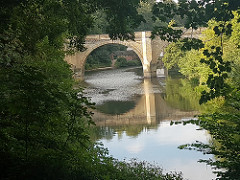
Newcastle to Durham

Durham
I spent one night in Newcastle after arriving back in England from The Netherlands by ferry.

The next day I headed off towards Durham. I had a vague plan to ride there via Chester le Street.

After leaving the centre of Newcastle, I cross the Millennium Bridge to the Gateshead side of the Tyne River and headed west.

Good Advice from Old Mak’em Cyclists
As I was riding along, I came across a couple of old blokes on folding bicycles. We ended up having a chat. They turned out to be ‘Mak’ems, that is from Sunderland. Refer to the below for an explanation of where that expression came from.

One of them told me that he was heading to The Netherlands in a couple of days by ferry. He was going to spent 2 weeks cycling around the country.
When I told the blokes that I was heading to Durham, they told me to take the ‘scenic’ route on National Cycle Route 14. This was about twice the distance of the more direct route via Chester le Street, “but well worth the time and effort”.

Rail Trails
The National Cycle Route 14, to Durham follows three rail trails – Derwent Valley, Waskerly Way and Lanchester Way.

The lines were built to service the coal mines and industrial plants in the district, in particular the steel works at Consett.

The Consett steel works were among the first in England and they were s a major industry from the start of the Industrial Revolution through to their closure in the ‘Thatcher Years’.

The rail lines were used to transport coal to the plant from the local mines and to transport iron which had been shipped from Sweden to Newcastle. The finished steel was transported back to Newcastle and to Sunderland by train. The lines were also used for other freight and passenger services.

When the lines were closed for rail services, the local county councils had the presence of mind to convert them into bicycle and bridle trails.

There is more about the Rail Trails in the link below.

Many Dogs
As I rode along I came across lots of people walking dogs.

A couple of times I stopped to chat with the owners. One of the dogs was a Schnauzer. I like Schnauzers having owned two. They are great dogs.

This particular dog was very good example of the breed. She was real character. The owner told that he had an older Labrador who was “now too old to go on long walks”. He told me that he got the Schnauzer as a puppy and she was “brought up by the Lab and did whatever he did. This included swimming in water”. It is very usual for Schnauzers to go swimming.

Not a Schnauzer
Further along the path I came across another dog that looked like a Schnauzer. When I see one, I often say “who is a Schnauzer” just as joke.

The owner of this dog relied: “I am a not a Schnauzer. I’m a Kerry Blue Terrier me” in very strong Geordie ascent. It was a classic. I wished I had the dog and the owners voice video.

Into Durham
It was later in the afternoon when I finally rode into Durham.

The reception of the University College where I had booked accommodation was closed. I rang the Night Porter’s mobile number and he let me in.
It was some time before I actually made it to my room. The intervening time was taken up by a long discussion about motorbikes with the Night Porter. The conversation was hilarious. The Porter sounded just like Oz out of ‘Auf Wiedersehen, Pet’. He told that his “favourite bike was a Yamaha 100” which he was currently rebuilding. He had Ducati Scrambler, but he “could bond with it”.

Good to be back in Familiar Place
I like Durham. It is good to be back in familiar places sometimes.

Mark Steel’s In Town
It you haven’t listed to Mark Steel’s in Gateshead, I suggest you do. It is hilarious. The link can be found below.

Flickr Link
https://flic.kr/s/aHsmrD6MBK

Garmin Link
https://connect.garmin.com/modern/activity/2975667222

Derwent Valley
https://www.newcastlegateshead.com/things-to-do/derwent-walk-p59981

Waskerly Way
https://www.thisisdurham.com/things-to-do/waskerley-way-railway-path-walking-and-cycling-route-p666901

Lanchester Way

Click to access RailwayPathLanchesterValley.pdf

Mark Steel’s in Gateshead

Not a Schnauzer
https://www.dogbreedinfo.com/kerryblueterrier.htm

What is a Mak’em?
https://en.wikipedia.org/wiki/Mackem

About Consett
https://en.wikipedia.org/wiki/Consett

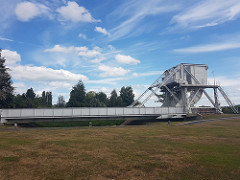
Pegasus Bridge

Pegasus 3

After spending some time in Caen, I headed the short distance along the canal towards Ouistreham.

Operation Deadstick

My destination was the Pegasus Memorial. The memorial commemorates one the most crucial events on the Normandy Landings – Operation Deadstick.
Operation Deadstick involved the capture of the Orne river Canal bridges, which would be crucial to defend the left flank of the landings and was vital for the D-Day invasion itself.

The Operation was undertaken by the British Airborne Division. It was an extraordinary operation that involved extreme risk, skill on behalf of the solders and some luck. The operation turned out to be a great success.

The operation involved the landing of three Horsa gliders containing soldiers and equipment on the evening of the 6th of June 1944 near the bridges that cross the Orne River Canal between Ouistreham and Caen. The beach at Ouistreham (Sword Beach) was where the main British Forces were to land on the morning of the 7th of June – D Day.

The capture of the bridges of the Orne River Canal was critical to enabling the soldiers in the landing to exist the beach. It was also critical in thwarting any German counter attacks and the days after the landings.

The link to the National Geographic video (refer below) on the operation highlights the key elements of its remarkable success. (Don’t be put off by the American style of presentation).

The key elements were:

The skill of the glider pilots and their ability to find their targets in poor conditions (cloud and darkness) and to land almost exactly on target.

The glider landings were successful with most of the soldiers not injured and able to fight immediately on landing.

The speed at which the soldiers were able to complete their objectives, e.g. taking out machine gun emplacements.

Some luck, including the being able to blow-up a German tank with a dodgy piece of kit.
After taking the bridges, the Airborne Troops held off German counteracts until they were joined by the Commandoes that had landed on Sword Beach in the early hours of the 7th June.

Operation Deadstick has been the subject of numerous books and is portrayed in the 1962 film – ‘The Longest Day’.

The Pegasus Memorial

The Bénouville Bridge was renamed ‘Pregasus’ Bridge in on honour of the Operation and is the site of the Pegasus Memorial and Museum.

The Museum focuses primarily on Operation Deadstick and highlights its importance in the successes of the D Day Landings. It includes many exhibits including the equipment that soldiers carried and verbal accounts from key players on what happened on the night. There is a short film about the Operation.

The original Bénouville Bridge has been moved into grounds on the Memorial.

There is also a replica of the one of the Horsa Gliders in the grounds.

Flickr Link
https://flic.kr/s/aHsmnuBR9X

Garmin Link
https://connect.garmin.com/modern/activity/2902169693

Pegasus Memorial Web Site
http://codegeek.memorial-pegasus.com/en/

National Geographic video on Pegasus Bridge
https://www.youtube.com/watch?v=2JoQoh3Gy4A

Wikipedia Links

Pegasus Bridge
https://en.wikipedia.org/wiki/Pegasus_Bridge

The Longest Day
https://en.wikipedia.org/wiki/The_Longest_Day_(film)

Guide Book Link


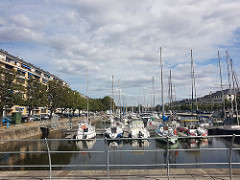
Caen

Caen
There was a bit of a mix up when I bought my ticket from Portsmouth to Cean (Ouistreham). The upshot was that I ended leaving England a day or two earlier that I expected.

I rode from the camping ground on the Isle of Wight down to the ferry terminal at Ryde caught the ferry to Portsmouth.

Ferry to Ouistreham
The crossing to France was not the best in that it wasn’t possible to get a cabin. It was very difficult to sleep on the seat which hardly reclined at all.

Up the Canal to Caen 

The ferry arrived in Ouistreham around 6.00 0’clock in the morning. There was quite a long wait before was able to get off the ferry. There were a large number of other cyclists waiting to get off including a group on a charity ride. They were going to ride to Paris in time to see the finish of the Tour de France. They were very keen to get started as they had over 120 klms to complete on this day.

After finally getting off the ferry, I headed through Ouistreham to the canal that links the sea to the city of Caen. There is cycle path next to the canal.

Nice little Hotel
Before leaving Portsmouth, I had checked on the internet as to whether there was a hostel in Caen. There was but its website was all in French and they didn’t respond to my email regarding the availability of accommodation.

It was still early when I arrive in Cean. I had to wait until 9.30 a.m. before the Office de Tourism opened. When the office opened, I asked the very helpful young lady on the desk about the hostel. She gave them a call and told me that the place was ‘complete’, i.e. full for “the next week”.

She recommended a hotel less than a block away in the centre of the city. It turned out to be reasonably priced and really good.

Caen Memorial
One of the first things I did in Caen was to visit the Caen Memorial.

This is one of the many ‘memorials’ or museums that have been built to commemorate the ‘Normandy Landings’ in June 1944.

This particular museum turned out to be a good starting point for my tour through the Normandy Landings region.

It provides a summary of the issues confronting Europe in the period between the end of the first world war and the commencement of the second world war. It also covers some of the more important issue in the war itself including the French collaboration with the occupying Germans and the Holocaust. It also covers the impact the Japanese joining the conflict and of course that on the USA’s reaction.

In the final section, the museum covers the Normandy Landing themselves. This is both at overall context and material on the battles that took place in and around Caen itself.
The exhibits in the museum are very well presented and the audio commentary is excellent.

Sometime in Caen
I spent a couple of extra days in Caen due to the rainy weather. The city was badly bombed during the war and it does not have the charm of a lot of French towns and smaller cities, however the canal area is pleasant, and I found a couple of good restaurants and nice pub selling good craft beer.

Flickr Links

Portsmouth to Caen
https://flic.kr/s/aHsmpFQdDi

Caen Memorial
https://flic.kr/s/aHsmp8NVMf

Caen Other
https://flic.kr/s/aHsmfUpDjj

Garmin Link
Ouistreham
https://connect.garmin.com/modern/activity/2886249193