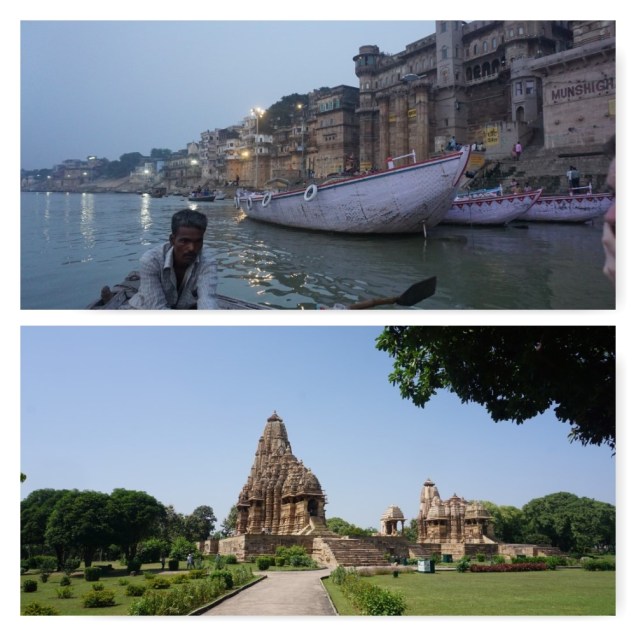
I stayed a couple days in New Delhi before heading to Varanasi. My original plan had been to take a train, but this wasn’t possible because the first-class sleepers were fully booked. I ended up flying.
The flight was uneventful. One interesting point to note was when the plane flew low into land, it was possible to see the ‘village life’. There are hundreds of small houses dotted across the countryside. A very high proportion of Indians (over 70%) still live in rural areas.
Basic Hostel
I caught a taxis into the city. I was quite a long drive. The main part of the city was extraordinarily congested, even more than Old Delhi.
The last part of the journey to my hostel was up a very narrow street.
The hostel was very basic. Only the dorms were air-conditioned and even they were not very cool. The rest of the place was stiflingly hot.
There was a café on the top floor, covered by a tin roof. Every now then they was a loud ‘bang’. It took me a while to work out what was causing the banging. It turned out to be monkeys jumping on to the roof from the surrounding building. There were lots of them.
Difficult to Find a Meal
After settling in, I headed off to find a restaurant. This proved to be difficult. The place was very crowded with lots of shops, but there were very few restaurants. I finally found a place to eat. I wasn’t very good.
Varanasi is in the state of Uttar Pradesh. It is a ‘dry’ state and alcohol is not readily available. I wasn’t able to the wash the very ordinary meal down with a beer.
Early Start to Ganges
An old school friend had told me that “the best time to see the Ganges River is at dawn”. I took his advice.
I awoke at around 5.00 a.m. Very early.
There was a couple from Ireland also on the trip.
The bloke who was taking us on the river came to the hostel. The Manager of the hostel who had organized the trip, had warned me that the guide’s “English wasn’t too good”. He was right. The bloke was virtually unintelligible.
It was about a kilometer walk to the river. Even this hour of the morning, the street was crowded.
Hard work Rowing
On the river, we headed down stream.
Varanasi has been a cultural centre of North India for several thousand years, and is famous for the Ganges. Hindus believe that death in the city will bring salvation, making it a major centre for pilgrimage.
The main feature along the river are the many ghats – embankments made in steps of stone slabs where pilgrims perform ritual ablutions.
The Ghats have a lot of steps. This is because of the huge variation of the in the level of the river. When I was there the water level was quite low. You could see the marks where the water is at it’s highest during the melting of the Himalayan snows. I estimate that the difference was over 50 metres. It must be an amazing sight when the river is in full flood.
There were quite a lot of people taking a dip in the water. You wouldn’t catch me doing that.
Funerals
As well as the ritual bathing, Varanasi is famous as a site for Hindu funerals. The Manikarnika Ghat is the Mahasmasana, the primary site for Hindu cremation in the city. Adjoining the ghat, there are raised platforms that are used for death anniversary rituals.
We came close to the Ghat when a funeral was taking place.
It made me recalled the Foreign Affairs trip I mentioned in posts about India last year. That trip also took in Kathmandu. It was in Kathmandu that I witnessed the only other outdoor cremation I have seen. My work colleague and I were working through the city when we came across the funeral. The fire had just started and the body was still rapped in cloth. Suddenly, the fames took off and the cloth was alight. A hand was exposed and as it burned the fist clenched. It was a real shock.
Not Feeling the Best
After see the cremation, the boat man rowed us back the jetty, against the current. This look a deal of effort.
I wasn’t feeling too good when I got back to the hostel. I spent most of the day in the hostel, some of it sleeping.
Train to Khajuraho
I had booked a train to my next stop Khajuraho. I went of the Bundelkhand Express which left at 5.45 p.m. and took over 11.30 hours to cover the 405 klms distance – hardly express.
Tour Guide
There was that usual hassle at the station, with Tuk Tuk drivers offering rides. I picked one. A young bloke joined us. He said he was a tour guide and offered to show me around. It was clear he was not going to take no for an answer.
I checked in to my hotel and agree to meet with the guide and the driver in a couple of hours. The hotel turned out the very good and great value at AUD 40 per night.
Temples
The guide and the driver took me to the main tourist attraction, the temples.
“The Khajuraho temples feature a variety of art work, of which 10% is sexual or erotic art outside and inside the temples”.
Some of the temples that have two layers of walls have small erotic carvings on the outside of the inner wall. “Some scholars suggest these to be tantric sexual practices Other scholars state that the erotic arts are part of Hindu tradition of treating kama as an essential and proper part of human life, and its symbolic or explicit display is common in Hindu temple”.
At one of the temples a security guard was particularly keen to show me some of the more explicit carvings. He also was keen to tell me the best angle from which to photograph them.
Walk in the Town
After seeing the temples, the guide lead me a short walk through the town. He explained that because the town is relatively small, the various castes live close together. He pointed out the houses where the different castes lived.
I have serious issues with the caste system and the attitudes that it appears to engender in Indians. In some cases they carry those attitudes and related to behaviors with them when they migrate to other countries.
School
At one point we stopped at a school. The head of the school explained that it had a Dutch couple as benefactors. They raised money in Holland to assist the school with scholarships for the very por student and the equipment that was sourced locally. One of the thing they did was to buy locally made bicycle to the used by students in remote villages so they could get to the school without waking for hours. What a great idea.
Flying Back to Delhi
I had thought about taking the train ack to Delhi. This turned out to be too much of a pain, with two connections. The bloke at the station said that there was “real chance that I would miss at least one the connections”.
I decided to fly back to Delhi.
Flickr Links
Varanasi
https://flic.kr/s/aHskFkSLJS
Khajuraho
https://flic.kr/s/aHskLx4uwW
About Varanasi
https://en.wikipedia.org/wiki/Varanasi
About Khajuraho
https://en.wikipedia.org/wiki/Khajuraho_Group_of_Monuments
Garmin Khajuraho
https://connect.garmin.com/modern/activity/1461130187
Indian Census
http://censusindia.gov.in/Census_And_You/area_and_population.aspx
Hotel in Khajuraho
https://www.tripadvisor.in/Hotel_Review-g297647-d10174733-Reviews-Syna_Heritage_Hotel-Khajuraho_Madhya_Pradesh.html
Caste System
https://en.wikipedia.org/wiki/Caste_system_in_India


 billrider2013