After a 24 hour delay in Sao Paulo, I finally made it into Buenos Aries. As recommended by the hostel I took a taxis into town.
Walking tour
In the morning I decided to take a walking tour offered by the hostel.
This was quite informative and took in the main sights in the main part of the town. In the square (Plaza de Mayo) in the front of the ‘Pink House’ (the Presidential Palace) the guide pointed out where the mothers of the children, which disappeared during the Military Dictatorship that governed the country between 1976 and 1983, gather. The dictatorship interned its critics. Many were killed and disappeared without trace.
Some of the ‘disappeared’ were pregnant women. Many of the children of these women were adopted by supporters of the regime. In recent times there has been a concerted effort identify these children and united them with their grandparents. This whole episode highlights how corrupt and immoral undemocratic regimes can be.
Evita Museum
At the end of the tour, the guide offered an “additional attraction”. This was the Union Offices. The significance of this building was that it where Evita Peron used to work from when she was the first Lady of Argentina up until her death in 1952.
The ‘Museum’ turned out to be two rooms, with memorabilia (mainly photos and paper clippings that were collect by a union official who actually worked in the office when Evita was still alive. He is in his late 80’s and speaks to the visitors to the ‘Museum’. His presentation was in Spanish, but effective in that he was very emotional. The guide gave a brief translations of what the old guy had said.
One of the things we learned from the old guy was that Evita’s body was held in the building for some time after her death. At some point in 1955, it was taken by the military regime that overthrew her husband Juan Domingo Peron. Apparently the body was ‘lost’ for some time until it turned up in Madrid were Juan Peron was in exile.
Evita’s body now lies in her family the Duarte family tomb in La Recoleta Cemetery. The irony is this where the rich people are buried and she is the hero of the poor.
A couple of days after visiting this museum I visited the cemetery. There are volunteers at the gate to the cemetery that sell you a map detailing the location of the tombs with the names of the families. I asked that volunteer where Evita’s tomb was. She feigned ignorance. I asked again saying the “Duarte Tomb”. Again she feigned ignorance. I suspect that this evidence that Evita is still a very controversial figure in Argentina. The current left wing president Cristina Fernandez de Kirchner evokes Evita in the presentation of her government’s policies. Her opponents are vociferous. The volunteer is clearly not a supporter of the current president.
Bike ride
I decided to take a bicycle tour of the southern part for Buenos Aries. This is the ‘dodgy’ part of the city. The tour turned out to be really good.
Boca Juniors Football
The guide was well informed and clearly had a sense of humour. The tour started near to the hostel and headed south towards the Boca area. We stopped at the stadium where the Boca Juniors soccer team plays. The guide told us that they got their blue and yellow colours from the Swedish flag. The story goes that they decided that they need a flag. One of the supporters when down to the nearby by port and took a flag off a ship. The ship happened to be Swedish.
Tango
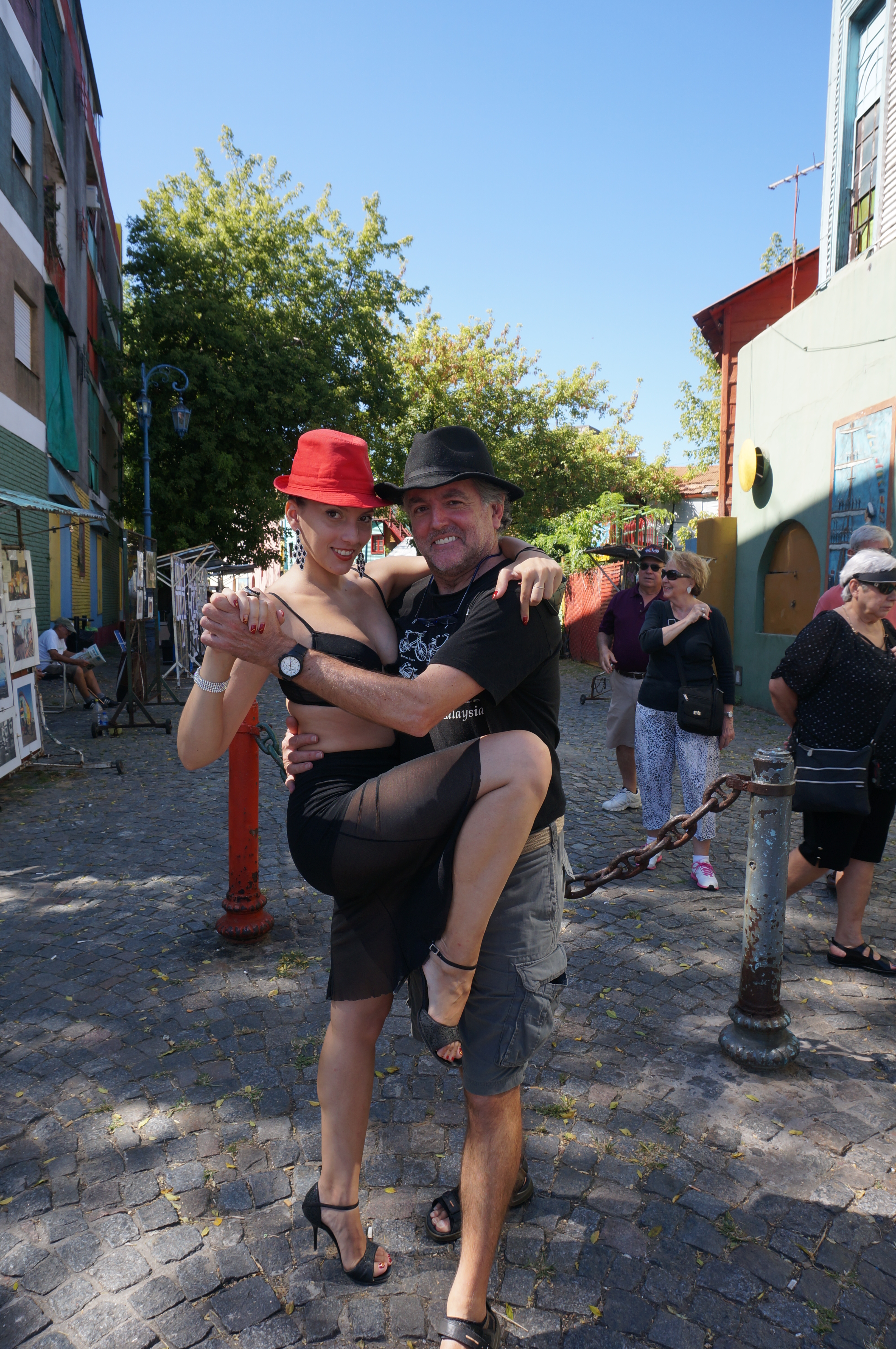
Next stop was the ‘tourist’ bit of La Boca. This a bit contrived, but you do a feeling as to what it was like when the poor immigrants lived in this area in the early 1900’s. It is where the Tango started. The original Tango dancers were prostitutes and their customers. I had a short dance with a young lady the required payment for a photo to be taken. That was all. Check out the Flickr link.
Back into the Main Part of Town
We headed back into the main part of the city, via a park that has recently been established on the river. We also passed any new residential area which is built on the canals. Housing here is very expensive.
The route also took us into the main square. The guide gave his spin on the Evita years and the current state of Argentinian politics.
The last part of the ride was a bit hectic and we negotiated the traffic in the main part of the city. It wasn’t too dangerous as the traffic was moving so slowly.
Tour of the Palermo Park
When I returned to the hostel there was a group pf people waiting for a ‘free tour’ to the Palermo area, including the Park. I decide to join the tour.
The woman leading the tour was a teacher. She was very interesting. The first part of the tour involved a bus trip on a local commuter bus. That was interesting in itself as it was rush hour. There was a lot of ‘up close a personal’ on the bus.
We got off the as the entrance to the park area. One of the first things the guide pointed out was a planetarium. The guide told us that this was the site of a cricket ground which established by early English settlers. Overtime, they left and the Argentinians didn’t take up cricket.
As we walk through the park the guide explained that it was designed to replicate that great city parks in London. Paris and New York.
As one point we stopped for some mate tea. The link below provide more information on this drink. It isn’t my favourite.
Tigre
The next day I took a trip out to Tigre. This a town about 40 klms from Buenos Aries. It involved taking the metro to the end of the line and then a surface train. The second was packed with people going to a Music Festival. I had a brief, but interesting conversation with a Lufthansa air hostess who was going to the festival.
In hindsight I should have gone to the festival. Robert Plant (Led Zeppelin) was playing that day.
I took and ‘hop on hop off) tour of Tigre. The most interesting things were a naval museum which included a section of the Falklands (Maldives) war and the fact that the river that passed through the town was covering the roads in parts.
Cemetery and Palmero
The following day I check out the La Recoleta Cemetery. I talked about that above. I also walked around the residential and shopping area of Palmero. This is a very affluent area. It is such a contrast with the southern part of the city.
Quick trip Across to Paraguay
On my last day I decided to take a trip across to Colonia del Sacramento which is across the river from Buenos Aries.
The crossing is made on fast ferry. There is a bit of mucking around with passport control and both ends.
The town of Colonia is UNESCO heritage listed. The main reason appears to be that at various times in was occupied by the Portuguese and the Spanish. Ultimately the Spanish won out. The guide pointed out that the streets that were built by the Portuguese sloped to the middle with water draining down a channel in the middle of the road. The Spanish roads sloped away from the middle, like roads of today.
On the reasons people travel to Colonia is to get US Dollars that can be withdrawn from the ATMs. These can then be used to buy Argentinian Pesos and the black market (blue) rate that is 30% better than the official rate. People wander up and down the main street withdrawing the maximum allowable amount from each ATM.
Quick Comment
It was good to see Buenos Aries. It will interesting to see how the place changes, if at all, when the new president is elected at the end of the year.
Flickr Links
Buenos Aries
BA Bike Ride
Tigre
Colonia
Link to Mothers of the Disappeared
http://en.wikipedia.org/wiki/Mothers_of_the_Plaza_de_Mayo
Link to Bike Tour
Link to Mate Tea
 billrider2013