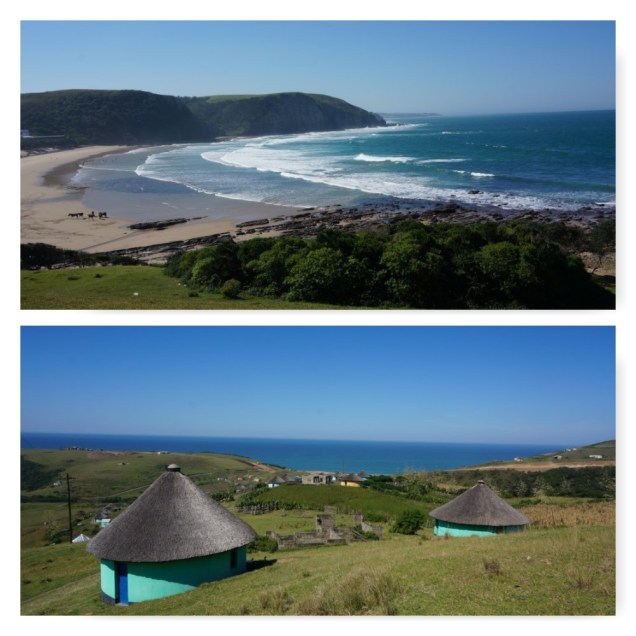
The Baz Bus from East London was to take me to Mthata where I would take a shuttle to Coffee Bay.
Mandel’s House and Grave
Short of Mthata we passed through small town called Qunu. This is where Nelson Mandela grew up. When he retired from being President of the RSA he built a house there. It is also where he is buried.
The driver slowed the bus down as we passed the gate of the house. A little further up the road he stopped. We got out of the bus. We could look down the hill to see the house. It is on a farm that extended into the distance.
The driver also pointed out some shrubs on hill on the property. He told us that that was Mandel’s last resting place. It is interesting that this is still a ‘private’ place.
Shuttle to Coffee Bay
The Baz Bus dropped me off at a large Shell Service station at Mthata. This turned out the be a transit point for a number of regional and local buses. There were people everywhere. The take way food shop and the mini supermarket in the complex were doing a roaring trade.
There were a couple of other people from the Baz Bus that were going to Coffee Bay. The shuttle bus was waiting. We joined some other passengers and headed off.
The route took us through the main part of Mthata. This is very chaotic town. It is obviously quite poor.
We continued towards the coast. Most of the traffic was mini buses and small trucks. There were very few sedan cars.
There was a lot of road works being performed. This seems to be the case across the RSA. I seemed to have struck at least one major piece of road work every day I have been travelling. Typically, the work is simply resurfacing the road. This involves closing one lane. What is really odd is the length of the lane closures. Some are over 2 kilometres long. This results in long waiting times as the oncoming traffic passes. The really odd thing is that actual work is being performed on a very small part (typically a couple of hundred metres) closed section of the road.
Coffee Shack
There are a number of hostels in Coffee Bay. I had heard that the Coffee Shack was the best.
The place seemed to be very popular – it was fully booked. Most of the quests were young and were in Coffee Bay to surf.
The hostel offered dinner. This there were only two options – vegetarian and non-vegetarian. The vegetarian option turned out the be the non-vegetation option without the meat.
Walk in the Village
One of the activities that the hostel offered was a tour of the Coffee Bay village. I decided to take the tour. As it turned out, I was the only participant.
The guide was a young bloke from the village who worked in the hostel. His name was Jesse. As we headed off he explained how the village worked. The village was basically the houses that we could see. They were spread out, 300 to 400 metres apart. There was ‘Mayor’ of village. This an elected position. His role is to sort out any disputes, e.g. the allocation of land and any disagreement about the use of the land e.g. fencing off areas to plant corn.
There is a chief of the area that includes the Coffee Bay village. This is a hereditary position. The Chief’s area of control covers 20 villages. The Chief’s role includes sorting out any issues that cannot be solved by the Mayors.
We walked past the village school, Jesse told me that he attended the school. He said that the students were taught in the local Xhosa language. “The idea is that they are taught English, but is difficult to find teachers who can speak good English”.
As we walked along we came across a white bloke walking in the same direction. Jesse clearly knew him and they started to chat. The white bloke told us that he had “found a house in the village and was very happy”. He turned off the path.
I asked Jesse “who was that guy”? He told me that he was from Johannesburg and was working one of the hostels in the village. It was interesting to see a ‘white’ who had gone ‘native’.
After a short distance, we came across a group of houses. There were a group of people sitting in chairs outside one of the houses. Jesse spoke to them in Xhosa. He introduced me to the people. One was his father, two were his sisters and there were a couple of older female neighbours.
No Electricity
As we walked off I asked Jesse if his house had electricity. He told me that it didn’t because “his father and the other elders of the village were against having it in the village”|. I said “but I can see electricity wires on the hill”. Jesse told me that “the village could have electricity, but the elders asked that government not the link the houses to the grid. There is only one house that has electricity, and that was owned by a German bloke who has married a girl from the village”.
We actually passed the German blokes house. Apart from having electricity, it looked like all the other houses in the village. Apparently the German was a doctor who met his wife while working in the local clinic.
Face painting
Next stop was place where the locals get mud that they use for face painting. Jesse explained that in the past it was used for ‘war paint’. Now it is used for sun protection. Apparently it is very effective. Given my skin issues, maybe I should have painted my face with mud in my youth.
Mud Bricks
We also passed a place where some of the villagers were making mud bricks to the used to make a house. Jesse told me that if the house is properly maintained, it can “last forever”.
Tradition Meal
Towards the end of the walk, we stopped off for a late lunch in a village house. The meal consisted of corn meal and vegetables. Jesse explained that it is the staple diet of the people. They basically eat the same meal every day. If someone in the village kills a goat or another animal they will share it will others, as there is no way of storing it.
Blokes wanting a “contribution”
Later in the afternoon, I when for a walk to the main beach. As I returned I was meet by two blokes in their teens. They chatted a bit in broken English: “where are you from? “ and that sort of stuff.
They then asked me “if I would like to make a contribution of 100 Rand? I told them politely that I would not. It was a bit threatening.
More Dutch
Back at the Hostel I had dinner. It was better than lunch. I chatted to a young Dutch couple who were studying at the University of Stellenbosch. The girl was very striking. I wondered if she had a sister who was in Koh Tao in Thailand in August 2012
Back to Mthata
In the morning the shuttle bus took me back to Mthata.
There was another older bloke on the bus. He spoke with a southern USA accent. He told me that he was “George for Georgia”. He said he had only recently started travelling outside of the USA. He was an interesting bloke.
The shuttle bus dropped us off at the Shell service station. From there a ‘local’ mini bus was to take me to Port St Johns. I had been told by the hostel in Port St Johns to “wait the fast food restaurant and the driver will find me”.
As I was sitting drinking my coffee, I heard a girl speaking in French accent chatting to a waitress. She seemed worried about a bus being late. I asked her where she was headed. She said that she was going to Port St Johns. She seemed quite distressed. We were staying at different hostels and she could not get hold of her hostel. I said I would call mine. As it turned out were to take the same mini bus.
Local Bus
Finally, a bloke emerged asking for passengers for Port St Johns. We got on the bus. This was my first ‘local mini bus’ ride, albeit I had seen them and read about them. They are almost all Toyota vans. As well as the driver, there is an ‘off-sider’ who calls outs (I assume telling potential passengers where the bus is going). The offsider also collects the fares. The objective appears to be to maximize occupancy at all times.
As we went along I chatted with girl with French accent. Back at the Service Station, I had assumed that she was an inexperienced traveller. I could not have been more wrong. She was from Belgium had been travelling for over 5 months from Kenya south. She had previously travelled in South America, Asia and Australia and New Zealand. She speaks French, English, Dutch and Spanish. Her plan was to do the 60 kilometre walk along the coast from Port St Johns to Coffee Bay.
Port St Johns
It took ages to get to Port St Johns – dropping passengers off and getting new ones.
The hostels that the Belgium girl and I were staying at were quite a way out of the town. My place was very alternative. It was run by a white South African who appeared to be constantly stoned. A number of the quests appear to have the same interest.
The owner of the hostel has pet donkeys that roamed all over the place, including into the bar area.
I spent a couple of days in Port St Johns not doing too much apart from reading and walking. One of the walks took me into the National Park. It was interesting to see. There were about 30 huts for accommodation. The only thing was that there didn’t appear to be any guests.
To Durban
I caught a local bus back to Mthata where I was to take the Baz Bus to Durban.
Flickr Links
Mandela House
Coffee Bay and Port St Johns
 billrider2013