Australian High Commission Delhi

DSC04257

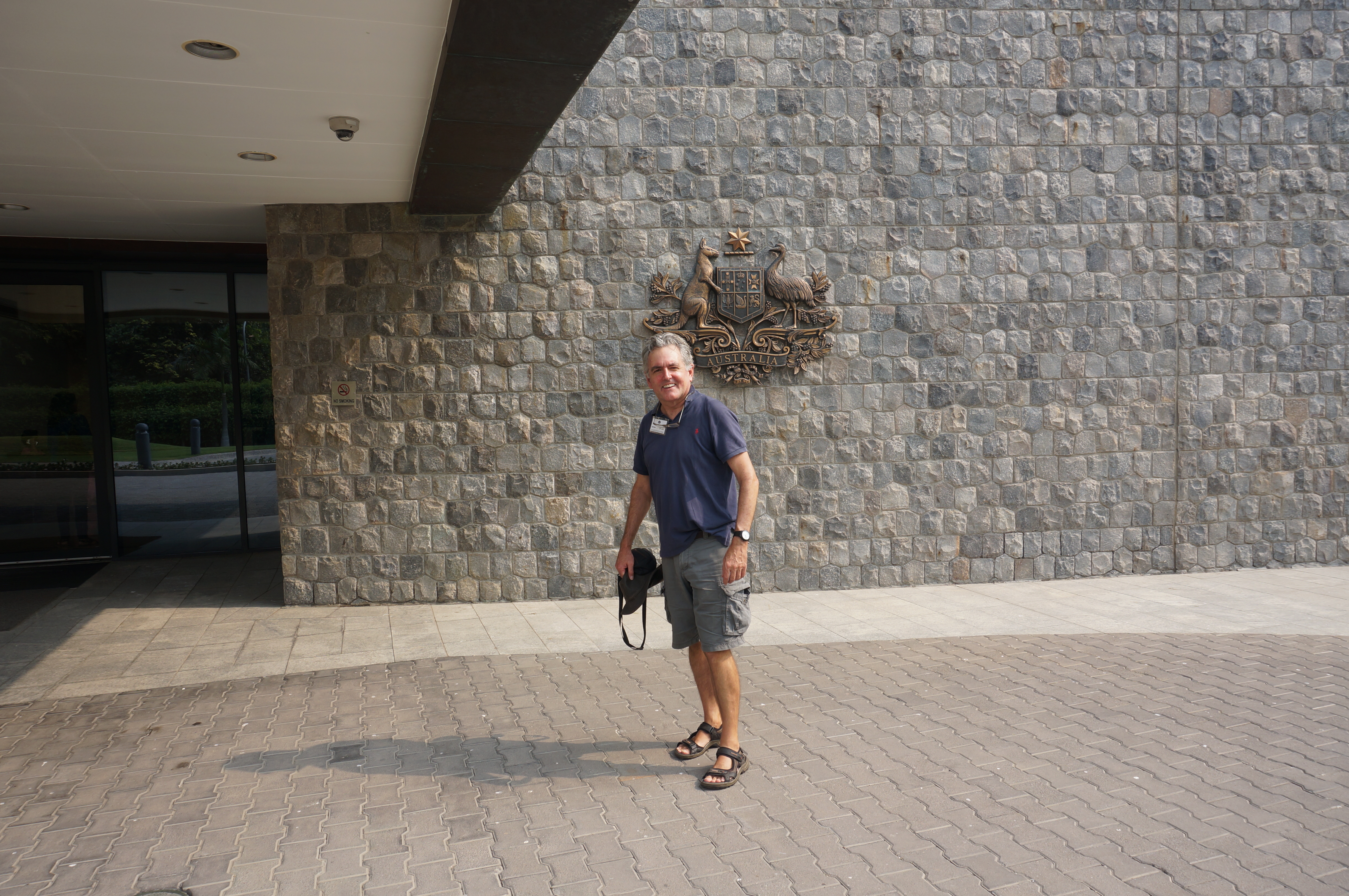
As I was in Delhi, I decided to visit the Australian High Commission. I have mentioned in previous posts that I visited the High Commission in February 1985 as part of a trip I undertook with the Department of Foreign Affairs.

That trip included, Dhaka in Bangladesh, Bombay and Kathmandu as well as New Delhi. It was the third trip I had undertaken since joining the Department in September 1984. The previous two were to the then USSR, East and West Germany, and New Zealand. This was my first visit to the so called ‘hardship posts’.

In my previous post about Delhi I talked about the day my colleague and I arrived and our attendance at a wedding of one of the High Commission staff.

The Taj Hotel

After the wedding we settled into our hotel- the Taj which is located within the Diplomatic enclave of New Delhi. I had already learned one thing about travelling for Foreign Affairs, you got to stay in very nice hotels. This was to prove to be one of the best.

It is set in quiet large grounds with a large pool. I can recall that on the afternoon we arrived after the wedding, the pool was very crowded. The hotel was used by airlines. I recall that there were a lot of tall blonde women sunning themselves by the pool. Some turned out to be Lufthansa aircrew.

Over the weeks we in Delhi, it was very pleasant to return to the hotel are a ‘hard day’s work’ at the High Commission. It was a real oasis.

On this trip I decided to revisit the hotel. It is still impressive. The reception area is all marble and there are large marble staircase leading to the conference room and restaurants on the floors above and below.

The pool and grounds are still very impress by today’s standards.

The High Commission

The AHC was one of the first foreign missions to be built in the diplomatic enclave in the 1950’s. It is located opposite the British High Commission and the American Embassy is around the corner.

I wanted to revisit the HC for a couple of reasons. I wanted to see if had changed at all. The second reason was to take some photos on behalf of my London host. His father was posted to Delhi as an Australian diplomat with his family. When I was in London I was shown pictures of the compound as it was when they were there.

The day before I headed to the AHC I sent an e-mail, telling them that I wished to visit and why.

Security Presence

I caught the metro and then a Tuk Tuk to the HC. As I approached, I was immediately struck by the security. The wall around the compound is high. There are guards wandering the street and there are signs up staying photography is forbidden.

As I approached that entrance, I was greeted by a guard who asked what I wanted. He didn’t seem to understand what I was saying. Another guard arrived. He directed me to another guard box. By the time I arrived at the next guard box, there had clearly been some communication with the chancellery. I was asked to show my ID and sign that visitor’s book. I then had by backpack checked and I was given a Visitors Pass and directed the main entrance.

Walking Around the Compound

As I approached the Chancellery door, I was greeted by Indian gentleman, unfortunately I didn’t catch his name properly. He told me that he had been in the HC since 1983 and would be showing me around.

Even though I was being accompanied, there restrictions on where I could go. A feature of the compound is the garden in front of the Official Residence and a ‘billabong’. I was only allowed to take photos from the path.

Not much seemed to have changed since 1985, except that the Deputy High Commissioner’s house has be converted in offices.

I took a photo of the tennis court. If my colleague ever gets to read this post and looks at the photos, I am sure it will bring back memories of game play there and she will have a chuckle.

Remembering Friday Night

We passed the Club House. This is used as an informal entertainment area for the High Commission’s staff and guests. My guide made a particular point of noting that it is used for ‘Friday Night Prayers’ – after work drinks.

These were, and obviously still are, a feature of diplomatic life, particularly in the hardship posts. All the friendly Embassies and HC’s (i.e. British, NZ, Canada and the USA) have similar facilities. Staff from the different missions visits each other’s clubs.

When we were in Delhi I recall that the night started in the Australian Club House. We then moved to the British HC across that road. I have a vague recollection of ending up in the USA Marines Club House late at night.

Flickr Link
To be posted when the Internet permits.
Taking the Metro in Delhi

DSC04255

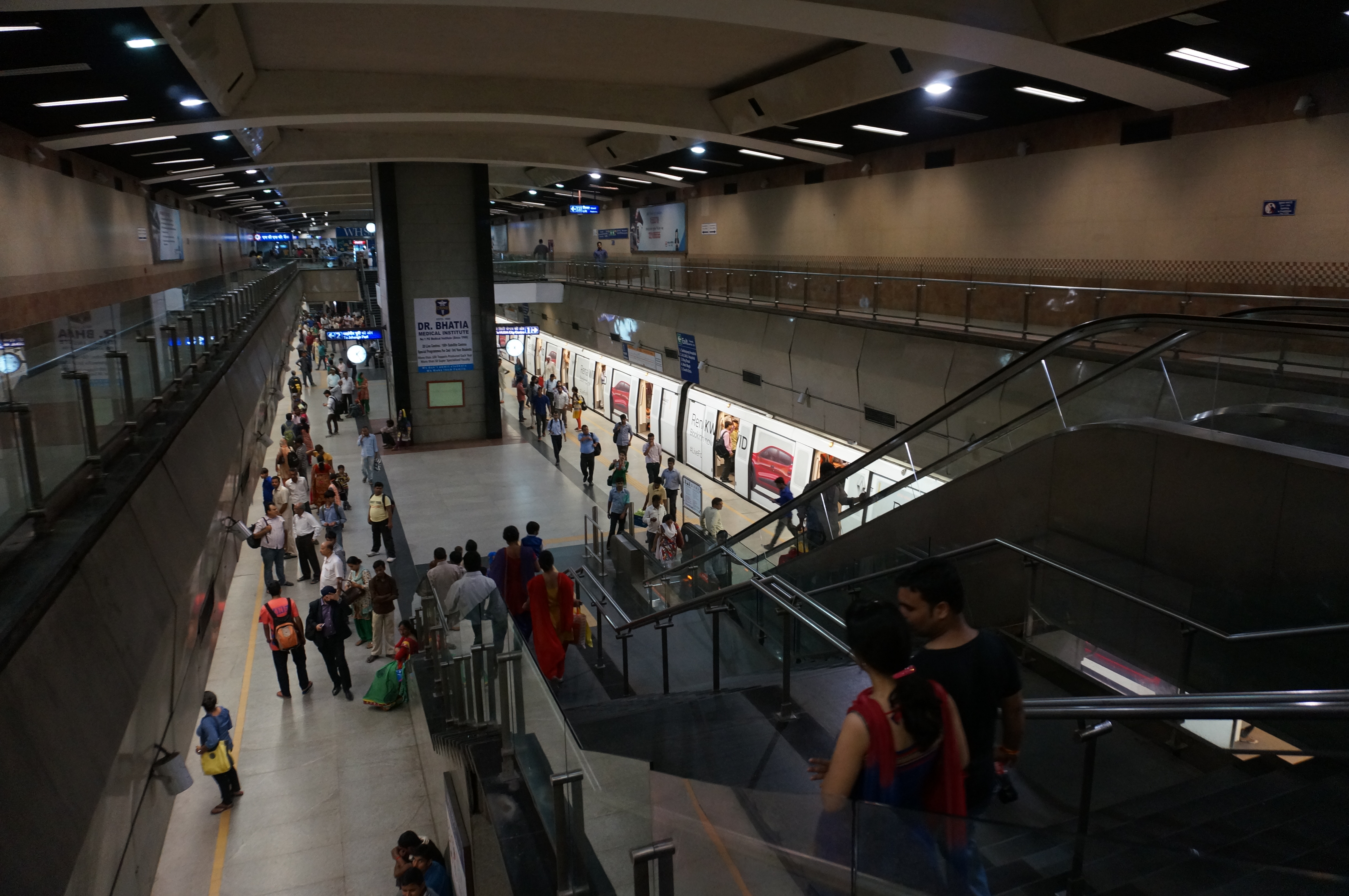
Probably the biggest change I have noticed in Delhi is the metro train system. It is not that it is physically obvious, particularly in the central area in that a lot of it is underground. Where it is above ground it is mostly on pylons – in the sky.

A Modern System Comparable to Anyway

It is a very good system with modern air conditioned trains running on very smooth tracks at high speeds (for a metro system). There is electronic ticketing and automated gates. It is on par with other ‘new” systems I have seen in Shanghai, Singapore and Seoul. In many respects it is better than ‘old ‘systems in London, Paris, New York, and Rome and in Sydney and Melbourne.
There is no doubt that a good metro train system has more of an impact on a city that simply being a way to get around. It has a social impact.

Two Stories to Illustrate a Point

I recall the Roderick Carnegie (the former head of what is now Rio Tinto the second largest mining company in the world) being interviewed. He said that he liked living in Melbourne rather than Sydney because he could get to work by tram. He said that he travelled to meetings in the CBD by tram. This amazed visitors from Sydney and the USA, less so those from the UK.

Another story I liked was David Attenborough (I don’t have say who he is) talking about travelling on the London Tube. He was standing on a District Line train heading to South Kensington. A girl sitting below him was reading his autobiography and did not notice, or pretended not to notice, that he was standing front of her.

The point of these stories is to highlight that impact of good public transport of society. It brings most levels of society together.

It also so encourages civil behaviour.

Women on the Delhi Metro

In the case of Delhi, it is notable that the behaviour on the trains is excellent. There is no splitting, no litter, and the people are generally courteous and wait in line to get off and on the trains.

There is a heavy security presence, but that is unfortunately necessary.

The attitudes to women and the attitudes of women are also interesting.
The front carriage is reserved for women. I didn’t bother looking whether they were are more or less used than other carriages.

In the carriages I caught, there was a mixture of ages, gender and (I assume) class. There are signs on some seats indicating women have preference. I saw numerous case where men stood and offered seats to older women irrespective as whether it was a ‘preferred’ woman’s seat or not.

On one occasion, a middle aged woman got on the train. A younger well dressed man was sitting in the ‘preferred seat’ (he looked like the equivalent of an ex-Shore Boy who was up himself) She stood over him and stared. He eventually got the message and stood up. I suspect she had noticed that I had been watching and smiled. The man walked to the end of the carriage.

I suspect an encounter like that would not have occurred between a Delhi man and woman on bus 30 years ago.

Back in to Different Word

The Metro runs about a kilometre from where I am staying in the Main Bazar, a very old and traditional area of Delhi. It is run down (in a nice way) and chaotic.
As you exit the air-conditioned and orderly Metro, you are met with the sounds and smells of ‘old’ Delhi.

There is a queue of bicycle Rickshaw operators. I took one back to my Hotel.

The contrast between the Metro and the Rickshaw ride is a quintessential Indian experience.

Flickr Link
To come Internet permitting

Arriving in Delhi

DSC04237

Arriving In Delhi
I left my London host’s place fairly early. It was a beautiful day and I decided to spend some time in the West End before heading out to Gatwick to catch the plane to Delhi.

I went into Fortnum Mason for a Welsh Rarebit. I really must get their recipe. Or made be I shouldn’t, because if I managed to make one just like theirs, I would be eating Welsh Rarebits every day.

After a bit of wandering around, I caught the train to airport.

The Flight
The plane turned out to be an A380. I thought it would be a smaller plane. Anyway is was packed. The airlines are very good at maximising their seat utilisation these days.

It was possible to use the internet on the plane. I saw this before on my flight to Iceland from New York last year. It still amazes me. I recall how I loved being on the plane during business trips with Caltex and Foreign Affairs before the days of laptops and the internet. It was not possible to be contacted.

During the flight I communicated with my Balmain host who was in Dubai and scheduled to catch a plane to Sydney an hour after I was scheduled to arrive.

Short Layover

It was a short layover in Dubai and I had to change terminals for the connecting flight to Delhi. The internet in the airport was a pain to use and I was not able to contact my Balmain host. I was later to learn that he could not get the internet in the airport to work at all. That is the way of technology. It worked and 40K feet, but didn’t work in one of the most modern buildings in the world.

The flight from Dubai was relatively short.

Taste of Indian Bureaucracy

India is famous for a number of things. One is mindless bureaucracy. I experienced this first hand when I visited in early 1985 when I was working for Foreign Affairs.

It would appear that things have changed little in the intervening period.
As you get off the plane you are confronted by an official who checks if you have a passport.
I then joined the queue for the holders of ‘e visas’. Given that this was an automated system I though the processing would be relatively fast. It was taking 10 to 15 minutes to processes each person.

When I reached the end of the queue, I handed over the printed receipt for the visa. I noticed a young girl at the next desk showing her receipt on her mobile phone. She was not going to be going anywhere fast.

I am not sure what the bloke was doing on the other side of the desk. Whatever it was, it wasn’t as simple was scanning the visa receipt and matching the details with my passport and my face. There was a lot of typing and writing.

He then took my photo and asked me to put my fingers and thumb on a finger print machine. Where and why they are stored is anyone’s guess.

Finally my passport was stamped.

As I continued on I was asked to show my passport two more times. The first bloke did not check if I had a visa. That could have been reasonable as a check to ensure the bloke at the desk was doing his job properly.

I asked the second bloke who wanted to check my passport, “why are you doing this, you can see that I have just come from the immigration desk and someone else has looked at my passport since then”? His response was “it is Indian process”. I just walked off.

Taxis into the City

I had arranged with my hotel to be picked up at the airport. My driver met me outside the departure gate. The ‘taxis’ was a metal box on four wheels.

Remembering Arriving in Delhi in February 1985

As we headed into the city, I recalled the last time I was met at the airport in Delhi in 1985.
My Foreign Affairs colleague and I had flown in to Delhi from Bombay (now known as Mumbai). We were met by the Attaché in the High Commissioner’s car. The High Commission was out of town in Pakistan.

It was a weekend and the Attaché told us that, if we were interested, we could go with him to a wedding. The wedding was of a member of the High Commission’s gardening staff to a girl from his village. He told us that they were from the lower Castes. We told him that we were interested.
We dropped our luggage off at the hotel and headed directly to the wedding. The Attache told us that there would be other members of the High Commission staff at the wedding as it was good for staff morale for the Australian based staff to be seen at these events. He also told us the staff had collected some money to be given to the couple.

At this point I need to note that my colleague was 25, female, very attractive and she was wearing a ‘light dress’.

When the car stopped we were met by a number of Indian gentlemen. These turned out to be relatives of the bridegroom. It was to later transpire that because we had arrived in the High Commissioner’s car, it was assumed that we must have been very important and as such, we were the honoured guests.

We were escorted to a large tent which was crowded with other quests including Australian and Indian staff from the High Commission. The Attaché introduced us to several people including an Indian woman who said she was the High Commissioner’s Protocol Advisor. She told us that we would “shortly offered food”. She said that we should accept it, but try not to eat it”.

We chatted away to the other guests holding the plates of foods. A various times the Protocol Advisor approached us from behind. As we turned to her she swapped our plates for another one will less food on it. I am sure the Indian guests noticed, but nothing was said.

While talking to the Australian staff, we were told that this was traditional ‘arranged marriage’ and the bride was meeting the groom for the first time. The ceremony was quite complicated with a number of stages and it was officiated by a number of priests. We were told that some of the stages had been completed and it was now time for us the ‘honoured guests’ to now participate, including handing over the cash that the High Commission staff had collected.

The ceremony was taking place under a canopy and there was a small fire burning. The Bride and Groom were sitting on cushions.
The first thing I noticed was how distraught the Bride was – she was howling with tears pouring down her face.

The other thing I noticed was how that Groom was looking at my colleague. As noted before she was young, very attractive and wearing a ‘light dress’. It was hot and the fire was making us hotter, everyone was sweating. He seemed to be fixated by my colleague.

After a couple of minutes, the ceremony appeared to stop and major argument erupted, behind us. We were later told that the dispute related to the how much one of the priests was demanding to be paid. It appeared that some of ‘gods messengers’ want more that others.

The dispute was resolved and the ceremony continued.

My colleague was clearly concerned as to how upset the Bride was. She told me that this “was terrible and it had to be stopped”.

I can’t recalled the full conversation, but it went along the lines that: I said it probably wasn’t for us to decide on that. She responded, that she didn’t care what I thought, it was just wrong what was happening to the girl………… As we had our little discussion the ceremony continued.

Finally, it came to the point where we were to hand over the cash gift. My colleague took the envelope and thrust it towards the couple with a clear look of displeasure. The transfixed Groom took the money and my colleague stormed off.

Back to October 2015

The ride into the city from the airport was slow. This wasn’t due to lots of animals on the road. It is my recollection that this was an issue in 1985. This time it was the volume of traffic.
There are lines on the road delineating lanes, but no one takes any notice of them.

Check out the Flickr link for a video.

At one point we stopped to get LNG fuel for the taxis. The driver paid over 400 rupees. I don’t know how many trips to the airport he can do on that, but my fare was 500 rupees.

In the Hotel

It took nearly two hours to get to the hotel in the Main Bazar. The location is infamous for a bombing that took place in October 2005. Check out the link below.
The hotel is very basis, but all that I need.

Walk to Connaught Place

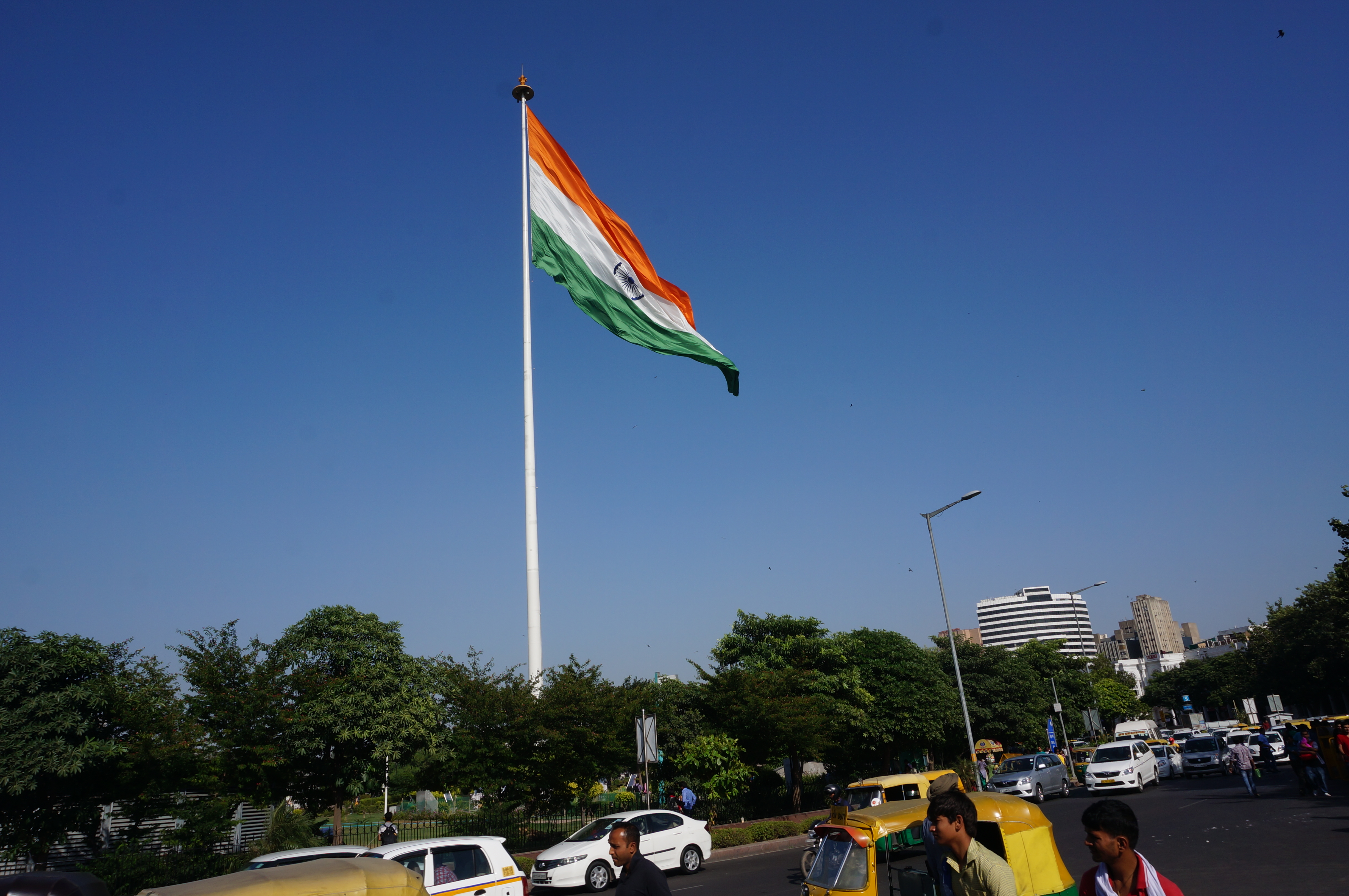
Next day I walked into Connaught Place. It is the main Business and Shopping area of New Delhi. The fabric of the place does not have appeared to have changed much since 1985. What is notable, however is the number of international brand shops there are now. All major city shopping areas are looking the same.

Watching the Rugby

In the evening I found a bar that was showing the Rugby World Cup game between Australia and Wales. I was that only one watching this try less, but tight encounter.
It looks as though it will be a Wallabies v All Blacks final on the 31st.

Flickr Link
https://flic.kr/s/aHskmpnbKm

Link to Information on Main Bazar Bombing

https://en.wikipedia.org/wiki/2005_Delhi_bombings

Link to Information on Connaught Place
https://en.wikipedia.org/wiki/Connaught_Place,_New_Delhi