Berlin Again

37148705200_f437355a32_m
I spent a couple of days in Cologne before heading to Berlin.

Train from Cologne

The train to Berlin was an ICE train. It was very comfortable and fast.
Staying in the East

I had booked into a hostel that is in the East. This part of the city has slow become gentrified in the period since ‘The Wall’ cam down in 1989. Initially it was very popular with students and bohemian types because the cost of housing was cheap. These people are slowly being forced out of the area as the price of flat rents rise.

However, it is still a good palace to be with lots of different bars, restaurants cafes. Of course I was about to find a pub selling craft beer.

Remembering 2012

I visited Berlin briefly in 2012. I also visited the city in 1978. This was followed by another visit in 1984 when I was working for the Department of Foreign Affairs. I have already posted about that visit. Refer to the link below.

I was interested to see the changes that have occurred since my 2012 visited. A lot had obviously changed between 1989 well The Wall came down and when I visited in 2012.

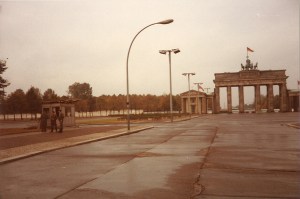
The area around the Brandenburg Gate and the Reichstag was where most of the work had been done to ‘unify’ the two halves of the city. The Wall ran in front of the Gate and the area on the Eastern side was ‘scare’ about 400 metres wide. By 2012 this had been repaired with a lot of work including pathway across to the new Train Station.

Since 2012 it appears that attention is now being given to area East of the Gate around Alexanderplatz. This area still has the ‘severe soviet style’ building from the communist era, however they rea slowly

Hop on Hop Off Bus

I decided to take one of the ‘Hop on Hop’ Buses that operate in Berlin. These are often a good way to get a quick feel for a city.

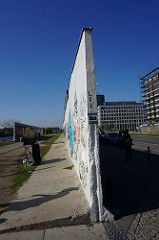
The hop off places included, the Olympic Stadium, the main shopping street Kurfürstendamm and Checkpoint Charlie, an area where there is over a kilometre of The Wall. One the circuits of the bus route took in a few of the suburbs in the East. The contrast with the suburbs in the West is still obvious.

Walking from Checkpoint Charlie Down Friedrichstraße

In the afternoon on my last day in Berlin, I went to Checkpoint Charlie and retracted that walk down Friedrichstraße that I wrote aboot in my post on the 1984 visit.
The contrast could not be more stark. In 1984, there was no one walling on the street apart from me. The Buildings were drab and hardly seemed to be occupied. Today Friedrichstraße is lined with upmarket shops and restaurants and cafes.

Off to Warsaw

Next day I made my way to the train station where I caught the train to Warsaw.

Visit to Berlin in 1984

East Berlin 1984

Flickr Link 2017

https://www.flickr.com/gp/twwilko_photos/pU1253


East Berlin 1984

20161213_162255_31497765821_o31576089276_b22cc9ae20_o

I left Moscow on Saturday the 27th of October 1984.

In the morning, the Attaché and a driver came to the hotel to take us to the airport for our flight to East Berlin.

On the way, we came across a body of the road and group of blokes trying to pick it up.  They were all obviously very drunk.

Getting through immigration was a circus.  The Official took my passport and simply stared at me.  He then stared at the passport and at me again.  He repeated this ‘over and over’ for at least half an hour.

Once through immigration we boarded our East German Airlines Ilyushin jet heading to East Berlin.

Flight from Moscow Interflug

I recall the flight was ‘different’.  The plane climbed very steeply and was very noisy. The flight attendants were very large women.  One of them walked long the aisle with a very large jug of very hot tea. The passengers held out their  cups.  The attendant filled the cups as the passengers held them. It was amazing the no one was burnt.

Schönefeld Airport

We landed at Schönefeld Airport and were met by the First Secretary from the Australian Embassy. Again there were issues at the immigration check point. We had switched our passports from the Diplomatic Passports, we had used to enter the USSR, to Official Passports. This really confused the East German Immigration Officials.

Interhotel

We were booked in the Metropol Hotel located on Friedrichstraße.   The land behind the hotel was cleared – ‘no man’s’ land and beyond that was the Berlin Wall that divided East and West Berlin.

The Metropol was an   Interhotel’.  The Wikipedia entry is interesting.

“The Interhotel hotels were under the control of the East German state security service, the Stasi, under the Tourist Department. The Stasi tried to monitor the activities of international tourists, by sending prostitutes to audio- and video-controlled hotel rooms”.

First Crossing from East to West Berlin

On Sunday we crossed the border into West Berlin at Friedrichstraße railway station.

Security was very high.  Our passports were closely scrutinised.  The officials were confused by the fact we appeared to have arrived at  Schönefeld Airport, but hadn’t come from anywhere.  Finally they let us through.

The next step was really interesting.  Despite being located in East Berlin,  Friedrichstraße    station was on two intersecting rail lines that passed through West Berlin. The station served as a transfer point for these lines, and trains stopped there.

The other stations on these lines were in East Berlin.  These stations were sealed-off ‘ghost stations’ (Geisterbahnhof). The  trains passed through these stations under guard without stopping. As the train passed through the stations, you could see the East German guards with their  metal helmets and sub machine guns.

Once through these stations the train was in West Berlin and the stations were, of course, open.

We had arranged to meet the Consul  from the Australian Consulate in West Berlin. He was waiting at the first station on the West Berlin side.  The Consul took us on quick tour of West Berlin finishing with a lunch.

In the afternoon my colleague I and took a walk through the main shopping precinct.  I was really getting sick of John by this stage of the trip and was glad when said  he said he want to return to the hotel.

I continued on walking around the  city and found the Europa Center.  It is large shopping and entertainment centre  that was designed to showcase the best of the ‘West’ in this divided city.

Good Looking Women in the Bar

When I got back to the Metropol Hotel, I found John in the bar.  There were 10 to 12, extremely attractive women in the bar and only a couple of other people – two pommie blokes who told us they were in East Berlin on business.  The scene was consistent with the description in the Wikipedia entry.

Starting Work at the Embassy

Next day we started work at the Embassy.  The experience was somewhat surreal. The Embassy was to closed and had already been downsized.  There were only three Australian based staff – the First Secretary, an Attaché and a Communications Operator (to handle the cables).  The only locally engaged staff member apart from an East German driver was a Swedish woman who was married to a Swedish Diplomat.

The First Secretary was a ‘character’.  He had only been at the post for three months, but had managed to spend almost all of this annual ‘representation allowance’ on “parties most often attended by the ‘Friendlies’ (i.e. staff from the USA, UK and Canadian) and other Embassies”.

I was to come across this bloke on later trips with DFA and playing cricket in the ‘Bangkok Sixes’ in 1987.  I will posted about that sometime.

Room Full of Bank Notes

The East German government (DDR) fixed the country’s currency,  the ‘Ostmark’,  at one to one with the West German ‘Deutsche Mark’.  This was similar to the Russian Rouble being set at one to one with the USA Dollar.

Both the Rouble and the  Ostmark were ‘soft currencies’ and could not be traded or exchanged on the open market.  They were, however,  traded on the ‘black market’.  The black market rates revealed the real value of the currencies. In the case of the Ostmark v the Deutsche Mark’ the black market rate was more like 40 to one.

The GDR forced the western embassies to convert a certain amount of hard currencies (Deutsche Marks, USDs, GBPs and AUDs etc.) into Ostmarks each month and to pay all their expenses (local salaries, utilities etc.) in hard currencies.

The embassies, including the  Australian Embassy did however, receive income in the form of visa fees and the disposal of unneeded equipment etc., in Ostmarks.  The problem was that there was virtually nothing the embassies could buy with this money, apart from some foodstuffs.

The result was that the Australian Embassy accumulated a huge amount of Ostmarks in cash that it could not spend.

There was a room in the Embassy that was almost full of paper Ostmarks of various denominations.  They were stacked from the floor to the ceiling.  The notes were rotting and really stank.

It you applied the official exchange rate, these notes were nominally worth thousands of Deutsche Marks and AUDs.  In reality, they were worth nothing.  They couldn’t even be sold on the black market as that would have been illegal.

 Back into the West

We ate dinner in the hotel on Monday night.  The food was very ordinary.

On Tuesday I decided that I wasn’t going eat in the hotel again and told John that I was going to eat in the West.  Part of the reason for doing that was that I knew that he would be stay in the East and would not be venturing out of the hotel.

I crossed that border at Friedrichstraße station and headed to the Kurfürstendamm, the main shopping and entertainment street in the West.

I found a good restaurant and ate well.

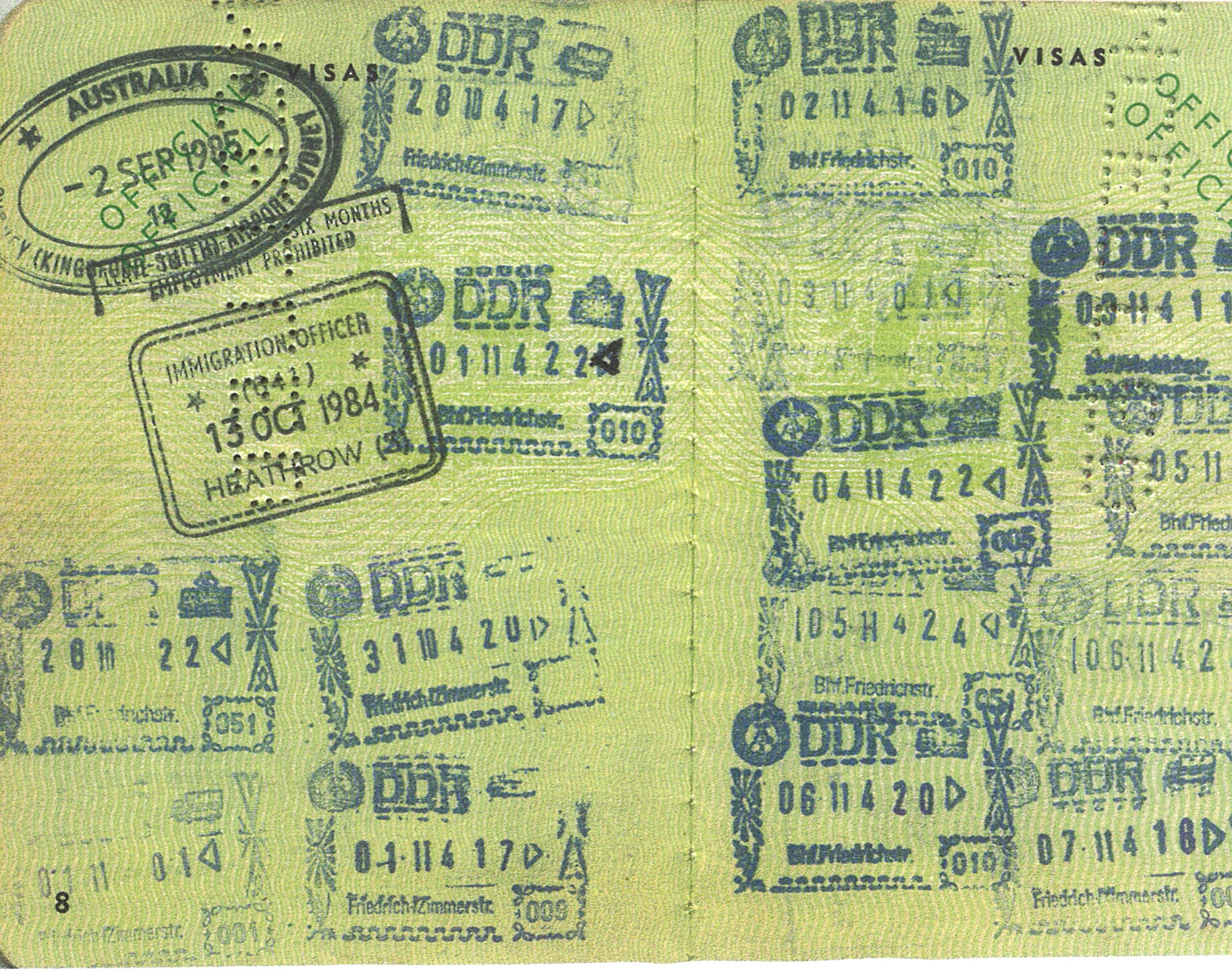
I took the train back to , Friedrichstraße    station and crossed back into East Berlin.  I now had three DDR stamps in my passport.

Dinners with A Based Staff

Later in the week we had dinners at the staff from the Embassy in their apartments.  I can recall, as we were driven to and from the apartments, how dark the streets were in East compared to the West.  There were hardly any cars and no people walking.

Back in the West

On Friday night, I headed back into the West and the Kurfürstendamm district.  After eating. I went to an Irish Pub.  The place was really jumping.

I started chatting to a group of people who speaking English.  One of them turned out to be a Swedish girl who worked as a nanny for a Swedish diplomatic family living in East Berlin.  She of course knew the Swedish woman who was working as a locally engaged staff person at the Australian Embassy.

When it was time to head back into the East, the Swedish girl said that she was taking taxis to ‘Checkpoint Charlie’ and where her “family would be here to meet her”.  She asked if I wanted to share the taxis. I did.

The crossing at Checkpoint Charlie was interesting in that it was ‘open’ as opposed to the crossing at the railway station.

The “family” turned out to be the father. He offered me a lift to the  Metropol.

Quick Trip to Hamburg

Next morning John and I crossed back into West Berlin and caught the train to Hamburg.  It was interesting travelling on the train, as it crossed form West Berlin into the part of East Germany west of the city and then into West Germany.  There was a lot of carry on with East German border guards.

We stayed overnight in Hamburg, returning to East Berlin on Sunday afternoon.

Meals in the West

On Monday and Tuesday I cross over to the West to eat.  I had decided to cross back into the East via Checkpoint Charlie. This involved taking a taxis to the Border, passing through the Checkpoint and walking back the hotel along Friedrichstraße which ran parallel to ‘The Wall’.

As I walked along the street,  a Trabant car followed about three metres behand me.  When I stopped, it stopped.  When I started walking again, it started up again.

It was surreal.  It is almost certain that the two blokes in the car were from the Stasi.

Date with Swedish Girl

I had arranged to have dinner with the Swedish Girl that I had met in the West the previous Friday.

We had agreed to meet in the same Irish Pub in the Europa Center. Over the meal she told me her experiences living a working the East including, the constant surveillance.

One of the stories she told me was about efforts by the Swedish Embassy to find  ‘bugging’ devices in their cars.

They had concluded that was impossible to stop the bugging in the Chancellery or the residences.  Like the Australian Embassy the  bugging in the Chancellery has counteracted by the use of a ‘sound proof box’ constructed within the building.  If sensitive issues needed to be discussed, staff went into the box.

The Swedes did, however, think that they could find any ‘bugging devices in their cars.  They drove on the cars across to West and searched them thoroughly for any bugs.  They didn’t find anything.

They then orchestrated a series of events including conversations in the cars, designed to determine if the conversation were being bugged.

Whatever the East Germans did next proved that they must have be listening to conversations in the car.

The Swedes took the cars back  into the West again and searched for the bugging devices.  Again they found nothing.

No Talking

After dinner the Swedish girl and I crossed back in the East via Friedrichstraße station.  As we approached the entrance to the hotel she told me that she “wasn’t going to speak to me anymore”.  I wasn’t sure what to make of that.

As it turned out there was a lot of writing on pieces of paper and sign language.

Flight to Bonn

We finished up at the Embassy around lunch time the next day, Thursday the 9th.

Our next stop was Bonn.

The First Secretary drove us to Checkpoint Charlie.  We walked across into the West where the Australian Consul in West Berlin met us and drove us to Tempelhof Airport.

The flight was interesting in the that when the plane was flying over East German land east of Berlin, it was only allowed to fly at 10,000 feet.  When we cross into West Germany it climbed to the normal 35,000 feet.

It was evening by the time we checked into our hotel in Bonn.

Flickr Link

https://www.flickr.com/gp/twwilko_photos/SF4Yr0

About Interflug

https://en.wikipedia.org/wiki/Interflug

About Interhotel

https://en.wikipedia.org/wiki/Interhotel

Europa Center

https://en.wikipedia.org/wiki/Europa-Center

Kurfürstendamm

https://en.wikipedia.org/wiki/Kurf%C3%BCrstendamm

Checkpoint Charlie

https://en.wikipedia.org/wiki/Checkpoint_Charlie


Moscow 1984

31497770611_3fe06a8d24_o

I started working at the Australian Department of Foreign Affairs on the 20th of September 1984.

My first trip was to Moscow. My travelling colleague was a crusty old former member of the Air Force called John.

Flight to London

We left Canberra early in the morning on the 10th of October for Sydney, before flying to Singapore and onto London.

I can recall that the place was very grey and gloomy as the taxis drove us from Heathrow to the Tower Hotel which is, as the name suggests, next to the Tower of London.  The cost of the taxis was GBP 18.

The plan was to stay awake all day to avoid jet lag.

 Meeting old Friends

I had arranged to meet up with a girl I knew from Kent.  I got to know her when I was living in London in 1983.  She worked for an interesting organisation that had offices opposite Green Park.

After a quick shower, I headed to Victoria Station meet her off the train. We spent most of the day together.

In the event I met up with couple also from Kent.  I had met the bloke at the St James Tavern in 1978 when I was first living in London.  I become good friends with him and bunch of his mates.  We used to meet up at the St James Tavern most Friday nights.  It was a very popular place with Swedish au pairs.  Two of the blokes ended up marrying Swedish girls.

My mate didn’t marry a Swedish girl.  He married a Welsh girl. I was privileged to go to their wedding in 1983.

My diary note says that we had dinner in Convent Garden and the I was “knackered” when I finally got to bed.

Flight to Moscow

The next day, Sunday John and I flew to Moscow. The First Secretary and the Attaché from the Embassy met us at the airport and drove to the National Hotel which is opposite Red Square.

We ate in the hotel.  The food was excellent.

Interesting Bathroom

I got up early to have a shower before breakfast. The bathroom was a bit odd.  It opened directly on to the bedroom.  The bath/shower was in the middle of the bathroom.  Another odd thing that was that there were no curtains on the windows of the room.  It looked directly on to Tverskaya Street and the building on the other side of the street were quite close.

The really odd thing about the shower was that there was no hot water.  I had a very short and invigorating shower.

After breakfast, a locally engaged driver arrived and drove us to the Embassy.

The First Secretary asked us what we thought of the hotel.  I told him about the issue with the shower.  John had no problem with his shower.

The First Secretary also asked if I had noticed that there were no curtains on the windows.  I said I did.  He then told me that I had almost certainly been photographed by the KGB from the building across the street.

He also said that when I got back to the hotel: “if  the water is still cold, you should talk to your door knob and ask for the hot water to be turned on”.  He suggested that I call the door knob “Boris”.

The Hot Water is Delivered

Back in the hotel after work, I turned on the shower.  The water was still cold.  I left the tap running and walked to the front door.  I spoke directly at the door knob: “Boris can you please turn on the hot water”.  Almost immediately, steam started billowing from the bathroom.

Beautiful Women

For the next two nights, we ate in the restaurant in the hotel.

An unforgettable feature of the bar in the hotel were the women.  The staff in the Embassy had told us about these ‘Beriozka’ girls.  They were state sanctioned prostitutes who were allowed to ply their trade in the hotel and long as they told the police and KGB who they had been with and what had happened.

This information could be used as “black mail material”.  They were called ‘Beriozka’ girls, because Beriozkas were stores in the USSR that would only accept hard currency and could only be used by foreigners and high ranking Soviet Officials.  They sold western and luxury Soviet goods, not that there were many of those.

One of the women was particularly stunning, with long black hair, pale skin and striking blue eyes. Her body was perfectly designed.

My colleague, John was at pains to tell me that “under no circumstances was I to have any contact with any of these women’.  If it did happen, “news of that would be get back to ASIO and my security clearance would be gone and so would be my career in the Department”.

Down Under Club

Friday night was drinks night at the Embassy.  It was held in the social club called the Down Under.  All of the ‘friendlies’ – UK,USA and Canada have these clubs and took turns to be the main venue each Friday.  This was, and still is, the practice in many capital cities around the world, particularly at the so called ‘hardship’ posts where social life for diplomats can be limited.

Staff from all the ‘friendly’ Embassies were at the club.  It was a big night.

Sightseeing

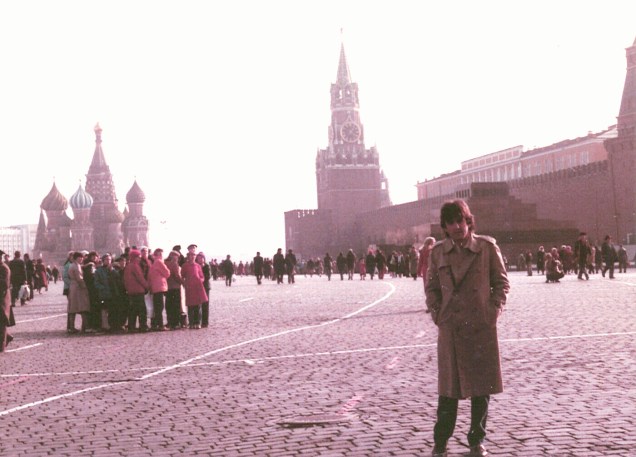
Next day we went on a tour of the Kremlin and walked around Red Square checking out the grave of the ‘Unknown Soldier’ and Lenin’s Mausoleum.  We also went into the GUM Department Store.  There wasn’t much for sale, and what there was looked like something from the 1950’s.

On Sunday we went on city tour.  This didn’t involve much except a visit to the university.

The Circus

In the evening we went to the Moscow Circus.  That was fantastic.

We got to and from there on the underground train system.  The stations are like art galleries.  Truly amazing.

Concert

After work on Monday we went to the Moscow Conservatory to see a concert. The tickets were organized by the Embassy.

We arrived late and could not take our ‘special’ seats. At the intermission, the attendants came looking for us and were very apologetic. It was our fault that we were late.

The concert was excellent and include Dvorak’s New World Symphony. My colleague didn’t like the concert at all.  I added philistine to my list of opinions on him.

Dinner being Monitored

On Wednesday night, we had dinner at the apartment of the Trade Commissioner.

All the Embassy staff, with the exception of the Ambassador, lived in the same apartment complex.  Staff from other missions, such as the Brits and the Canadians also lived in the same complex.  It was a very secure place.

We had been told about the extent of the monitoring and surveillance diplomatic staff are subjected to. We were now going to be given a demonstration.

Part way through the meal, the Trade Commissioner indicated that he wanted silence.  We all stopped talking.  He then looked to the roof and said: “I have you are having a good night Comrade.  We are having an excellent meal and very good Australian wine.  I am sure you would like it”.

The rest of the guests laughed.   He then went on to say: “Comrade, I don’t want you to get jealous.  I am going leave a bottle of wine outside the front door”.

The Trade Commissioner beckoned me to follow him to front door carrying a bottle of wine.  He opened the door and left it on the floor outside.

We then returned to the meal.

After about 10 minutes, the Trade Commissioner beckoned me back to the front door.  He opened the door.  The bottle was gone.

Last Night

Friday the 25th of October was our last night in Moscow.

The First Secretary had arranged a meal for us and Embassy staff at the ‘Berlin Restaurant’.  We needed a ‘Third Person’ diplomatic note to be granted permission.

John and I walked to the restaurant from the hotel.

The girls manning the cloakroom very remarkable attractive.

We were taken to the table where we met the First Secretary and other staff from the Embassy.

Part way through the meal a band started playing and people started dancing.  One of the cloakroom girls came over to the table asked me to dance.  I looked across at the First Secretary and struggled as if to say “what do I do?”.  I declined the offer.  After she left, I told the others who didn’t hear the request, what had happened.  I asked if would have been ok to dance with her.  They said that it would have been ok. My colleague, John frowned with disapproval.

No long later, a second girl came over to the table and asked me to dance.

This time I accepted.

As we were dancing, she asked me where I came from.  I told her that “I was an Accountant working in London for an oil company”. She gave me a very confused look and walked off.

Back at the table the staff from the Embassy agreed that “the girls must have been trainees”.

Speaking to Bar Girls

After the meal, John I walked back  to the hotel and agreed that we would have one beer in the bar to celebrate leaving Moscow.

The very striking ‘Beriozka’ girl, that I mentioned above, was there.  We both looked at her and she smiled. It was obvious that she was coming over to speak to us.  I said to John, “what are you going to do now?” He said “I suppose a chat on the last night is Ok”.

The girl said “you two are here every night but don’t talk to the girls?”.  John looked flustered. I said “we can’t afford to buy you drinks”. She laughed. We then had a bit of chat about what we had seen in Moscow.  She told us that she “worked as a secretary”.  At one point she asked us “how are the repairs at the Embassy going after the fire”.

We left the bar.

Leaving Moscow

In the morning the Attaché and a driver came to the hotel to take us to the airport for our flight to East Berlin.

On the way, we came across a body of the road and group of blokes trying to pick it up.  They were all obviously very drunk.

Getting through immigration was a circus.  The Official took my passport and simply stared at me then it.  He repeated this over and over for at least half an hour.

Once through immigration we boarded our East German Airlines Ilyushin jet heading to East Berlin.


Flickr Link

https://www.flickr.com/gp/twwilko_photos/3Hg799

Links to National Hotel

http://www.national.ru/

https://en.wikipedia.org/wiki/Hotel_National,_Moscow

Hard Currency Stores

https://en.wikipedia.org/wiki/Beryozka

Moscow Conservatory

https://en.wikipedia.org/wiki/Moscow_Conservatory