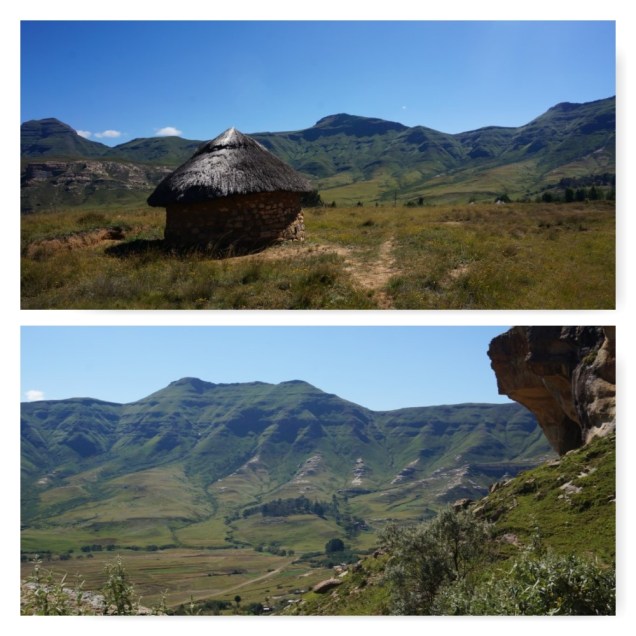
Lesotho
The Baz Bus for Johannesburg arrived at the hostel early. The driver explained that he wanted to get to Johannesburg before the worst of the peak hour.
We drove out of Durban through the western suburbs. It is a very big city.
Once out of the city we passed through farming land. It is similar to the Western Cape, with broad acre farms similar to the farms you see in Australia.
Pietermaritzburg
We passed through Pietermaritzburg, the driver joked that “there is no point in stopping here because there is nothing to do?”.
Before mid-day we crossed into the Drakensberg district. This famous for its mountain range.
We stopped at the Amphitheatre Backpackers. I was immediately taken by the place. The driver told us that we would be stopping for 20 minutes or so.
As I walked in to the reception I ran into George from Georgia. He asked if I was staying there. I said I hadn’t planned to, but I may change my mind. He said “you should”. He also said that I “should do the Lesotho tour”.
I spoke to the driver and he called the Baz Bus office to vary my ticket.
I had a simple lunch and spent the afternoon relaxing in the hostel. It has large grounds and swimming pool. I was a bit of hit with a Labrador and another dog, who seem to want someone to walk with, albeit we went around in circles.
The hostel put on an evening meal. Like other places that I have posted about, there were two options – vegetarian and non-vegetarian.
Trip into Lesotho
The hostel offers a tour into Lesotho.
The tour party assembled in the reception area. There were four Spaniards three of who had been competing in the World Underwater Hockey competition in RSA. There was another Spaniard who was a Doctor. There was French girl who was travelling extensively through African doing a mixture of paid and volunteer work. There was an American bloke from Chicago who had been developing computer systems for Obamacare. Finally, there were two Germans – a young woman who was living in Pretoria with were boyfriend who was on a posting working for BMW. The German bloke with her was a family friend from Munich who was on a world trip.
We left at 7.30 a.m. The guide who works at the hostel explained it would be a long day. We drove towards Harrismith and then to Phathaditjhaba before heading into the mountains to the border crossing at Montantsa Pass.
The road up to the pass was ‘as rough as’. It is a goat track that is in the process of being rebuilt. We passed at least four different gangs working on the roads. The gangs seemed to consist of at least 50 workers. There seemed to be 50/50 men and women working on the gangs. They had some machinery e.g. cement mixers and trucks, but most of the work was being done with picks and shovels.
At the top of the pass, we came to the border control. We submitted our passports that were duly stamped by the immigration officials.
We then headed down the hill into the valley on the Lesotho side of the Drakensberg range. The road was very steep. Fortunately, the improvement to this part of the road have been completed. It is covered with concrete blocks or poured concrete slabs.
At the bottom of the hill, we crossed river that the guide explained, is “the official border between the RSA and Lesotho.
School
After a short distance, we stopped at what turned out to be school. I had noticed that the first row of the seats of the mini bus was full of gardening equipment – forks, spades and cement and boxes of seedlings.
These turned out to be gifts from the owners of the Hostel to the school.
Principal’s talk
We were invited to go into the class rooms to meet the children and watch their lessons in progress. That was an interesting experience. The children were clearly a accustomed to having visitors, but still seemed somewhat apprehensive about the experience of being watched.
The guide then told that the Principal would give us a talk about the school. She was speaking in English, but it was very difficult to understand what she was saying.
Some of things I was able to glean from what she was saying included: the school was not funded by the government – the parents paid fees and the Hostel where we were staying also provided support with books and equipment, a lot of the children had been impacted by the HIV/AIDs epidemic that is ravaging the country – some had lost a parent, others were orphans, the “lessons were in English” – albeit a form of English that was not easy for others to understand.
Walk to Rock Painting
After the Principal’s talk, we headed up a path into the hill behind the school. It was a real goat’s track.
Our destination was rock formation where we were to see some rock paintings.
Before seeing the paintings, the guide told us a bit about Lesotho. I knew that It was an independent country in the middle of the RSA, but very little else.
The guide explained that it was originally inhabited by the San people who were nomadic. Over time other tribes move into the area and established permanent settlements.
The major turning point for the people in the area was the Boer War. The English were pushing the Afrikaans off their land and they in turn, were moving into what is now Lesotho. The native people appealed to the British for assistance and the British declared the area as a British Protectorate.
When the South African Union (the forerunner to the RSA) was formed, the people of Lesotho decided to remain separate from the Union. The country was granted independence from the UK in 1996.
The country is very poor. As noted above, it is ravaged by HIV/AIDs.
After lunch the guide showed us the rock painting that were nearby. Apparently there are better examples in the Natal National Park, however these ones were interesting to see.
Beer
We walked back down the hill into the valley.
We passed a number of huts until we came across one with a white flag. The guide explained that the villagers use flags to communicate to others that they have items for sale. A red flag says that there is meat for sale, a green flag is for vegetables, yellow is for corn.
A white flag indicates that the people in the hut have some beer for sale. It takes three days for the beer to be brewed. Once it is ready for drinking it has to be drunk and finished off in one day.
We stopped to taste the beer. A couple of the locals had clearly had enough, but were keen to keep drinking.
Traditional healer
We got back to school and boarded the bus.
Our next stop was the house of a ‘Tradition Healer’. She was an ‘elderly woman’ (probably in her forties).
The guide explained that she would say somethings and he would translate. The upshot of what she said included: she was a healer because her ancestors had picked her, she was confirmed as healer in a ceremony where she danced all night with a cock (bird variety) on her head and the cock didn’t fall off, she gets her knowledge of which treatments to use (herbs and animal parts) from her ancestors, they speak to her when she is in trance after smoking a herb (take that as marijuana).
After her chat, the healer took questions. In response to these question we learnt that: the most of her patients had sexually transmitted diseases including HIV/AIDS, she works injunction with the clinics that administer ‘western medicine’, when she gets sick she goes to another traditional healer.
Traditional food
After leaving that healer we headed back towards the border. The guide was worried that it was getting late and that we would not be back at the border crossing before it closed at 4.00 p.m.
We stopped briefly at another house for a tradition of meal of corn ‘porridge’ and vegetable.
This place has a small solar panel and was the only house in the village with electricity.
Over the border before 4 p.m
We crossed over the border back into the RSA.
Phone Call
We stopped in Harrismith to get fuel. While the bus was being fuelled, the Spanish Doctor called a hostel in Johannesburg to book accommodation for himself and his companions. He had his phone on speaker phone.
Albeit the doctor could speak very good English he spoke with a very strong accent. The bloke at the hostel did not have very good English and spoke with strong African accent.
The ‘conversation’ between the two of them was hilarious. There was constant misunderstanding and Doctor resorted to spell words out e.g A for Africa, B for buffalo, N for Nigeria. His selection for words to indicated the letters add to the confusion.
The other passengers, including myself, were in hysterics. The German woman had tears running down her face.
At the end of the ‘conversation’ it was agreed that the Spanish Doctor would make to the booking on -line. As the American bloke observed, “technically you have yet to make a booking”.
I only wish that I had recorded to the whole episode.
Interesting Conversation
Back at the hostel we had a communal meal. There were some very interesting conversations covering a wide range of topics, including security issues when travelling Africa, the EU migrant crisis and the USA election.
Flickr Link
Garmin Link
https://connect.garmin.com/modern/activity/1141267610
About Lesotho
https://en.wikipedia.org/wiki/Lesotho
 billrider2013