It is long way from Buenos Aries to El Calafate. This required a plane trip. I had thought that I would walk up to the main avenue St Julio and catch an Airport Bus. The staff at the hostel in BA made a particular point that “you should take a taxis or hire car. I found this advice a little strange, given that I had felt safe walking the streets over the past few days.
Apparently the issue that this when you are walking the streets with a suitcase or backpack, it is obvious that you are a traveller, and likely to be a foreign tourist. As a foreigner you are likely to be carrying hard currency (USD or EUR) and would you would certainly be carrying credit cards and a passport.
The car arranged by the hostel took me to the domestic airport which is only about 15 klms from the centre of the city. Even though it a short distance, it took over 40 minutes due to the congested traffic.
Long Flight
The flight to El Calafe takes over 3 hours. That gives you an indication of the size of Argentina – it is a big place.
From the air, the area just south of BA appeared to reasonably fertile with green grass and I assume, cattle ranches.
The further south you travel the land appeared to become progressively more barren with no obvious evidence of agriculture.
As you approach El Calafate, you fly over Lake Argentina, which I was to later learn, is the largest lake in the country. It is an aqua blue colour cause by the sediment generated by the glaciers that feed into the lake.
America Del Sur Hostel
I had arranged transport from the Calafate airport into town via an email to the hostel. This turned out to be a mini bus.
The hostel has a great view of the Lake.
After checking in, I took the 10 minute walk into town. The place has to look and feel on a town near to a skiing area – a bit like Jindabyne in NSW, Bright in Victoria or Queenstown in New Zealand. How the main outdoor activity in this area is walking.
Tour to Glacier Perito Moreno
The big attraction of El Calafate is the Glacier Perito Moreno. There seemed to be any number of tour operators to the glacier. The hostel recommended a particular operator. I took their advice.
The tour was on a mini bus. This made it possible to take a gravel road along the lake rather than the main road.
At one point we stopped at small farm. The guide explained that the area around El Calafate and west to Andes was very dry. The moist air coming across the Pacific Ocean and hitting the mountains bordering Chile and Argentina, loses most of it moisture in the mountains in the form of snow. It rarely rains or snows to the east of the mountains.
The guide also told us that area had been used for sheep growing. This was reasonably successful for a while until it was realised that the sheep were destroying the land. This was due to their hard hooves and the fact that rather than cutting through the grass like scissors, they tended to rip the grass out of the ground. Over time there was less and less grass and it look ages for it to regrow. In the end the sheep growing become unviable.
The small farm that we stopped at had been turned into a guest house. The only animal were some alpacas, goats, a cat and a fox. The fox seemed to have been trained to arrive shortly after our bus.
Spectacular Glacier
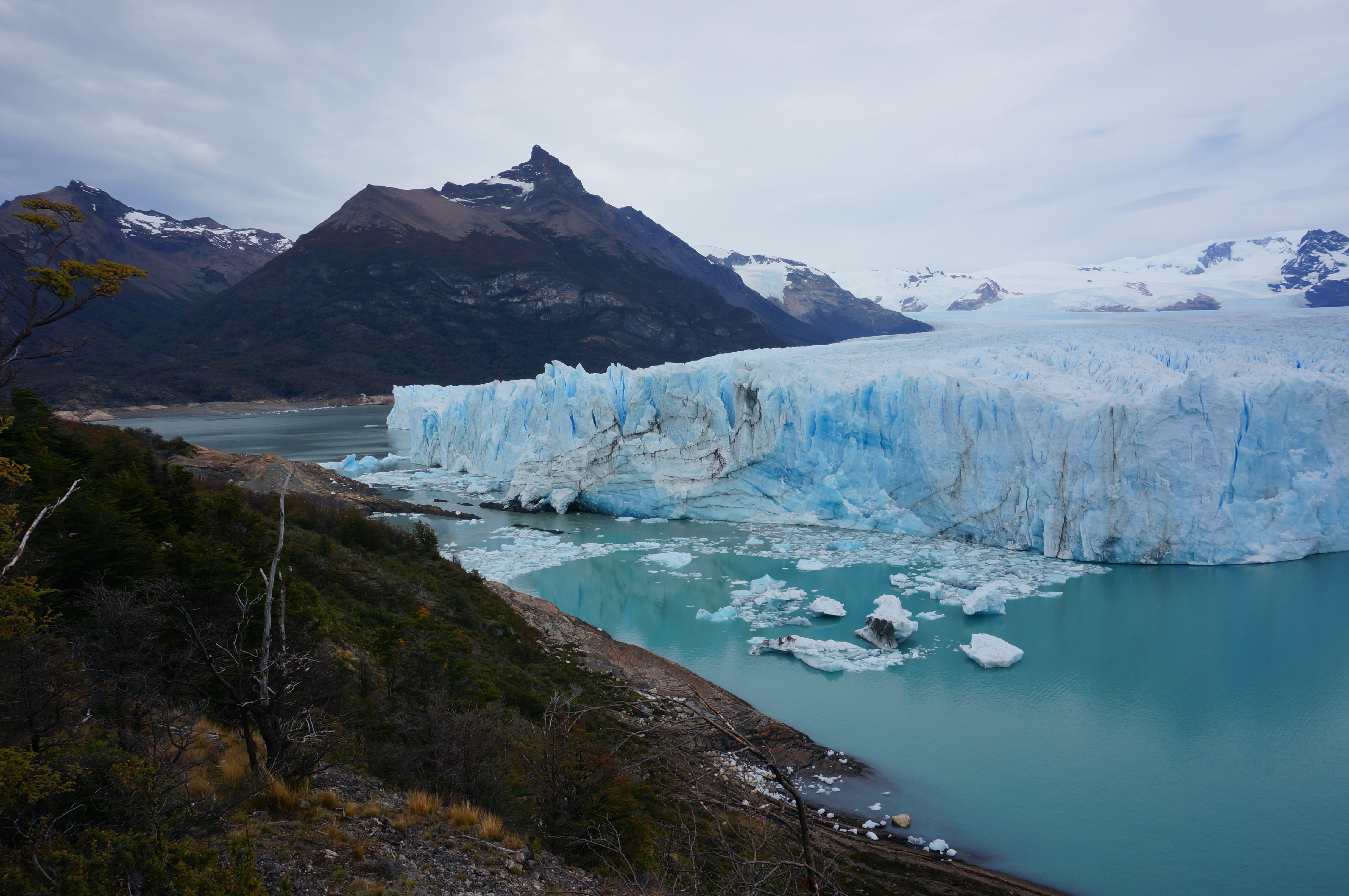
After leaving the farm, it was a short drive to entrance of the National Park that includes the Glacier Perito Mareno. We were dropped off on the northern side of the glacier. This side flows directly in to the main part of Lake Argentina.
It was not long before we heard a loud crack and splash. This was piece of the glacier falling into the lake. The guide had explained that the glacier advances about 3 metre per day. It is also ‘stable’ in that it is not getting longer or shorter. All of the other glaciers in the region are getting shorter or retreating. I guess that this is an inconvenient truth in for those that do not believe in climate change.
The Flickr photos are the best way to describe the glacier. Check out the ‘blue’.
There are series of elevated paths that take you from the northern side to a ‘point’ in about the middle and on to the southern side, of the glacier.
The ‘point’ is a piece of land, like a peninsular, that almost touches the advancing glacier. The guide had explained that periodically (2 and 8 years ago, in recent times), the glacier actually meets the peninsular and forms an ice dam between the south side of the lake and the much larger northern side. Given that the run of from the southern side of the glacier is trapped in the much smaller part of the lake, the water level rises relative to the larger northern side. This difference in the water levels and get as high as 30 metres before the pressure becomes too great and the ice dam breaks, letting the water floe from the southern side into the northern side. The guide said that the most recent ‘dam collapse’ took place at night and no one saw it.
German Girls and ‘Six Degrees of Separation’
Why walking on the paths, I got to chat with a couple of German girls that were travelling separately. One spoke with a very strong Irish accent, so strong that the other one found it difficult to believe that she was German.
It turned out that the ‘Irish’ German girl had worked as a Nanny for a friend of my ex-wife in Mosman in Sydney. I vaguely know that woman, but it is a classic case of ‘six degrees of separation’.
Boat Trip of the Lake
After wandering around the paths for a couple of hours, we were pick up by the mini bus and taken down to the Southern part of the lake where we caught boat.
The boat sailed up to 300 metres from the glacier. The Flickr photos and video tell it all.
Bike Ride
The other thing I did in El Calafate was a downhill mountain bike (MTB). This involved taking a chairlift to a very small little ski ‘resort’ about 20 klms from town. As noted above, the area around Calafate gets very little snow, so it is not much of a place to ski.
There were 6 people on the excursion – a couple from Norway and an American girl and myself that were doing MTB riding and 4 others that were doing Quad bike riding.
The MTB ride was from the top of the chairlift back into El Calafate. The path was a mixture of 4 WD paths and single track.
The guide was obviously a really good rider and was the Norwegian bloke. His wife was also very good. The American girl found the going tough and pulled out after about 30 minutes and was collected by a 4WD.
There was one really tricky bit that instructor did with easy. The Norwegian bloke managed to do it but was very shaky on the run off. I decided to chicken out. Breaking a bone in this part of the world would not be a good idea.
The last part of the trail just before getting into town was a great section of single track.
The ride was well worthwhile.
After the ride I had a coffee with the Norwegian couple. They live on the Island of Spitsbergen which is almost in the Artic Circle. He works as tour guide and takes people into the Aric Circle including the North Pole. Interesting life.
Early Night
I had an early night because I was due to walk up early to catch a bus to El Chalten.
Flickr Link
Garmin Link
 billrider2013