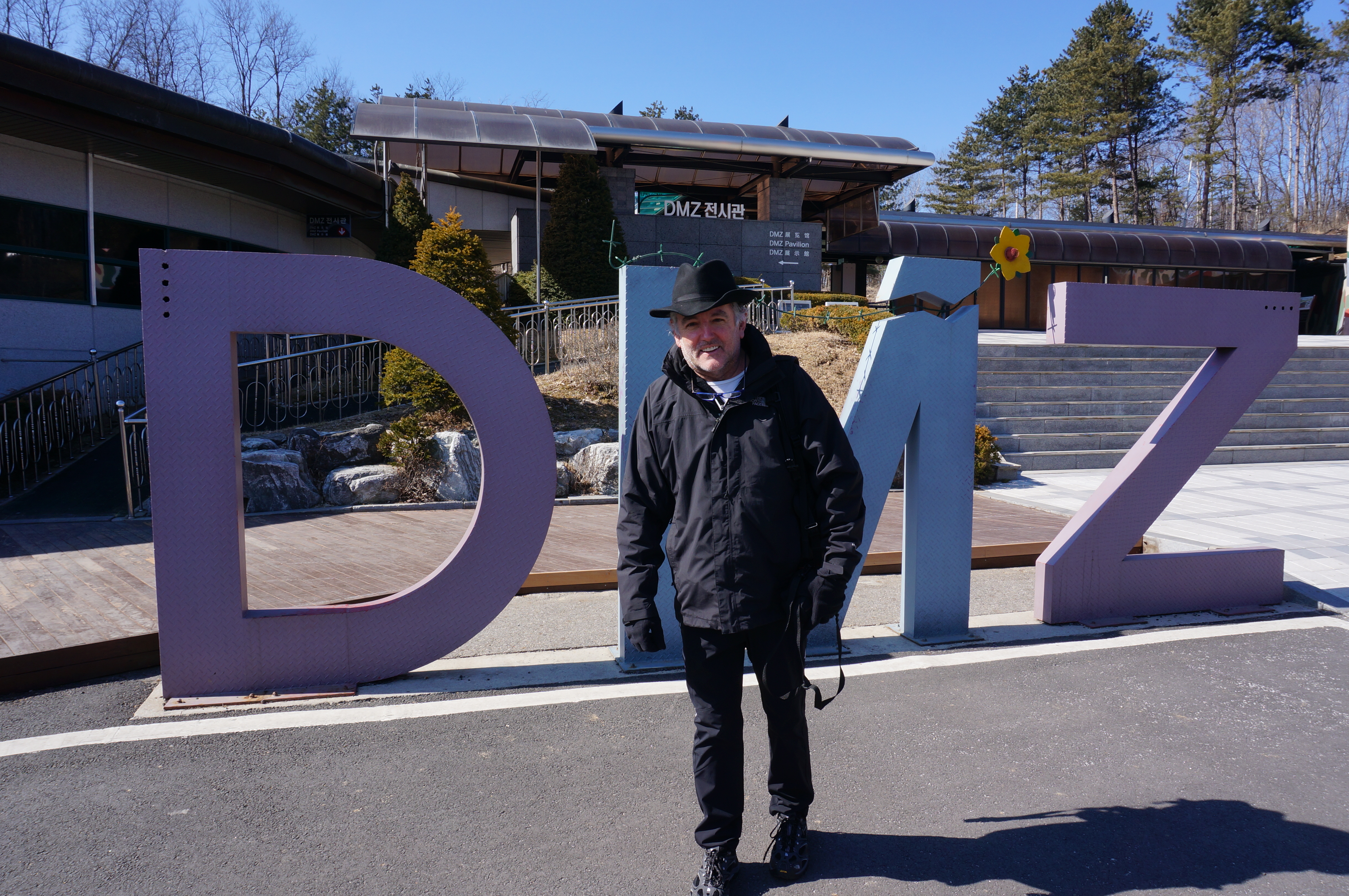
One of the things I wanted to see while I was in Korea was the Demilitarised Zone (DMZ) between North and South Korea.
Not Many Contested Borders Left in the World
I have a bit of an interest in ‘contested borders’. Since the fall of the ‘Iron Curtain’ in Europe and the opening up of China, there are very such borders left in the world. This is of course, the Ukraine and Russian border and the Kashmir border area between India and Pakistan that are contested. However. I am don’t know of one, other than that Korean DMZ, that is a tourist attraction.
I can recall the old East and West Germany border very well. In November 1984 I was in East Berlin on a Department of Foreign Affairs trip. I was staying in a hotel next to the ‘Berlin Wall’. I will post about that later.
Bus Tour of the DMZ and PSA
The woman that runs my Seoul Hostel told me that there were two tours of the DMZ. One was of only the DMZ and the other, a longer tour, included that Joint Security Area (JSA) that lies within the DMZ. She strongly recommended the later.
My Balmain Host, who had also arrived in Seoul had expressed an interest in seeing the DMZ. He also took the recommendation that we should take the longer tour. You are required submit your passport details to the tour operator over 48 hours prior to the tour. Presumably some sort of check is performed. You are also required to carry your passport on the tour.
I was picked up by a small mini bus which took me to a large hotel where the other tour participants (60 in all) had assembled. The tour Guide, Michelle, introduced herself and started to talk. She didn’t stop talking for the whole time she was with us.
The bus headed north from Seoul. We passed the Imjin River which forms part of the border with North Korea. You can see the North across a large body of water.
It is only 40 kilometres before you reach the DMZ area. The first stop was the Freedom Bridge. This is where prisoner exchanges took place during the Korean War. It was bitterly cold. Our guide was very precise as to how much time we had at this stop. Given that it was so cold, no one was late returning to the bus.
Tunnel No 3
The next stop was Tunnel No 3. This is one four known tunnels that the North Koreans have built under the DMZ with the intention of sending troops into the South. This one was discovered in October 1978. It is now a major tourist attraction.
The South Koreans have built a tunnel down to the ‘Tunnel No 3.’ This tunnel is quite steep, but high and lined with concrete. The actual ‘Tunnel No 3 is very small and any who is not ‘vertically challenged’ has to stoop. You are provided with ‘hard hats’. They are needed. It is virtually impossible to avoid hitting your head on the up and back along the tunnel. A wall has been constructed in the tunnel at the border between the North and the South.
http://en.wikipedia.org/wiki/Third_Tunnel_of_Aggression
Dora Observatory
We were then taken to the Dora Observatory which overlooks the DMZ. From the observatory you can see two flags, one South Korean and the other North Korean. They stand above the only two villages that lie within the DMZ. Both flags fly from very large poles. Apparently there has been a poles ‘arms race’ wherein both sides built bigger and bigger poles. This culminated in the North building a 160 metre pole, the largest in the world. At that point, the South gave in, theirs is only 100 metres high.
Train Station
The last stop of this part of the tour was a bizarre train station.
Prior to the separation of the country into the North and South Korea’s, there was a railway line that ran the length of the peninsular. Naturally, after the war, the line was cut.
In 2000 it was decided to reconnect the line. This involved the clearing of minefields and the construction of 17 kilometres of track. A station was also built on the Southern border. The work was completed in 2003.
You visit the station on the tour. It is a bit surreal in that there are only two trains a day and they only run to Seoul. Only one train has ever run north.
Since the line was completed, relations with the North have been problematic, and while the bloke with strange haircut continues to play up, it is unlikely that any train will run again soon.
At this point in the tour, those that were only seeing the DMZ headed back to Seoul. The remainder of us, were ‘treated’ to a lunch. Actually, is wasn’t too bad.
On to the JSA
We were introduced to our new guide who would be taking us into the JSA. She told us that she was “an English speaking Guide”. That was about the only bit of what she said that I understood. The other bit that she said that was vaguely intelligible was that photographs could only be taken at certain times and there were only certain things that could be photographed.
The JSA is an area of about 800 square metres that lies, as its ‘Joint’ name suggests, where both parties – the North and the United Nations (South) – have joint access.
When it was initially set up, this was the case. The actual border between the North and the South (the Military Demarcation Line – MDL) runs through the JSA. However, within the JSA personnel from both sides were permitted to move freely across the border. In other words they could ‘mingle. This occurred from its establishment in 1953 until August 1976.
On the 18th of August 1976, North Korean Guards murdered two UN soldiers. From that point on the MDL has been marked within the JSA and neither side crosses that line. The exception is in the buildings described below.
The Buildings Straddling the MDL
At the centre of the JSA there are three low rise timber building that straddle the MDL. It is in these buildings, that representatives from the North and the South meet.
These small building lie between larger concrete buildings, one on the South and similar one on the North.
The negotiators enter the smaller building from the larger building. On the tour you follow the path into the large building and down into the ‘negotiation’ buildings.
From the steps of the large building you can look across to the North’s ‘large building’. On the steps of that building (about 150 metres away) you can see a North Korean Guard. Below you, you can see UN Guards staring the North Korean Guard down. This the famous shot.
Photographic Frenzy
As we were on the steps we ‘told’ that we could take photos for “one minute”. Apparently we also told that we could only take photos in front of us. I missed that bit in that I could only vaguely understand about 1 in 100 of the words that the guide uttered.
I must have appeared to have taken a photo to the left of straight ahead. A guard was onto to me like a flash and checked my camera. I had not taken a photo to the left, but I had taken a photo behind where I was standing. That was duly deleted. The ‘Free World’ is doubtless much safer as a result of that deletion.
When then moved in to the buildings where the negotiations between that North and the South take place.
I suggest you look at the Flickr photos and the video. The video tells it all.
The Garmin Link show where all this is at.
Comment
It you are in South Korea, the DMZ tour is a must do.
Flickr Link
Garmin Link
 billrider2013