When I am travelling I like to read books about the places that I am visiting. Typically, these are books written by travel writers. These are not travel guides, but are books written by writers about their travels, in the style of Bill Bryson or Paul Theroux.
On this trip I a reading ‘Cape Town to Kruger – Backpacker Adventures in South Africa and Swaziland’ by an Irish bloke called John Dwyer.
One of the things that he did during his time in Cape Town was a visit to a ‘Township’. I decided to do the same.
I organised the tour through the hostel. My guide arrived in ‘reverse African time’ – twenty minutes early. The guide ‘James’ told me that he wanted “to get going because of the traffic”. We headed into town where we picked up three Americans from another hostel.
Forced Removal of Blacks
As we were leaving the CBD, James stopped the van and pointed out a sign which said ‘District Six’. James explained that this area was particularly significant in the history of Apartheid. In 1982 the white controlled government declared the area of District Six and as a Whites Only Area’. The over 60,000 Black people living the area were forced to leave and their houses were demolished.
He also explained the operation of the ‘Pass Laws’. I mentioned these laws in my previous post about Robben Island.
James explained that all Blacks had to carry a ‘Pass Book’ at all times. The Pass Book’ detailed where they could live and work. For example, the Pass Book may say the holder could live in Langa Township (where we were headed) and work in the CBD of Cape Town. However, the holder may could only be the CBD during certain hours. The police would routinely stop Blacks in the street to check their Pass Book. It the holder was in the wrong place for at the wrong time, they would be detained. Repeated offenders would be placed in gaol.
Hospital
As we continued on towards the Township. The road passes that main Cape Town Hospital. This is where Dr Christiann Barnard performed that first heart transplant in 1967.
This is somewhat surreal give what follows.
Langa Township
Our first stop in the Township was a community centre. James explained that it was an initiative designed to provide unemployed people with skills and meaningful work. There didn’t appear to be too much going on.
There were a couple of women and bloke doing some pottery. Some of the items were being made for the Maryland University.
There were some other handicrafts for sale. One of the American blokes bought a model a bicycle made from wire.
While we were in the centre the American girl told me that see had been working on a project for a local Telecommunications company in Port Elizabeth. She was working on the project because the company was linked to Ericsson, with whom she worked in California.
The project “was not going well” and she had decided to leave. She was spending a couple of day in Cape Town before flying home. She also said the one of the reasons she decided to leave South Africa was the “extreme racism” she was forced to witness.
Living in a Container
Leaving the centre, we walked down street into the Township itself. We stopped at a shipping container. James explained that we were going to meet the person that lived in the container.
He opened that door and we looked in. We were introduced to the person that lived in the container. She was a disabled woman in her forties. It was very confronting.
Ex-Policeman
Our next stop was a large hall. James explained that the hall was used for accommodation. It had been divided into small rooms that were occupied by mainly single men. I also had showers and toilets.
Leaving the hall, we were taken into a shack the was in lane behind the hall.
We were introduced to its owner. James told us that he “would tell us about his life” and that we were “free to ask him any questions”.
The guy told us that he 65 years old. He was brought up in small town to the west of Cape Town. His parents were poor and he was forced leave school when he was 14. His first job was a messenger for a clothing store. When he was 18 he applied for a job as policeman. It was long process including taking examinations and medicals. In the end he was successful and joined the force.
After a short period of training, he was transferred to Cape Town.
He told us that he had lived in Langa most of the time he was in the Police Force. It was a little unclear how long he had lived in the shack, but he told us the he had built it himself. He started with one room that he built “overnight”. Once he “had claimed his spot, that was his”. Overtime he had expanded the shack to include three rooms. One is for this daughter. He told us that his wife died in 2009.
The shack has no toilet or running water. He and his daughter bring water from the hall next door. They also use the showers and toilets in the hall.
I asked him if he got a pension for being a former policeman. He told that he received a pension of 1,020 Rand per month. That is less than AUD 100 per month.
He told us that he was on the waiting list for one of the government ‘flats’ that are being built in the Township. He told us the he was not sure when it would be his turn to get a flat. However, he was “confident that he would get one”.
Stopping for a Beer
Leaving the shack, we took a very short down a lane to a place for a beer.
James explained that this was where the locals met to “chat and have a drink”. There were a number of blokes sitting around. There wasn’t too much chat – one was comatose the others were on the way.
We were introduced to the ‘Mistress Brewer’. James explained that the brew was made of fermented maize. I asked where the maize came from? He told me that it now comes from “Shoprite, the Supermarket in the Township”.
Apparently the brew takes 3 days to ferment and is then ready to drink. I assumed that in the absence of any refrigeration, it is drunk on that day.
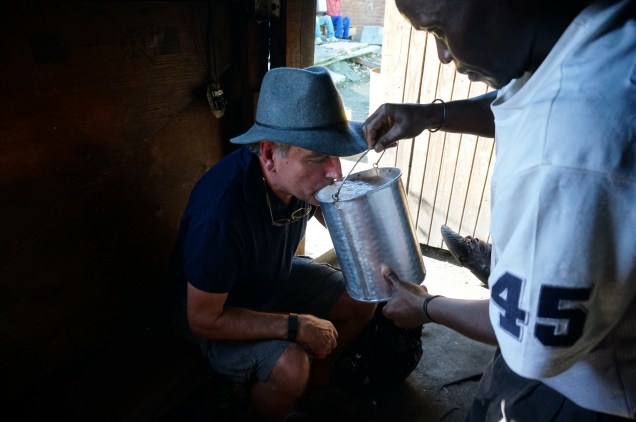
We were offered to opportunity to drink the beer. The two American blokes declined. The girl had a go. So did I. We drank it out of a bucket. I am writing this over 24 hours later. I assume I won’t have any after effects.
Different Levels of Housing
After the beer tasting, we went on a short walk. We passed some two storeyed builds. The American girl told me that the buildings did not look dissimilar to the housing that is provided to the “lower ranks of the USA military”. She told me that she knew what that was like “because her sister was married to an Infantry Man”. She said that the “USA doesn’t look after its Servicemen”.
We were taken into one of the buildings. There was a small room with bunk beds. James explained that the room was occupied by three families. The parents slept in the beds and the children slept on the floor.
As we left, the American girl said that while the building looked the same as her Sister’s place, the sleeping arrangement were “better than that”.
We then returned the mini bus.
Some New Buildings
James drove us passed some new buildings, some of which were still under construction. He explained that these were being built by the government and the plan was to “move people from the shacks in to proper buildings over time”.
We then passed some cottages. James explained that these were ‘Bank Houses’. They had been built by their owners with loans from banks. Most were owned by ‘professionals’ e.g. teachers and government workers. Some had cars parked in the front yards. These places also had satellite dishes. I asked if they there was any robberies of these houses. James said that it was rare. “Most people respect the owners and the fact they were the “same as them”.
Immigrants
James then took us into another area than was far poorer than anything that we had seen so far. It was on the fringe of the Township, near the highway to the Airport. He explained that this was where the “immigrants were”. These are people from Zimbabwe and elsewhere in Africa that “have come to South Africa for a better life”.
It is really grim.
Check out the video of Flickr.
Flickr Link
https://flic.kr/s/aHsksdAauv
Link to Christiaan Barnard
https://en.wikipedia.org/wiki/Christiaan_Barnard
 billrider2013