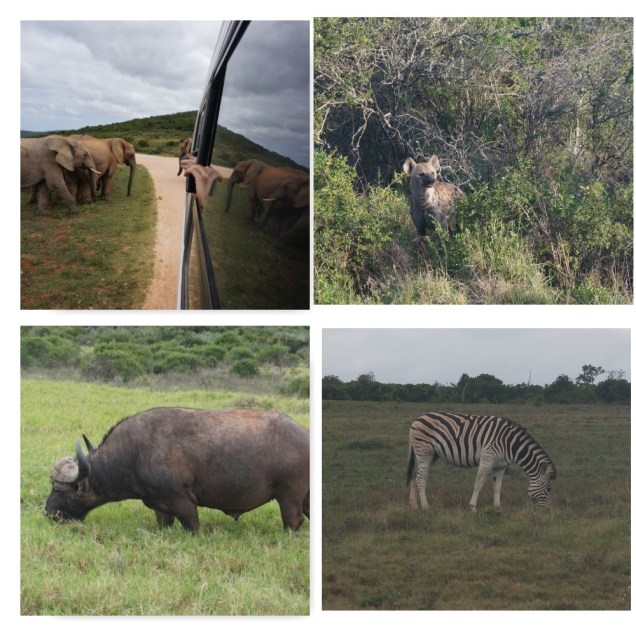
The main reason for staying Port Elizabeth was to visit the Addo Elephant Park. The park is located about 50 kilometres from the city.
I organised a tour of the park through the hostel.
Pick up
I was picked at the hostel by the guide, a bloke called Craig. We stopped to pick up five other passengers before heading out of town.
As we dove along, Craig told us a bit about Port Elizabeth. It is a major industrial centre with a large deep water harbour. There are two dock areas, one in near the CBD and another, newer port, about 15 kilometres away. Craig said that the plan was to move all of the ‘dirty activity’ from the CBD port to the newer port and redevelop the city port into a ‘green precinct.
New Industrial Park
As part of the new port development, the government has established a new industrial area. We passed through this area on the way to Addo.
Early settlers killed the Animals
As we approached the Park, Craig told us about the history of the park and why it had been established. Apparently the early British settlers in the area killed a huge number of elephants, lions and other animals as they established farms.
The elephant population was reduced to less than 20 and the lions were killed to the point of extinction.
In 1930, it was decided that “enough was enough” and the government established the Addo Elephant with the view to saving the remaining animals and re-establishing the numbers.
Over time that elephant numbers increased and in ???? it was decided to introduce lions into the park. It was determined that a species of lion from Namibia was that closest to the original species.
It the early 2000’s it was noted that most of the female elephants in the park did not grew tusks. It was believed that this was due inbreeding. It was decided to import some male elephants from the Kruger Nation Park in the north of the RSA. This seems to have been a success and the female offspring of these bulls are growing tusks.
Into the Park
We were not in the park for long before we sighted our first elephants. There were at a water hole near the road. Craig explained that there are few natural streams in the park and the rangers have built water holes using artesian water.
As well as the elephants, we saw zebra, antelope and lots of warthogs.
Craig explained that the trick to seeing as many animals as possible was to travel along the roads as much as possible.
The park is large. In all it coves over ???? hectares, the diagonal distance across is over 200 kilometres. Over the years, the park has been expanded as farmers on the adjoining lands have been willing to sell to the government.
As we drove along, we spotted a lone buffalo. Craig explained that it was an old bull. Most of the buffalo live in groups with multiple families, however, as they get older the bulls tend to leave the groups and travel alone.
Off to see Lions
At one point Craig received a call on his mobile phone. He told us that the call was from another tour guide that had spotted some lions. The place was about 30 minutes’ drive from where we were. This was an opportunity not to be missed.
The area where the lions had been spotted, was a new part of the park which had formerly been farmed. Most of the ‘natural’ parts of the park are covered by thick bushes. The previously farmed areas were largely cleared.
Craig spotted the mini bus owned by the guide who called him. We knew that we in the right place. Craig quickly surveyed the scene and spotted the lions. There were three lions on hill about 500 metres from where we were on the road.
Craig told us the that were a “lioness and two teenage cubs – a male and female”. He passed his binoculars so we could be a better look of the animals.
As we watched, one of the lions, the male started to move down the hill. Craig pointed out that appeared to be heading towards an antelope and was grazing at the bottom of the hill.
As we watched, the lion moved from one small bush to another. It was fascinating to watch. Craig explained that he had been seeing this family group of lions since the cubs were born.
Male cub is not likely to have a good time. There are two other adult males in this part of the park. Craig told us that they are unlikely to accept that young male when he is fully grown and will drive him away or possibly kill him.
No Lunch for this Lion
The young lion moved further and further down the hill. We could see the antelope that he was head for another about 200 metres to the left. Craig told us the it is “likely that one of the antelopes will spot the lion soon”. They will they will make a load “bellowing noise to warn other Antelopes that there is danger”.
Craig was right. One of the antelopes bellowed and they ran towards each other. Craig told us that the lion was probably not strong enough to take on an antelope at this stage. He certainly would take on two.
Lunch
We had watched that lions for over an hour. He did not get to have lunch, but we did. There is a really good restaurant in the main camp of the park. The food was excellent.
Big Elephant
In the hour after lunch we actually saw nothing. Craig was rather apologetic about the “lack of sightings”.
However, all was not lost, we came across a group of elephants including one of the bulls that had been brought down from Kruger National Park. He is a seriously big boy.
Hyena
As we were heading back to the exit of the park we came across a hyena. Craig explained that this is a “rare sighting”. We were lucky. Check out the Flickr link.
Back late
It was after 7.00 p.m. when we got back to Port Elizabeth.
Flickr Link
https://flic.kr/s/aHskxHVDWr
 billrider2013