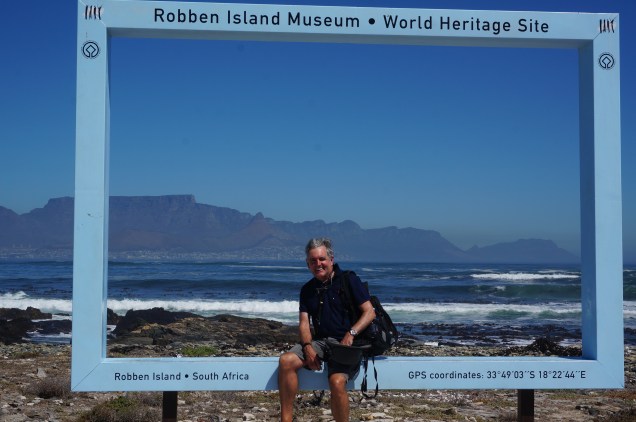
One of the places I really wanted to see while in Cape Town was Robben Island. It is the location of the infamous prison where Nelson Mandela and other political prisoners where held during the apartheid years in South Africa.
As you would expect, it is a place of great significance for South Africans. It has been accorded World Heritage status by UNESCO.
The people at the hostel recommended that I book ahead to get a ticket. My tour started at 1.00 p.m. The boat to the island was not what I expected. It appeared to be a ‘working’ boat, with limited places for the passengers to sit.
Prison Ship
The trip out to the island took about 50 minutes. There was quite a large swell. As we drew into the harbour on the island we could see a number of other boats. They all looked like your typical harbour cruise boats.
Once on the island we were directed to a line of buses. Once on board we were greeted by our Guide. He looked like a young Nelson Mandela. He asked which boat brought us to island. Someone old him it was the “Dias”. He explained that the Dias was one of the original “prison boats” that were used to transport supplies to the island. It was also used to transport the prisoners to the island.
Tour of the Island by Bus
The bus took us past the prison and to an area which the guide explained was the site of a leper colony. The island housed the colony up until the 1930’s. It must have been dreadful to suffer from leprosy in those days. I note that it has been determined that leprosy has been determined to not be very contagious. I guess that leper colonies were a bit of an overkill.
Robert Sobukwe
The bus then stopped at a house. The guide explained that house was where a political dissident by the name of Robert Sobukwe was held in solitary confinement. He was famous for leading the resistance to the ‘pass laws’. This was system under apartheid wherein the Blacks were issued with identity passes that were used to restrict where they could live and travel within the country.
The Guide told us that as part of his solitary confinement Sobukwe was not allowed to talk to anyone, including the Warders that were guarding him. Towards that end of his incarceration he was visited by the anti-Apartheid activist, Helen Suzman. The guide said that he met Suzman when she visited the island shortly before her death. She told him that Sobukwe told her that he was “forgetting how to speak”. What an extraordinary form of torture solitary confinement is.
Lime quarry
The tour took past the Lime Quarry, where the political prisoners were forced to work. The Guide explained that the educated prisoners used the “relative freedom” while working in the quarry to teach the illiterate prisoners to read and write. He also explained that the dust and glare at the quarry caused eye damage to the prisoners.
Penguins and Great View
We stopped for a short break the northern end of the island. From this point there is a great view of Table Mountain. You can also see some of the local penguins. Apparently their numbers are declining and no one is sure why this is occurring.
Large guns
Heading back to the prison we passed a large gun, one of three that were placed on the island during WWII. Of course these guns never fired a shot in anger.
Prison
The bus dropped us off at the prison. We were met by our next Guide. This gentleman was really interesting he was a former political prisoner.
The Guide explained that the prison had several blocks. The prisoners of different categories were held in separate blocks. There was a block for the ‘Coloureds’ (mix race) and the Indians. The ‘Blacks’ were held in separate blocks. The ‘Leaders’ like Nelson Mandela were held in a separate Block.
The first block that we entered was where the guide was kept. The ‘cells’ were large. Up to 20 men were held in the cell. The prisoners slept on blankets placed on the floor. There were no beds. This practice ceased under pressure from the Red Cross and it was causing the prisoners to contract TB.
The next block was where more ‘dangerous’ prisoners were held. This block has single cells. On the walls of the cells are cards will short stories written by the inmates. They are all harrowing.
Guide tells of his Personal Experiences
While we were in this block, the Guide fielded questions from the group. This was very interesting.
He told us about the controls that the Warders placed over their communications will the outside. The sending and receiving of mail was very restricted and all mail was read and censored. He told us about one particular Warden with whom he become friendly. This
Warden took the Guide’s letters and smuggled them off the island and personally sent them to the Guide’s family. He also encouraged the family to send him letters that he passed to the Guide.
The Guide told us the “the Warden is still alive and is one of his best friends”.
The last part of the tour of the prison was where Nelson Mandela was held. There is a quadrangle next to the block. The Guide explained that in the corner of the quadrangle was one of the spots where Mandela hid the manuscripts for his book ‘The Long March to Freedom’. Where the original fence was being replaced will a stone wall, the manuscript was discovered. Mandela had to re-write that part of the book.
Clever use of a Tennis Ball
The Guide also told us about the tricky thing that the ‘Leaders’ used to communicate with the other prisoners in the adjoining Block.
They used to play tennis in the quadrangle. They cleverly placed written messages inside one of the tennis balls. During the course of the game they would hit the ball over the wall into the next block. The prisoners in the next block would reply to the message and throw that ball back over the wall.
Apparently this went on for years. Notwithstanding the Warders saw the ball going over the wall and being returned, they never twigged that it was being used for communication.
Mandela’s Cell
The final stop on the tour was Nelson Mandela’s cell. I always find it a bit eerie to visit a famous place in history. This is one of those places.
Flickr Link
About Helen Suzman
https://en.wikipedia.org/wiki/Helen_Suzman
Long Walk to Freedom
 billrider2013