The Galapagos Islands

Galapagos

In the second week of May I decided that I would have time to go to the Galapagos Islands and still be able to arrive in London on the first week of June. I searched the net for a flight. There are only two airlines that fly to the islands. They seem to know what that duopoly power gives them as far as pricing is concerned. Anyway I found a reasonable return fare from Lima.

Trip to the Airport

The taxis ride from the hostel in Mirafores to the airport was interesting. The route took us through back streets of what is clearly a very poor part of Lima. The driver was on his mobile phone for the whole journey, steering with one hand. I was very relieved to arrive at the airport.

Guayaquil

The first leg of journey was a flight to Guayaquil. I was one of the last to get off the plane and was near the end of the queue to get through immigration. The bloke standing next to me told me to expect a long wait. He was right. It took nearly two hours.   It was after three in the morning when I was finally through.

My flight on to the Galapagos was due to leave at 9.30 a.m. I was able to catch some sleep on a bench chair departure area,

Getting a Pass to the Islands

When I was checking in for the flight to Baltra, I was told that you have to purchase a pass to for the islands prior to boarding the plane.

The process of purchasing the pass turned out to be a real circus. The que hardly moved. Some English blokes that were ahead of me, and on an earlier flight, went to the head of the que to investigate. They said that it seemed to take a long for the staff to enter information into the computer.

After a long wait I got to the point where I was processed. The information being entered into the computer turned out to be your passport details – name and number. The problem was that the blokes entering the information had the computer skills of a giant tortoise – one finger and the inability to remember more than one character at a time. With USD 20 paid, I was given a pass.

The next step was to have my luggage scanned. This again, was a slow process.

Finally I was on the flight west to the islands.

More Processing

Once landed, the passengers we greeted to more processing. This time we had to buy another pass for USD 100.

Even more surprising, our bags were scanned again.

Extraordinary bureaucracy to say the least. Adding USD 120 to the prices of the airline tickets and the scanning of luggage in Guayaquil would seem simpler.

 Hostel

I was booked into the Best Homestay Hostel in Puerto Ayora, the main town on Santa Cruz. Getting there involved a short bus ride to a ferry across a canal and another bus ride.

I stayed awake as long as I could before deciding to give up and going to sleep.

Checking out nearby Sights

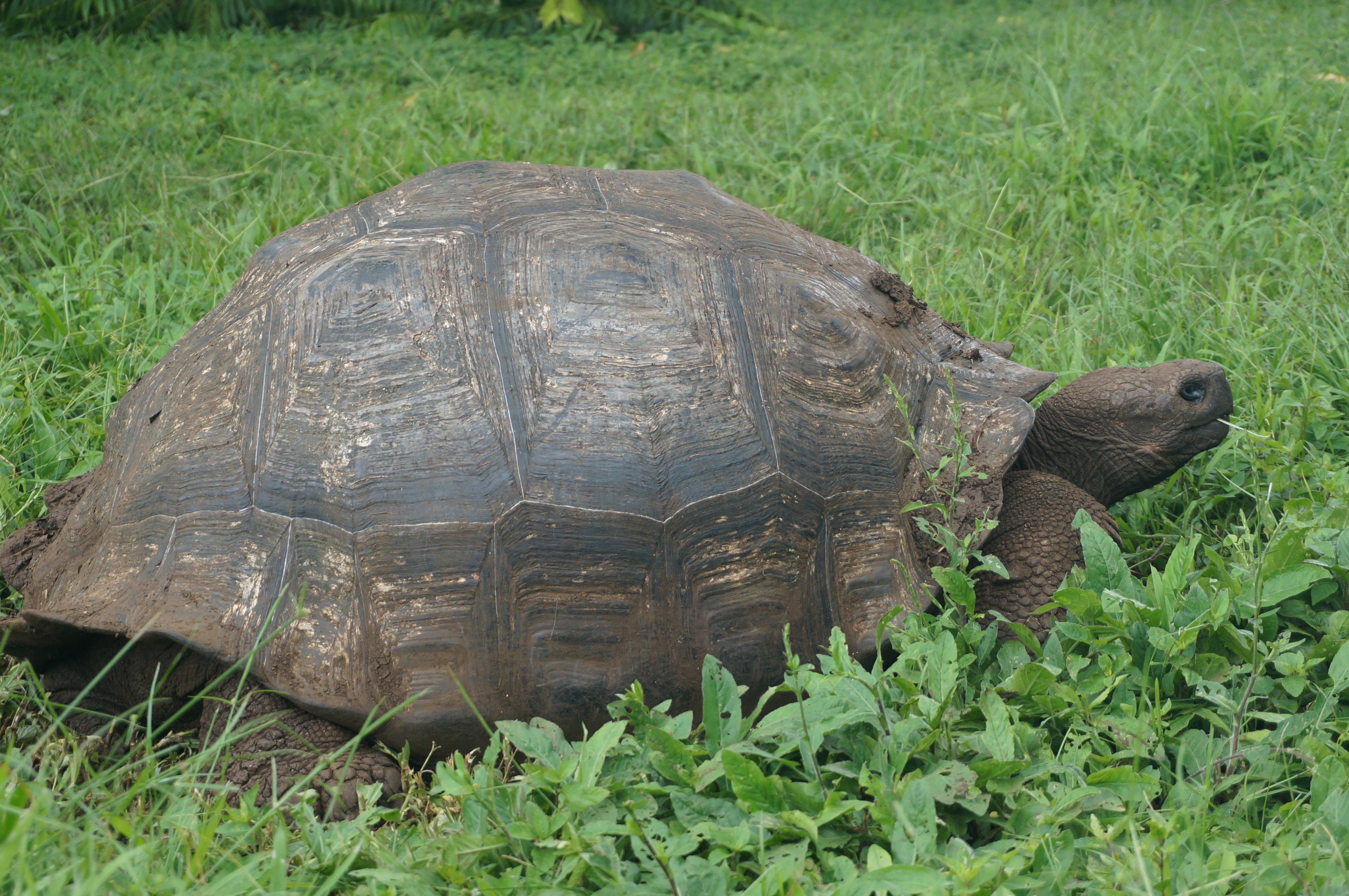
In the morning I headed off to check out the local sights. These included the Charles Darwin centre, where the Giant Tortoises are breed. It is also the where Lonesome George was brought to live. He was that last of a particular species of Giant Tortoise. Check out the link.

I also look a long walk to a beach which is the home of a large number of marine Iguanas. I also took time to check out the various operators of island tours, finally selecting one for a 3 night- 4 day tour.

The next day I took a short harbour cruise which included a stop at a canyon.

Meeting others on the Trip

The tour was due to start around mid-day. I meet the others that were on the tour on the wharf. As it turned out there were only four others – two young New Zealand girls and an English bloke and his New Zealand girlfriend.

The young girls were on a gap year before starting university. They were doing volunteer work with disabled children in Ecuador. This involved living with host families.

The couple had been living in Sydney and were returning to London.

Trip still on Santa Cruz

Rather than boarding the boat, the first part of the trip involved travelling inland on the Island of Santa Cruz. First stop was a farm were we could see some of the giant tortoises in the wild.   Our guide was very knowledgeable of the tortoises and other wildlife.

We also saw some ‘lava’ caves on the farm. These were caused by the lava flows from the volcanoes that formed the island.

Next stop were some ‘sink holes’ that were also caused by the volcanoes.

On to the Sea King

Late in the afternoon, we finally boarded the boat. We were provided with an excellent meal and shortly after we headed out to sea.

I was in a cabin with two bunk beds. I took the bottom one which was very cramped and took a lot of getting into. I don’t think I would have been capable of getting into the top bunk.

The sea was quite rough and the little boat bounced around a bit.

Isabella

We awoke in the morning to find ourselves moored off the island of Isabella. After breakfast we took our small motorised rubber dingy to the island. We were met by a bloke in a 4WD who drove us to the foot of a large volcano. The plan was to walk to the top of the volcano to see its very large crater. It was pouring with rain.

The walk up to the crater was very wet and muddy. When we got to top all we could see was a lot of cloud.

Snorkelling

Back on the boat we had lunch.   In the afternoon to took the dingy to an area in the bay where we had our first go at snorkelling.

It wasn’t long before we were met by sea lions and penguins. One of the New Zealand girls was using a GoPro. A penguin swam straight at her and pecked the screen with its beak. It made a great video. Hopefully she will be able to send me a link to the video.

Short Overnight Trip

Late in the evening we headed off towards Santa Cruz.

In the morning we did some more snorkelling. I managed to get a video of a reef shark. We also saw some small stingrays which I also managed to video. There were a number of sea lions, wherever because they are so quick, I didn’t manage to get a good shot of them.

We went ashore for a short walk. This wasn’t particularly interesting apart from an extraordinary large number of spiders.

We did some more snorkelling in the afternoon before dinner.

Last Night on the Boat

Another short trip over night brought us off North Seymour.

After breakfast we headed onshore. This placed turned out to be very interesting. It has a lot of land based Iguanas. They are golden in colour and as they get older their colours become more vivid. It is also where the Blue Footed Booby and Frigate birds mate and nest. They mate at this time of the year.  We walked through the area where both species had their nests.

Back into Puerto Ayora

It was late in the morning when the New Zealand girls and I were drop off on South Seymour Island near the Baltra Airport. The other were staying on the boat for another couple of days.

It took a couple hours to get back into Puerto Ayora on three buses.

Fight back to Lima

I had to wake up very early to catch my flight back to the mainland. My route to Lima was via Quito and Guayaquil. It wasn’t to late evening before I final arrived back in downtown Lima.

Lonesome George Link

https://en.wikipedia.org/wiki/Lonesome_George


Flickr Links

Photos

https://flic.kr/s/aHskd3kHTt

Videos

https://flic.kr/s/aHsk9vm1ye

Garmin Links

Isabella Island

https://connect.garmin.com/modern/activity/790267572

NW Corner of Isa Santa Cruz
https://connect.garmin.com/activity/790267682

Machu Picchu

Machu Picchu

I spent a couple of days in Cusco, not doing much. I tried to get on am excursion that included some mountain bike riding. To my frustration, there were not enough takers so the operator cancelled the excursions. Anyway, it was good to a have a pit of break from constant travelling. I spent a bit of time in the Norton Pub which overlooks the main square. This is a bit of a happening place. The owner is a British Motorcycle enthusiast, hence the name of the pub. There is a lot of memorabilia on the walls, including old posters, of Nortons, Triumphs, Matchlesses etc.

On one afternoon the place was packed with soccer fans watching a European Champions’ Cup match between Barcelona and Juventus. Even I impressed with the skill of the players, especially the bloke called Messi.

Mach Picchu

It would have been really good to walk the Inca Trail into Machu Picchu. Unfortunately it is so popular you have to book months in advance. I had to do with a 2 day trip by bus and train.

The first stage was a mini bus to a town called Ollantaytambo from there is about a 2 hour train ride to Aguas Calientes which is the town at the foot of Machu Picchu.

As I waited for my train, a really fancy train out into the station. It looked like what I expect the Orient Express carriages to look like – with plush seats and silver service dining cars.

After that train left, my train arrived. Even through it wasn’t as fancy as the other one, it was pretty flash.

Chat with Californian couple

The train was full. As it rattled off, the couple sitting opposite introduced themselves. They were from California and were serious travellers. It was very interesting to chat them. It became pretty obvious that they were your classic ‘Californian Liberals’ – pro universal health care, renewable energy and very embarrassed that George Bush had been President.

The trains passed through some very spectacular countryside.

After arriving in Aguas Calientes I found my hostel, which is located by the river. The sound of the water rushing by was amazing – so close and so loud.

Aguas is the classis tourist town. It seem that every shop is either a restaurant, tourist gift shop or tour operator.   I had a bit of a wander around before have a meal and an early night.

Early wake up

I woke up very early to catch one of the first buses up to Machu Picchu in the morning. As it turned out there were hundreds of other people with the same plan. The queue to get a bus was very long. Notwithstanding the numbers, the queue moved fairly quickly and it wasn’t long before I was on a bus and heading up the very steep and winding road up to Machu Picchu.

Very Enthusiastic Guide

After getting through the entrance gate, I was put into a group of English speakers and we were introduced to our guide. As we walked up the path a tall girl asked me if I was Dutch. I told her that I wasn’t. She said she “thought I was an actor she had seen at Schiphol Airport”. He seemed very disappointed that I was retired Australian.

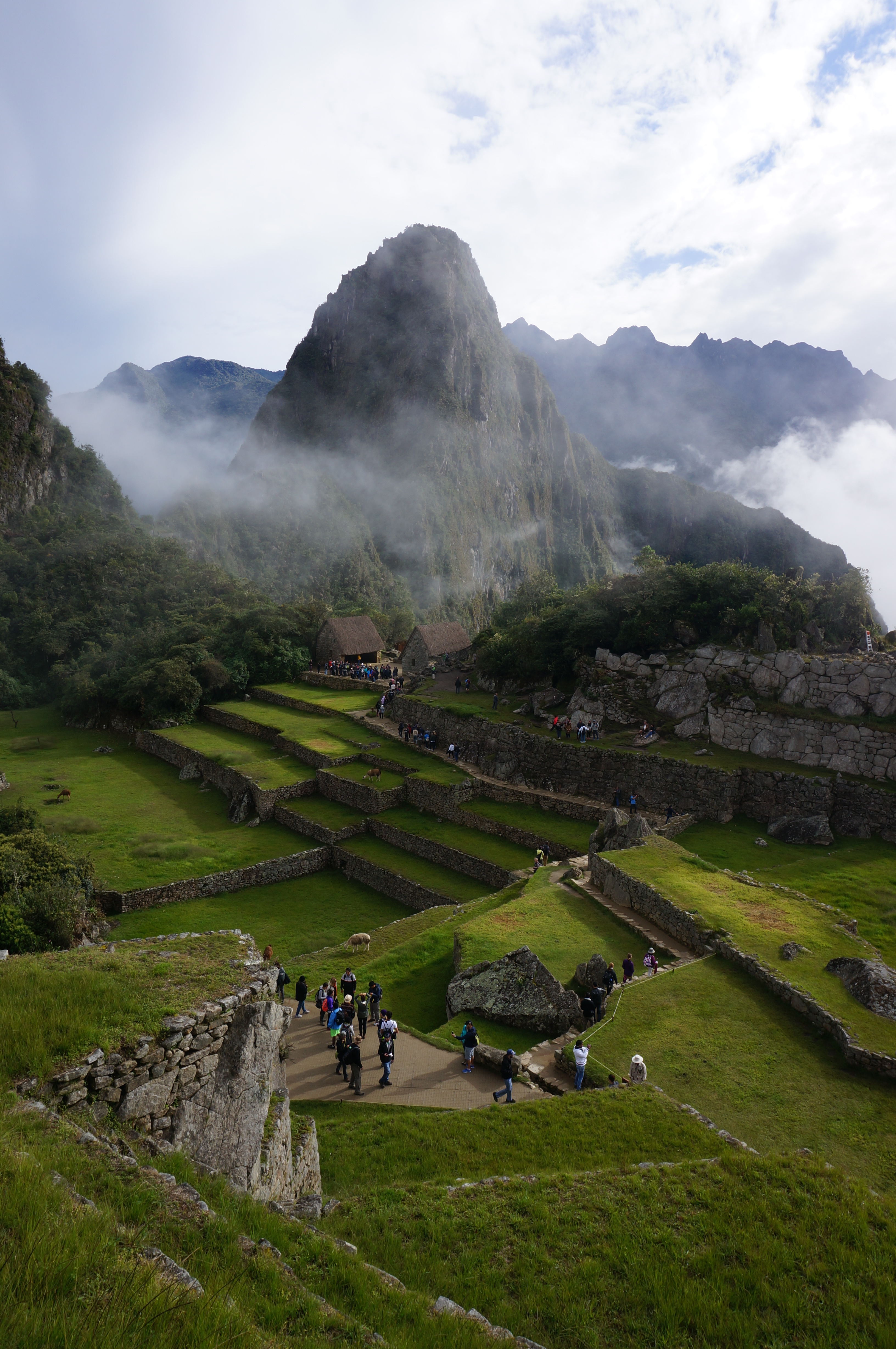
I must say Machu Picchu is one of those places that is more spectacular than the photos suggest. It is truly  remarkable. The guide was very enthusiastic and had a lot to say about the history of the place and the Inca people that lived there. We were taken to various points of the site the features were explained.

Long walk to the Sun Gate

It the end of the tour, I walked to the sun gate which is about 2 kilometre away. If you take the Inca trail, this is place where you get your first sight of Machu Picchu.

As I approached the Sun Gate, a huge blob of cloud suddenly appeared. I have a great photo of Peruvian cloud behind which is a great view of Machu Picchu.

I head back down the track. After about 300 metres, the cloud lifted and I got a slightly different photo.

Walk for the park entrance to the town

When I got back to park entrance I decided to take the path that leads down to Aguas Calientes. The walk is not long, but it is very steep. Check out the Garmin link and the videos on Flickr.

Lunch in the square

I had a lunch in one of the very touristy restaurants I the town square. I had become accustomed to the Peruvian practice of automatically adding a 10 or 15% ‘service fee’ to restaurants bills. This seems fair enough to me.

As I sat eating my meal, I witnessed that bizarre sight of an American couple complaining that the service charged was added to bill. I challenged them to name a restaurant in their country where you could eat without being forced to pay a ‘tip’.

Train back

As it turned out that my train back to Ollantaytambo was one of the last to leave. It was dark when it arrived. There was mad rush to get on to the mini buses to Cusco. The bus that I got aboard ended up with only me a young couple. After a long wait the driver announced that he wasn’t going.

The young bloke was furious and started yelling at the driver in Spanish. The driver left the bus and the girl told me in broken English that he was going to get a taxis for us. As we waited she told me that they were from Columbia.

The taxis arrived and we climbed aboard. There was another animated conversation. The Columbia bloke clearly didn’t agree with the fare the taxis driver was proposing. Finally a fare was agreed – SOL 20 per person.

It took nearly two hours to get to Cusco. As far as I was concerned that was a very cheap fare.

Based on this experience, I would be very wary of upsetting a Columbian.

Flickr Links

Photos

https://www.flickr.com/gp/twwilko_photos/8y41tv

Videos

https://flic.kr/s/aHskctq5sS

Garmin Link

https://connect.garmin.com/modern/activity/778166841

[Ma1]

Death Road MTB Ride Bolivia

Death Road

One of the major, if not the major, tourist attractions in La Pas is the Death Road. The Wikipedia piece below explains what it is all about.

As the piece notes, the road gets its name as a result of the number of deaths that occur from trucks and other vehicles going over the edge each year – between 200 to 300 fatalities per year.

A number of operators

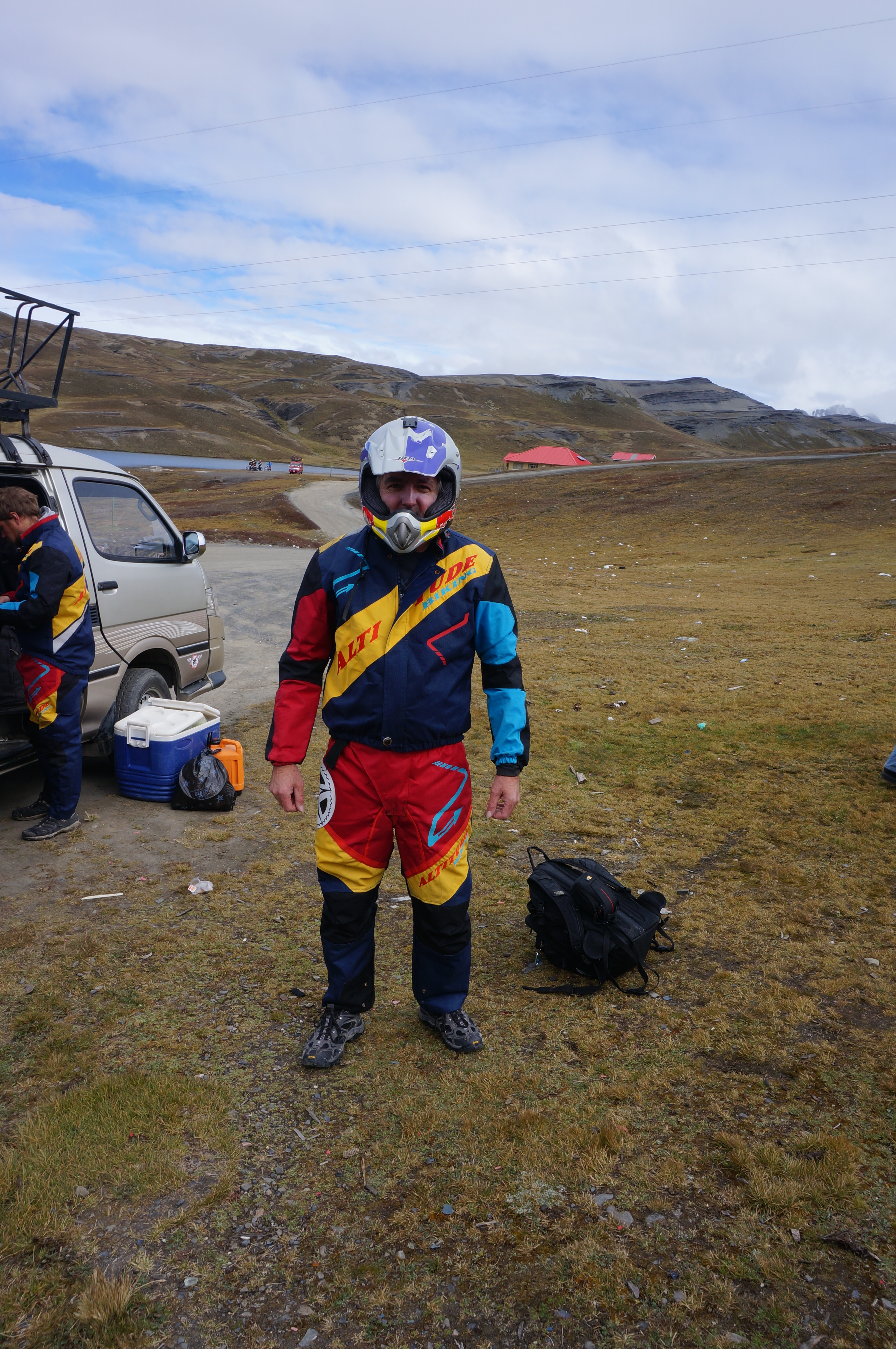
It is now a very popular route for mountain bike (MTB) riders. I booked an excursion with a company called Altitude. There were a number of people in the hostel that were booked with same company.

We loaded into a mini bus and headed out of La Pas. It is a seriously congested city and it look us ages to travel out of the built up area. Finally we were clear of the city and climbing quickly. We passed a hydroelectricity dam and some small farms with lamas being tended over by shepherds (or whatever people how look after lamas are called).

Very cold and snowing

We finally arrived at point where the driving stopped and the riding was to begin. This was next to a natural lake. It was very cold with snow flurries. Our guides gave us a safety briefing and we put on our protective clothing. Unsurprisingly it took some time to find a helmet that could accommodate my very large head.

The only Oldie

Our bus was joined by two others, making up about thirty in our group. Looking around, I realised that I was the only person over thirty. In fact, nearly everyone was in their early twenties.

Tarmac road

We headed off. The first part of the ride was on tarmac road. The snow turned to fine drizzle and then into quite heavy rain. Riding on this ride gave me the opportunity to lock into my brain that the right brake lever controls the rear brake. This is the reverse of my bike.

After about 15 kilometres we stopped for some breakfast. We also had to pay 25 boliviano for a park entrance fee. Why this was not simply included in the price of the excursion, I will never know.

After breakfast, we got back into the mini bus for a short ride up a bit of a hill.

On the actual Death Road

We had finally arrived at the start of the Death Road’. This required another safety briefing, including the sensible advise that: “if you have to stop any reason, put your foot on the hill side of the bike”.

Lots of trucks and vans

As we ventured off, we came across a relatively large number of trucks and cars. At one point we all had to press up against the side of the cliff as two trucks passed us. Check out the Flickr link.

There were also bikes from other Altitude groups and other operators. Throw in a few motorbikes, and we had one very busy road.

It is easy to see how large trucks and other motor vehicle fall off the edge.

Stop to take photos

After a while we stopped for photos. This is a point where cliff is sheer. It is a great photo opportunity, however, on this day, the weather was not too flash. We sat on the side of the road with our legs over the cliff for a group shot. A German bloke sitting near to me didn’t like this at all. He suffered from vertigo and was close to fainting.

Girl takes a fall

Not long after the photos, we came across a fallen rider from another group. It was a girl, who had fallen heavily and managed to bite her lip. There was a lot of blood and tears.

Check point

We made very good pace to a checkpoint, where we had yet another stop. The temperature had increased dramatically. We had dropped a lot of metres over the 50 or so kilometres that we had travelled so far.

Steep downhill

From the check point we took and much rougher road that at points, was close to being ‘single’ track. It was much steeper than the previous part of the road and there were no trucks or cars. Albeit it was steep, the drops on the side were not sheer. From and riding point of view, this was the best part of the trip.

Group Photos

Again the pace was good as we made our decent. Some of the party were a bit slow, but that didn’t slow the rest of us down.

It was not long before was reached the end of the ride. It was a relief to take off the protective clothing in the heat.

We were given out T shirts and assembled for group photos.

Late Lunch and Showers at Hotel

Next stop was a hotel where we were able to take a shower.

We were also given lunch, which was pretty good.

It was interesting talking to the other riders. They had some very interesting things to say about their experiences travelling in central and South America. I found their comments on ‘so illicit drugs, including cocaine, very interesting. One newly graduated Swedish Doctor, clearly did believe in the war on drugs.

Very long trip back to La Pas

The trip back to La Pas was on the ‘new’ road. It is all tarmac, but very busy. The 95 kilometres took for ever.

As we entered the city, the traffic was worse than we left. We found out that cause was a football match. Playing football at such a high altitude must take some doing.

Check out the Garmin Link for the details of the descent.

The Flickr videos and photos are courtesy of the tour operator. They use a basic camera, but you get an idea of what the ride is like.

Flickr Links

Video

To be included when the internet speeds permit.

Photos

https://www.flickr.com/gp/twwilko_photos/5d6dDb

Garmin Link

https://connect.garmin.com/modern/activity/768552887

Wikipedia Link

http://en.wikipedia.org/wiki/Yungas_Road

Atacama Desert

Atacarma Desert

It was still dark when I woke up on the morning for my trip into Bolivia.

Because my hostel was in a very small lane, I had agreed to be picked up in a slightly larger lane a couple of blocks away. I made my way there as the sky become slowly lighter. It was somewhat surreal, there were a number of travellers like myself positioned a various points along the lane obviously also waiting to be picked up. There were also the inevitable street dogs wandering around either by themselves or in groups of two or three. They came up to me and the other travellers, I assume looking for food. Mini buses travelled up and down the lane stopping a various points to pick up passengers. Finally mine arrived and I climbed on board.

I recognised two couples I had seen on the bus from La Serena. This was to be expected, given we were all heading in the same direction. I was to find out that two of the four were brother and sister originally from Benalla in north east Victoria. They were travelling with their respective husband and wife.

Big Climb

Our mini bus made a couple more stops before heading out of town and towards the border with Bolivia. The road was very steep.

After about an hour, we stopped. This was the point where we met the drivers of the Toyota Land cruises that were to take us across the desert.

The biggest shock when we got out of the mini-van was the temperature. It was freezing – minus 10 centigrade. We were all shocked. Some people were wearing shorts. Even with gloves, my hands started to freeze. This was made worse as we stood around eating breakfast.

Meeting my Travelling Companions

There were 18 people in the min-bus and we were split groups of six to ride in the Toyotas. My group consisted on three Russian blokes and a couple from Brazil. This was going to be interesting as it become immediately obvious that only one of the Russians had any command of English or Spanish and the Brazilian could speak very little English and only rudimentary Spanish.

My Russian is non-existent apart from a couple of phrases that you certainly wouldn’t use speaking to three blokes.

Crossing into Bolivia

After a long breakfast, during which we almost froze to death, we finally piled into the Toyotas and headed to the Bolivian border. I can add this one to the list of interesting border crossings I have made in my time in South America.

First Lake

We were now into the crossing of the desert. Rather than a single road, there are many tracks heading in same direction. It appeared that the drivers simply decided which one they preferred. As well as the company that I was with, there were a number of other operators with multiple 4WDs travelling on this day. At times there would be up to 10 vehicles travelling close together. At other times we appeared to be alone in the desert.

After a couple of hours. We came to a large lake. Check out the photos – they say it all. According to my Garmin we were almost at 5,000 metres. This highest I have been while still having my feet on terra firma.

As we continued north we passed an active volcano. It wasn’t doing much.

Overnight

Our first overnight stop was at Laguna Colorada. A feature of this lake was a large number of flamingos. Some are really pink.

As we were establishing ourselves in our accommodation, I noticed some cyclists arriving. I had a chat with them. They turned out be young Swiss blokes. They told me that they had ridden 50 klms that day, however it had taken them nearly 10 hours. They were clearly as fit as buggery, however even they were struggling with the effects of the altitude.

The accommodation was very basic. The building consisted on a large number of rooms. Each of the tour parties appear to be allocated a room with all the occupants of the 4WD, the exception of the drivers, sleeping in the same room. It was very cold.

A bit about the Russian Blokes

Over dinner, I was able to glean from the Russian blokes that they had been constantly travelling for six years. The bloke who could speak English said that he used to run a ‘finance business’ and the other two used to work for him. One, a very large bloke with an interesting nose (clearly having been broken more than once), was his driver. The English speaker said that he “would not be returning to Russia as long as Putin was in power”.

Tree Stone

It was freezing when we headed off in the morning. The scenery was spectacular. We stopped in area with some very interesting rock formations, including one that looked like a tree.

More Flamingos

We stopped for lunch at a lake with more flamingos. If you like flamingos there are heaps of photos on Flickr.

Second Hotel

It was quite late when we arrived at our second hotel. It was a real surprise. It looked quite dodgy from the outside. However, inside it was quite luxurious. I had my own room with an en-suite bathroom. That was all very well, the only problem being there was no water.

Very early start

Our last day in the desert involved a very early start. The reason was that we going to see the sun rise on the salt flats.

This turned out to be highlight of the whole trip. The photos say it all.

After watching the sun rise, we speed across the lake. The surface is remarkably hard. Check out the patterns. The Garmin shows the route and the speeds we achieved.

Funny Photos and Videos

One of the things to do on the salt flats is the take photos and make videos that take advantage of the ‘optical illusions’ caused by the flat surface on the lake.

Examples of what you can do are on Flickr. These include arranging the camera and an object, like an avocado to give the appearance that a person is sitting on the object. Other examples include making a video that gives that appearance that people are running out of tube or a bottle.

Cactus Island

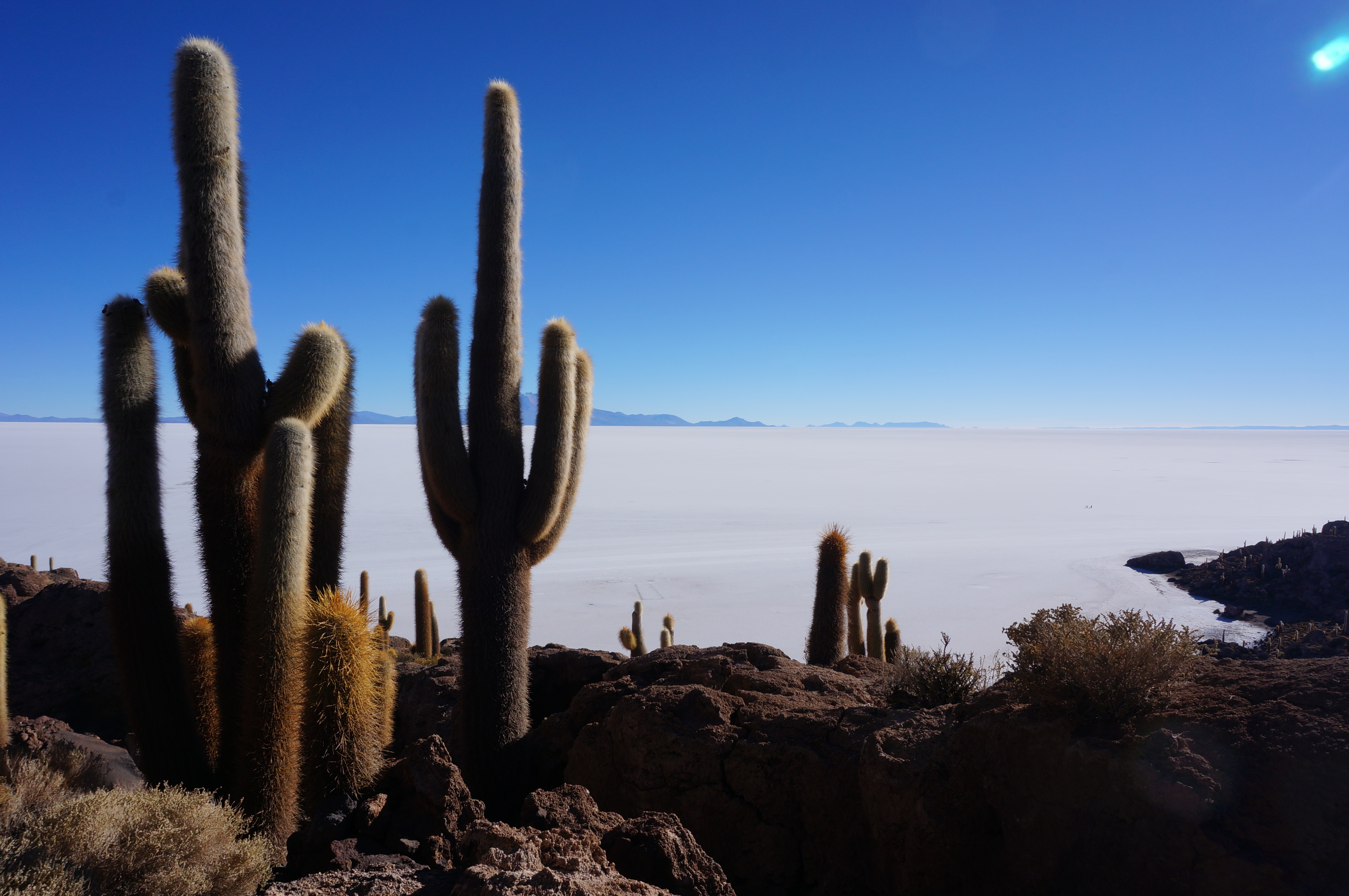
After the photo and video making we headed across the lake, to an ‘island’. This is a rocky outcrop rising about 200 metres above the lake. A feature of the island are cactuses (or is that cacti). Anyway the island is great place to view the lake which spreads out for many kilometres in all directions.

Hotel

Near to the edge of the lake we stopped briefly a hotel that is made from salt cut from the lake. It isn’t very interesting. However I was amused to find a model of ‘salt and pepper’ schnauzer dog.

Train Cemetery

Our last stop on the tour was train cemetery. The trains are what remains of a large fleet that was used to transport minerals up until the mid 20th century. It is an obvious reminder that mining is not a sustainable industry.

Overnight in Uyuni

We arrived in Uyuni in the early afternoon. I had made reservation at hostel. The couples mentioned above had planned their trip a bit better than me. They had already determined that Uyuni wasn’t a place to stay for longer than necessary. One of the couples had booked on a train heading north that was leaving at 1.30 a.m. the next morning. The others were taking a bus directly to La Paz.

Whenever I get a chance, I like to take a train. I bought a ticket. I managed to get a couple of hours sleep in the hostel before we headed to the station.

The train was slow, but reasonably comfortable. For some reason the line does not go as far as La Paz an stops in Oruro. From there you have to take a bus into La Paz.

We arrived in La Paz in mid-afternoon and I made my way to the Wild Rover Hostel.

Flickr Photos

https://www.flickr.com/gp/twwilko_photos/W4041P

Flickr Videos

https://flic.kr/s/aHskd6KL4P

 A bit about the Desert

http://en.wikipedia.org/wiki/Atacama_Desert

Garmin Links

https://connect.garmin.com/modern/activity/768117385

https://connect.garmin.com/modern/activity/768117570

https://connect.garmin.com/modern/activity/768117732

San Pedro

 San Pedro

I arrived in San Pedro at about 9.00 am. Even though it is a small place it took me a while to find my hostel. It was a bit away from the main part of the town.

After checking in, I headed off into the town. The main street consisted of restaurants, some outdoors shops, a couple of mini markets and dozens of tour operators offering trips across the Atacama Desert into Bolivia.

Lots of Tour Operators

There were a lots of fellow travellers wandering up and down the streets checking out the prices offered by the various operators.   I ran into a Dutch girl and her Mexican boyfriend who had been on two of the buses I was on travelling from Santiago. Despite her tender age, she was a seriously skilled traveller. She seemed to be conversant in many languages, including English, Spanish, German and French. She and boyfriend had already collected the details of five of the operators and their prices. They were heading off to check some more before going back to their hostel to look at the reviews for each operator on TripAdvisor.

I went to operator that the Manager at the hostel recommended. They were only slightly more expensive than the operators that the Dutch girl had investigated, so I decided to book with them.

Moon Valley

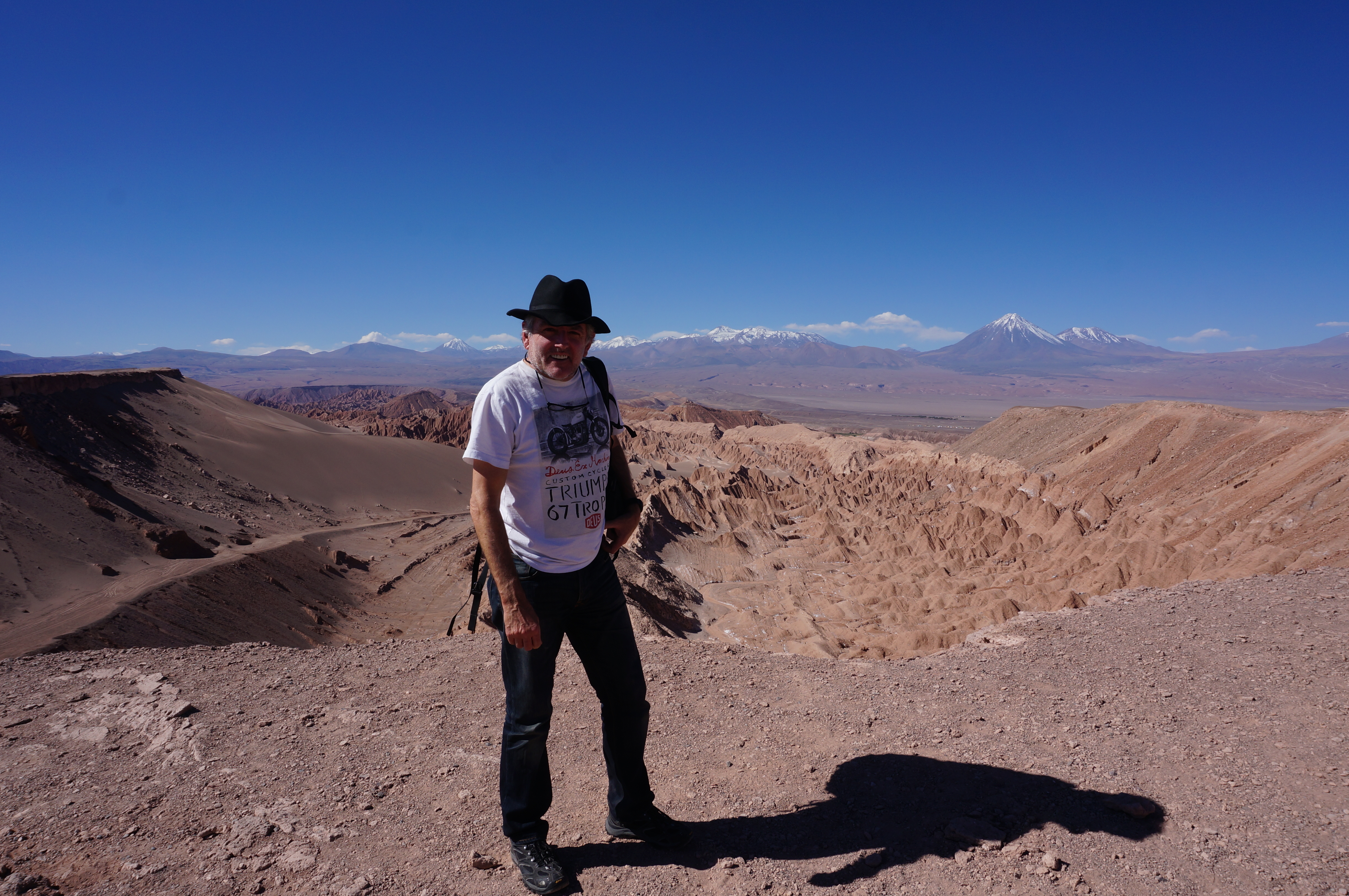
In the afternoon I look a short tour to the Moon Valley. It was only a few kilometres from town, but very spectacular. The tour ended with a view of the sunset. The change in the colours of the landscape as the sun went down was pretty amazing.

Hostel

I had a really good night’s sleep back in the hostel. You really appreciate a good bed after an overnight bus ride.

In the morning I had excellent breakfast offered by the hostel. Unfortunately I could only stay in this hostel for one night due it being fully booked. That was no surprise as it was really good. When I checked out, I had a long chat with the manager. She told me that she had worked with the owner to make the hostel the best in town.

As you can see from the Flickr photos the building in San Pedro are very ‘third world’. However these guys have managed to establish a really good hostel. The bathroom and toilets are spotlessly clean, the beds are good and the breakfast is excellent with fresh fruit, yoghurt and cereals. These are simple ideas that make that a difference.

Even though I had checked out, I was able to stay in the hostel to do some stuff on the internet (albeit it was slow – no fault of the hostel) and write up some of my blog.

Changed Hostel and Early Night

In the afternoon, I headed into town to a new hostel. I was a very strange place. I posted a picture of it on Facebook and got some interesting comments.

I had a late lunch in a very good restaurant. As I left, I look a video. It gives an indication of the remarkable contrast of the interiors and exteriors of the buildings.

Some Adventure Bikes

As walked back to my hostel I came across some BMW GS’s. They are very good, however, I am still looking at Triumph Tigers. My Canberra host take note.

I had an early night as I was due to leave for Bolivia before dawn the next morning.

Flickr Link

https://www.flickr.com/photos/twwilko_photos/sets/72157651511000623


La Serena

La Serena

It is a long way from Valparaiso to San Pedro. The manager of my hostel in Valparaiso suggested that I broke my journey in La Serena.

Hostel

I arrived in the city late in the afternoon. It took me a while to find the hostel. To be more precise it took me awhile to get into the hostel. I walked past it a couple of times before I realised that I had found it. The place is just a regular house.

Old and New

La Serena is one of the oldest cities in Chile. It is also one of the fastest growing cities. As a result it is place of two distinct parts: the original old town, and the newly developed areas.

The old town is quiet pleasant, with narrow streets and some very restaurants and cafes.

The new part of the city is not far away. There are two huge shopping centres. One in particular houses the largest supermarket I have ever seen.

Tour to Marine Park

There is not too much to see or do in La Serena. The manager of the hostel suggested that I take a tour on a Marine National Park to the north of the city.

The bus came to collect me quite early. There were only five people of the tour- a young English girl, an American women and a Chilean couple. The American woman turned out to be an Astronomer working for NASA. She was visiting one of the telescopes near to La Serena. She explained she really got to see a telescope. Most of her work involved programing a computer to enhance images of space that were sent to her over the internet.

She seemed to be very pleased to be able to travel anywhere. She explained that she, like many Americans got only two weeks holiday a year.

As we travelled north to the Marine Park, the astronomer took photographer and an extraordinary rate. This clearly amused that young English girl.

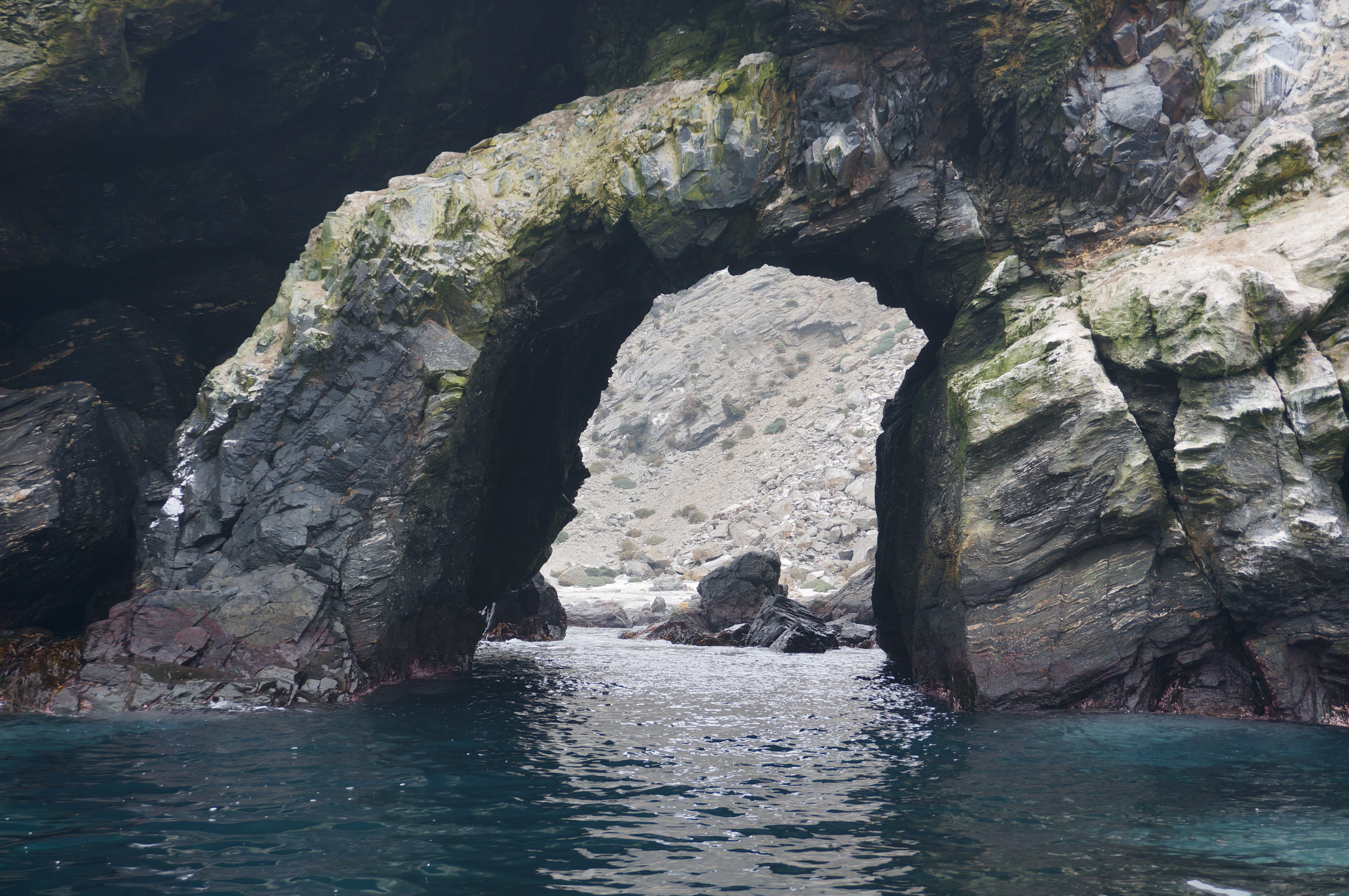
After almost 2 hours travelling we finally arrived at the marine park where we joined another couple of tour parties on a boat. The boat took us out to an island where we saw sea lions, penguins and sea otters. We then saw a pod of dolphins. This turned out to be the highlight of the trip.

It was very late when we finally made it back to La Serena

Heading North Again

My bus north to San Pedro left in the late afternoon the next day. This gave me the opportunity to do some much needed laundry.

Flickr Link

https://www.flickr.com/photos/twwilko_photos/sets/72157652282147435

Valparaiso

 Valparaiso

The English girl who is working as freelance journalist in Santiago told me that I must visit Valparaiso. I took her advice.

Interesting Hostel

I arrived in the city late in the afternoon. The instructions on how to get to the hostel were simple: take a mini bus to a stop near a Shell petrol station, walk up the hill and following the green footsteps painted on the pavement.

I did just that. The hostel in located in very funky area of this very funky city.

After checking in I found a very good restaurant and had an excellent fish meal.

Back in the hostel, I had an interesting conversation with a French girl would was on a 6 month tour of South America. She was speaking perfect ‘Peter Sellers’.

Walking Tour

Next day I decided to take a walking tour. The guide was very enthusiastic.   It is worth checking out the video at the Flickr link.

The main feature of the city is the street art. I think that probably took too many photos, however they do give an idea of what the place is like. The main part of the old part of the city has been declared a UNESCO heritage site. This is good and bad in that the old buildings are being retained, however the restrictions on development are such that many buildings are falling into disrepair

Rugby Fan

After the tour, had a meal at an ‘Irish Pub’ near the hostel. The owner is a huge Rugby fan. As I was eating he disappeared, only to reappear wearing a Wallabies jersey. His command of English was at the level of my command of Spanish. I only thing I understood was that he was huge fan of Stirling Mortlock.

Poet’s House

Next day, I took a long walk to the house where a famous Chilean poet Pablo Neruda lived. It seemed like a real character.

Flickr Link

https://www.flickr.com/photos/twwilko_photos/sets/72157652269413801

Interesting Poet

http://en.wikipedia.org/wiki/Pablo_Neruda

Santiago de Chile

Santiago

I arrived in Santiago from Mendoza late in the afternoon.

Bus Ride from Mendoza

The bus ride from Mendoza across the Andes was spectacular. Shortly after crossing the border with Chile, the road drops down amazingly steep section. There are 27 very sharp switch backs. This would be so much fun on a bicycle and even better on a motorbike.

Freelance Journalist

I caught the metro from the bus station to the centre of Santiago and checked into my hostel.

I then headed out to look for something to eat. I asked female a passer-by for directions. She turned out to an English freelance journalist. She took me a street that was full of very good restaurants and trendy bars.

She told me that she had come to Santiago for three months over five years ago. She had never intended to stay for so long, but had really enjoyed living there and had established a good little business as a travel writer and a food and wine critic. In our brief time together she gave me lots of advice on what to do in Santiago and in my travels north.

Walking Tour

Next morning I took a working tour. The tour took in the main sights in the centre of the city. This included that Presidential Palace which was is infamous for the military coup which the democratically elected   socialist President Salvador Allende’s government was overthrown by the military lead by General Pinochet.  More on that below.

The tour passed through the main shopping and business area.

Very Interesting Coffee Shops

One of the more interesting aspects of Santiago is the coffee shops. The guide explained that sometime ago a number of coffee shops were opened by women. To attract customers, they employed attractive girls as waitresses. This resulted in these places becoming very popular with men.

The existing coffee shops were challenged. They decided to fight back with a similar approach. They employed girls wear skimpy clothes. These coffee shops are only allowed in the main CBD area and can only operate between 8 a.m. and 8 p.m.

I have include a Wikipedia link to information on these places below.

University Area

An interesting area is around one of the university campuses over the river from the main part of town. This area was initially developed when the slums close to the CBD were demolished at time that the centenary of the establishment of the city was being celebrated. The poor people move across the city. It is now a trendy area with lots of bars and restaurants.

Haircut


After being on the road for two months, I was in need of a haircut. The receptionist at the hotel directed me to a building nearby that had “many hair dressers”. They were not wrong. There were at least four floors of men’s and women’s hair dressers. I have never seen that before. A very friendly women cut my hair and chatted to me in Spanish. I had no idea what she was saying, but the haircut was good.

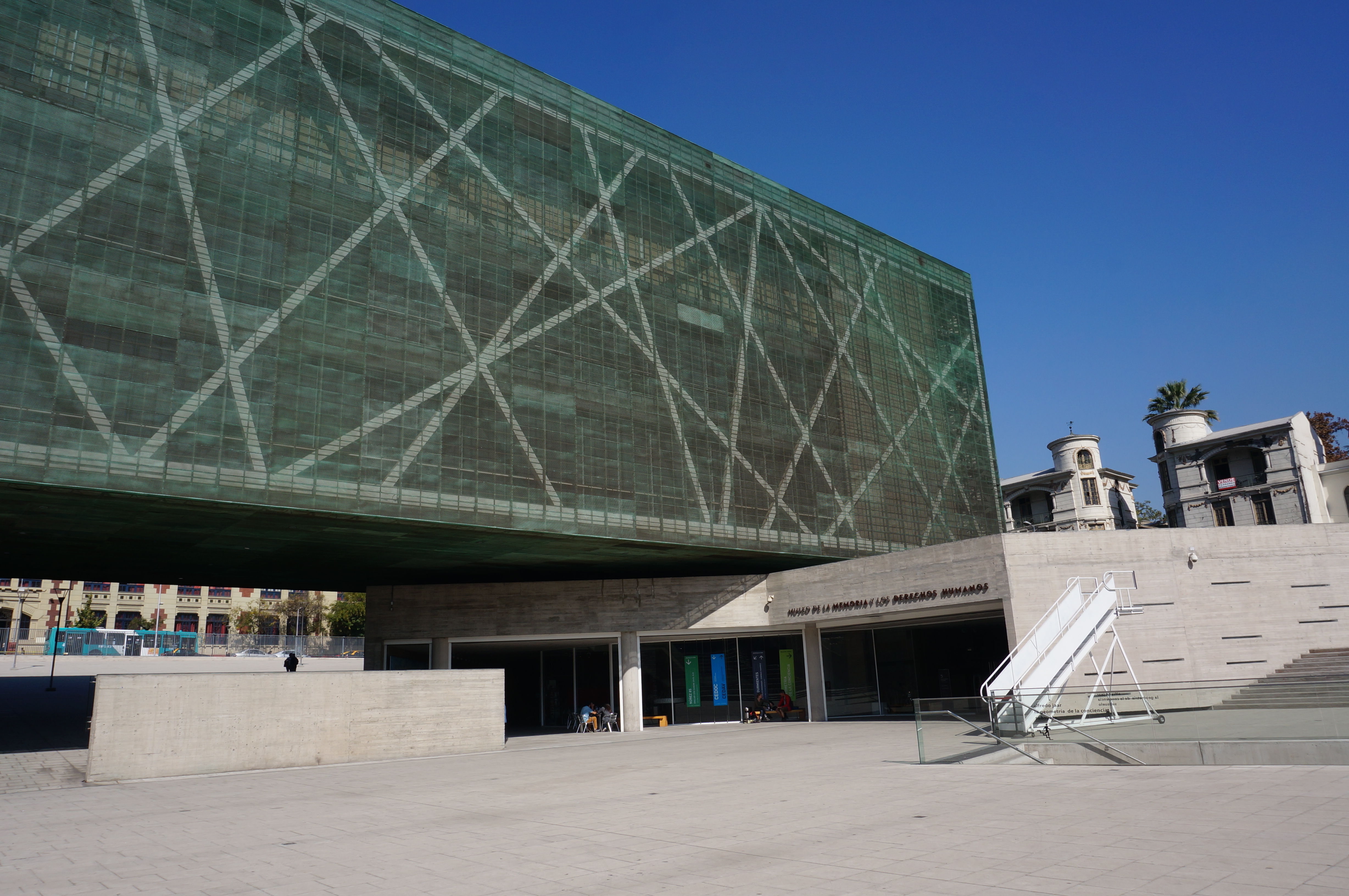
Memory Museum

On the last day I took the Metro to the Memory Museum. Actually the Metro is really good.

The museum has been to establish to remember the atrocities of the Pinochet regime. It is really good that this exists. It is very well done. It provides and lot of information of the coup which resulted in the overthrow of the Allende government its replacement by the military dictator General Augusto Pinochet.   What followed was simply appalling in terms of human rights abuses, including the torture and murder of opponents to the regime.

Flickr Link

https://www.flickr.com/photos/twwilko_photos/sets/72157652163526595

Coffee with legs

http://en.wikipedia.org/wiki/Caf%C3%A9_con_piernas

Link to Information on the Coup

http://en.wikipedia.org/wiki/1973_Chilean_coup_d%27%C3%A9tat

The Memory Museum

http://en.wikipedia.org/wiki/Museum_of_Memory_and_Human_Rights

Puerto Varas to Bariloche

Puerto Varas to Brailoche

Puerto Varas to Bariloche

I ended up staying a couple of days in Puerto Varas. It is quite a nice place and the hostel was very good. It gave me some time to sort out some ‘administrative’ issues, including regaining access to internet banking. My bank had suspended my access after I had transferred some money to travel card by BPAY. It would seem that albeit, they brand the card as one of theirs, it is actually a Visa card and it is not controlled on their system. I don’t mind them stopping credit cards and suspending access to internet banking, if they see something suspicious. I do, however, have an issue when it is difficult to get things going again. This particularly the case if you have to call a 1 300 number that costs a fortunes. After several frustrating hours, I was able to regain access to internet banking.

Interesting was to get back into Argentina

The guide on the ferry from Puerto Natales has mentioned that there was a really interesting way to travel from Puerto Varas to Bariloche in Argentina. This involved taking a series of buses and boats through the National Park that straddles the border between the two countries.

I found a tourist agency that offered the trip. The cost was a bit of a shock. Back in the hostel I found the web site of the trip operator. The cost was USD 50 less than the agent’s price. The only problem was that you could only book 2 days in advance on line. I sent the company an e mail enquiring about a ticket for the next day. Within 30 minutes I received e mail telling me that I could pick up a ticket for the next day at their office in town. I went into town to pick the ticket. The very helpful woman in the office told me that “you booked the ticket 3 days ago”. I suspect there are issues between the travel agents and the company.

Up Early

I awoke early and headed into town. Chile and Argentina us the same time zone. At this time of the year, this means that it is still dark in Chile at 8.00 a.m.

The assembled passengers for the trip piled onto two buses. There appeared to be two groups – independent travellers and a group of Australians. For the first time in a long time, I felt young compared to my fellow travellers. There were a lot of slow moving grey haired people.

The bus travelled along the side of Lake Llanquihue. Through the clearing mist we could see Mt Osormo which is a very spectacular volcano.

The guide told us that the farms we were passing had been settled by German migrants in the early 1900’s. They had also settled in Puerto Varas itself and in Bariloche in Argentina. Their influence can be seen in the architecture of the towns.

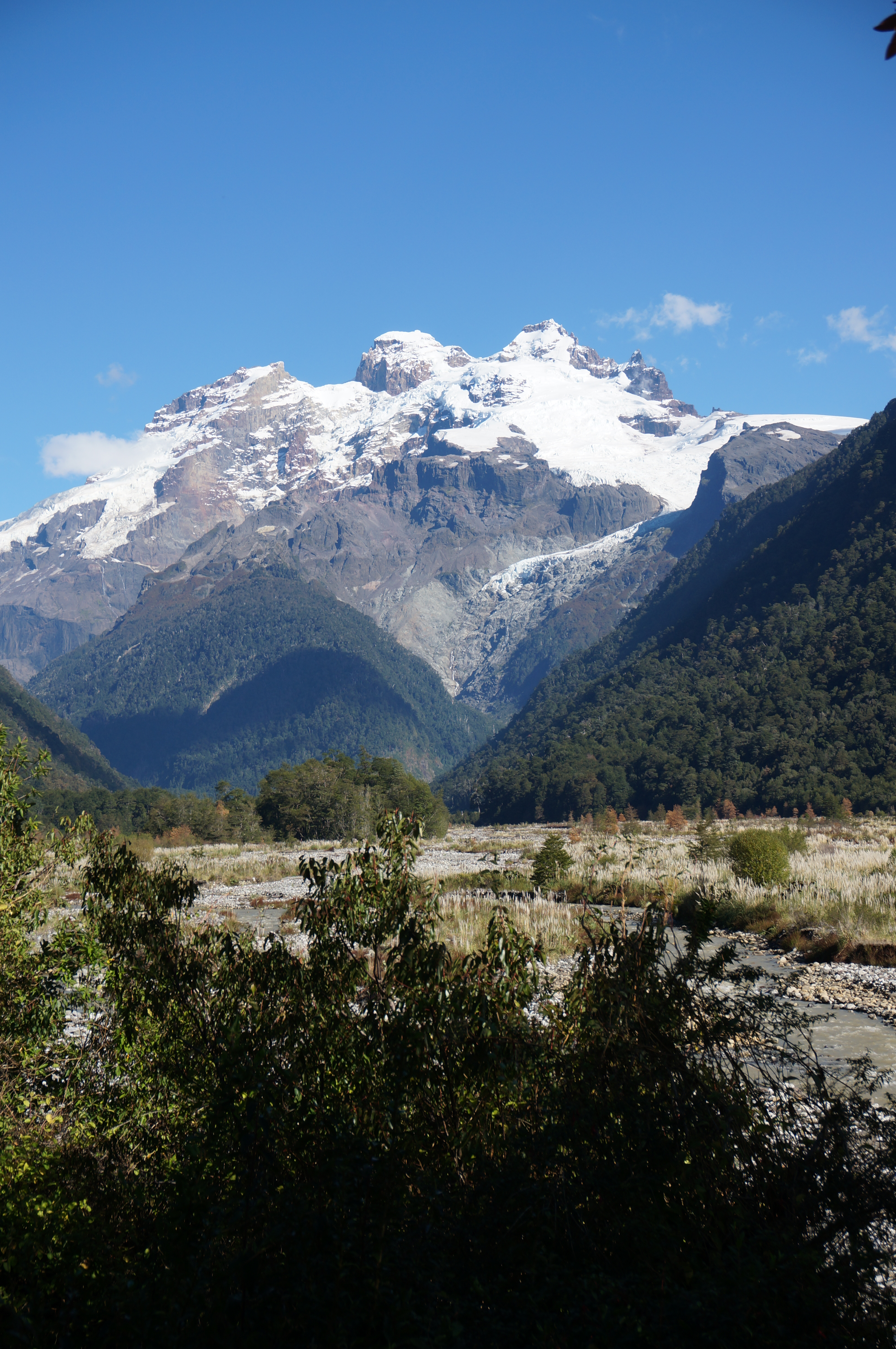
It wasn’t long before we entered that National Park. There was shot walk to a waterfall that flows over some lava rocks. The lava had come from the volcano which is nearby. The views of the volcano are really spectacular. Check out the photos on Flickr.

Our next stop was a wharf where we boarded our first ferry. As we travelled across the next lake we had great view of the mountains that surround the lake. The lake is famous for being emerald green due to the fine sediment that is washes down from the glaciers.

As we travelled along, I got into conversation with some New Zealanders who were doing a ‘best of South America’ tour in 5 weeks. One couple were farmers from near Dunedin. They were interesting to talk to.

Our next stop was the Peulla Hotel which is owned by the tour operator. We were offered a number of activities to do during our 3 hour stopover. These include horse riding and ‘canopy’ – which is a flying fox through the trees. I opted for the canopy. It was great. Check out the Flickr videos.

After the flying foxing, we had lunch in the hotel. It looks like a really nice place.

Rough Road and Border Crossing

After lunch we boarded buses with very high clearance and 4WD. This was required as that road was very rough.

We passed through the Chilean border control and headed up the road into the Andes. The guide told us that this was Che Guevara passed over his journey that is featured in the film The Motorcycle Diaries. The Norton Commando he was riding was certainly not designed for this type of road.

Near the summit of the pass we stopped for photo opportunity of Mt Cerro Tronador.

We crossed into Argentina at the summit of the pass. One of the more interesting border crossing I have made.

Proof that Argentinian Border Control Staff are Stupid

Next was a decent to the Argentinian border control which is located by the next lake we were to cross. The woman in the tour operator’s office was at pains to ensure that I had a copy of my ‘Reciprocity Visa’ that Australians (along with citizens of the USA and Canada) must carry. This is necessary even through, given that I have already been Argentina, a stamp in my passport said I have access to the country for 90 days from the 16th of March.

Apparently Australians with a stamp, but no ‘paper Reciprocity Visa (a PDF on a computer will not suffice) have been turned back at this border.

After being processed, we crossed the lake and boarded another bus for a short ride to the next lake. There is stream running into this lake that is green due to the sediment mentioned above. However, the water in the lake is clear. Everyone felt obliged to take a picture of the ‘two toned’ water.

Last Ferry and Bus

The last ferry was a rather large catamaran that was also carrying people who I assume had been on day trips into the National Park from the Argentinian side.

There was then a short bus into Bariloche. It was a bit of climb up to my Hostel named the Marco Polo, which seems a bit odd for this part of the world.

Flickr Link

https://flic.kr/s/aHska89UHv

North from Puerto Natales to Puerto Montt

Ferry north from Puerto Natales

Ferry to Puerto Montt

I boarded ferry (SS Eden) at around 9.30 p.m. on Easter Friday. I found myself sharing a cabin with an Australian bloke from Perth and an English bloke from Liverpool. After quick introductions we got off to sleep, expecting to set sail early in the morning.

Another Delay

Breakfast was at 8.30 a.m. We were still tied to the dock. At about 11 we were told that our departure had been delayed until 3.00 p.m. The reason was bad weather and the need to wait for high tide to get through a narrow channel in to the first fjord on our route.

Chicken or Turkey?

We were served lunch. As I was in the queue I asked that bloke next to me what he thought the meat on offer was. He confidently answered that it was chicken. The Chilean cook serving the meal abruptly said in a disdainful tone that it was “turkey”.   Back at the table, the general consensus among the people eating the meal was that it was impossible to tell whether it was turkey or chicken. One of the girls told us that she was vegetarian. That seemed to be a good idea when it came to this meal.

Through a Very Narrow Channel

At about 3.00 p.m. we final left the dock and headed south. We hadn’t travelled too far when the ferry stopped. Apparently we were waiting for the tide to rise. Around 5.00 pm we started again. Shortly after that an announcement was made that we were approaching the “narrow channel”.

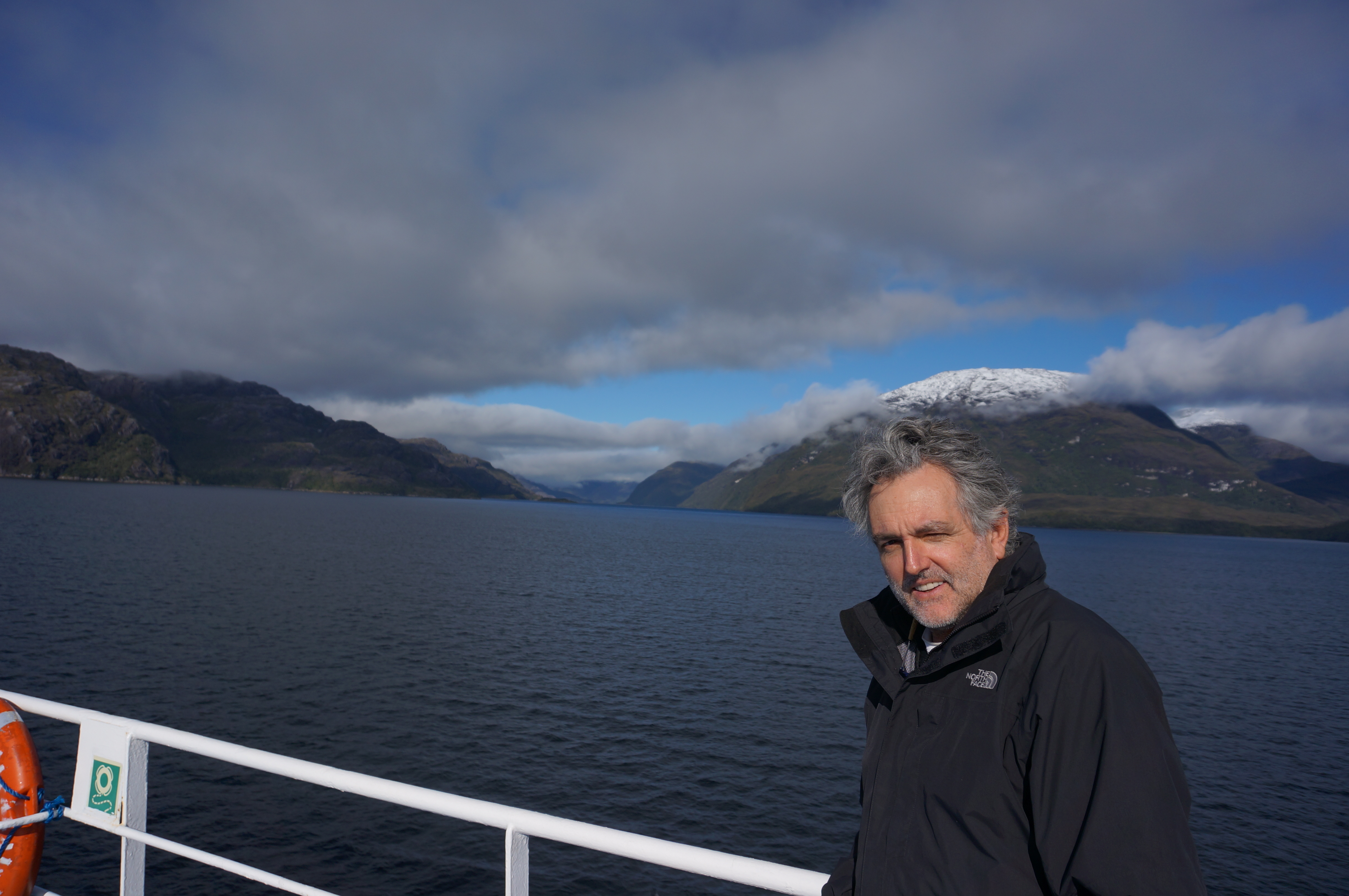
As it turned out there were two narrow channels. The first was between two low lying islands. Most of the passengers went out on the deck to watch. It was very cold. There was no doubt that the gap between the two islands was narrow. The next channel appeared to be between the mainland and an island. This was more spectacular in that the cliffs into the water were higher. Check out the Flickr link for the photos and a video.

Reading and Interesting Chats

I found being on the ferry was great opportunity to read. I have been using an eReader since 2013. My first one was a Sony. I selected it because I did not want to support Amazon. At first I used Angus and Robertson to buy ebooks. It wasn’t too long before Angus and Robertson ebook service was taken over by Kobo. This caused any amount of hassle as Kobo didn’t register that I had an A&R account. I persisted for a while, but then Sony announced that they were not going to make eReaders anymore. Soon after that, they announced that they were going to cease supporting the software on the existing eReaders.

Given my experience with Kobo I wasn’t going to buy one of their devices. They and Amazon are the only players left in the market. Reluctantly I bought an Amazon Kindle late last year. I have a few books loaded on the device. Before leaving Natales I loaded William Boyd’s James Bond book Solo and The Second Machine Age by Andrew McAfee and Erik Brynjolfsson. These plus the books I hadn’t finished on the device gave me plenty to read on the trip north.

The dinning arrangements on the ferry were conducive to forcing the passengers to socialise and chat. Also virtually all of the passengers were ‘world travellers’ who tend to chat in any event.

I end up spent a lot of time with a particular group. It is included two sisters from Brighton in SE England, a couple of scientists from Bristol, and my cabin mate from WA and an American girl from Santa Cruz in California. They were all very well-travelled and clever.

One of the Brighton sisters is a physiotherapist.   She had some very amusing tales to tell about her experiences working on a very luxurious charter yacht in the Mediterranean. The clients included Russian Oligarchs associated with Vladimir Putin.

Small Village

In the morning of the second date we awoke to a clear and increasingly sunny day. At one stage were passed through and number of small icebergs. We also saw penguins and baby sea lions swimming in the sea.

Around 1 o’clock, we arrived off the small village. It has population of only 90 people and relies of the ferry for supplies and transport. Thirty passengers on the ferry disembarked on to small boats that took them and supplies into the town. I am certain that I could like in such an isolated place.

There is a guide on board the ferry that is a fountain of knowledge on the area. He gives a briefing on the thing you see each day. He told us that the villagers make a living fishing and cultivating mussels that are sold in Puerto Montt and Puerto Natales.

Ship Wreck

Not long after the small village we passed a ship wreck. I am surprised that there aren’t more of these in this area.

Short after that we passed a statute of Maria who is the patron saint of Mariners and “looks over them and keeps them safe”. Maybe she is not perfect, but is doing a reasonable job.

Cards no for Me

The group with whom I found myself having most conversations with turned out to be big card players. For whatever reason, I find playing cards a very boring activity. After dinner I headed to the lounge area of the ferry and continued to read my books.

Another Smooth Night

The ferry headed north into the night. Whether because we still in a channel of because the weather was calm, I am not sure, but we had another smooth night. This made sleeping easy.

Quiet Day

The next was relatively uneventful apart for the sighting of some dolphins and a couple of whales.

Another Smooth Night

We had been really luck with weather. The departure had been delayed by bad weather when the ferry had been heading south to Puerto Natales. The return journey proved to be very smooth.

Leaving the Ferry and on to Puerto Varas

The ferry docked early in the morning. We had breakfast on board and disembarked around 8.30 a.m.

The guide on board had advised that Puerto Montt is not the greatest place to be. Most people to either know that already, or took this advice and decide to travel onwards.

I joined a small group that were heading to Puerto Varas which is located on a lake and 40 klms from Puerto Montt. We found a very hostel not far from the centre of the town.

Staying a Couple of Days

I found Puerto Varas to be quite a nice place and decided to stay couple of days.

Flickr Link

https://flic.kr/s/aHska1YKip

Garmin Link

https://connect.garmin.com/modern/activity/739918997